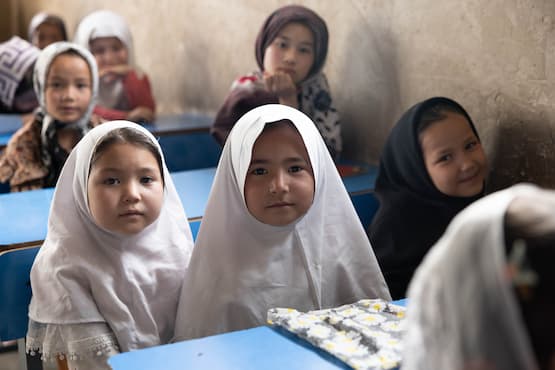
Image credit: Farkhondeh Akbari
As the international community marks five years since the Taliban takeover on 15 August, leading researchers, activists, policy makers and members of the Afghan diaspora will gather in Melbourne for the 2026 Afghanistan Conference to examine one of the world’s most pressing human rights, humanitarian, and security crises happening in Afghanistan under the Taliban.
Afghanistan remains the only country in the world in which girls and women are prohibited from secondary and higher education. The conference marks five years of the gender apartheid regime, which has banned 2.2 million girls from secondary school. This represents a total reversal of two decades of progress, during which girls comprised 40 per cent of Afghanistan’s student population. Having previously controlled Afghanistan between 1996 and 2001, the Taliban’s 2021 return to power has consolidated a far more entrenched and systemic regime of gender apartheid.
Dr Farkhondeh Akbari, a Research Fellow at the ARC Centre of Excellence for the Elimination of Violence against Women (CEVAW) and an expert on gender and diplomacy, provides a unique perspective on the international crisis. Having fled Afghanistan in 1998 as a child with her family after the Taliban first seized power in 1996, Dr Akbari lived in refugee camps before migrating to Australia when she was 13 years old, beginning school in year 8 in Australia despite arriving with no prior formal education. A member of the Afghanistan conference organising committee, Dr Akbari now uses her research to advocate for women’s rights and inclusive peace.
Dr Akbari said five years on, it’s time to assess what the international community has learned, and what responsibilities remain.
“As we mark five years since the Taliban’s return to power, their rule now exceeds the duration of their first regime, consolidating a deeper and more systemic crisis for women, girls and minority communities, and the future of Afghanistan.
“Our research shows escalating patterns of exclusion, repression and harm, with direct consequences for human insecurity, rise of extremism and long-term instability. The normalisation of these conditions carries profound risks not only for Afghanistan’s future, but for regional and international peace and security.”
Dr Akbari said that as a country that invested significantly in Afghanistan over two decades and continues to engage on humanitarian, refugee, legal and regional security issues, Australia has an important role in shaping future responses.
“There is an urgent need to assess how legal initiatives, diplomatic engagement, humanitarian responses, and security cooperation interact, and whether symbolic and legal commitments are being matched by substantive policies that advance the rights, protection and long-term future of the people of Afghanistan.”
The conference will provide a timely opportunity for Australia to reflect on the past five years, hearing directly from Afghanistan experts. It will also examine the growing tension between international human rights commitments and increasingly diplomatic engagement with the Taliban, asking whether current approaches protect human rights or contribute to the consolidation of a repressive regime.
Jointly organised by a network of Australian academics and universities and held annually since 2023, the Afghanistan Conference is Australia’s leading forum dedicated to informed discussion on Afghanistan. This year’s conference, titled “Afghanistan at the Crossroads: Five Years of Taliban Rule: The Implications of International Engagement with a Repressive Regime”, will be co-hosted by CEVAW, Monash University, alongside the Initiative for Peacebuilding at the University of Melbourne on 21 August, 2026.