A radiation sensor designed and built by Western Australian high school students has been tested on an ANSTO ion beam, ahead of its trip to the International Space Station later this year.
The Binar Space Program is a research group at Curtin University that, in 2021, designed, built and flew Western Australia’s very first homegrown satellite, Binar. Binar is the Noongar word for fireball.
“BinarX grew out of that program. It aims to inspire the next generation of space professionals by giving students an opportunity to connect to real space missions,” explained Meg Berry, Future Workforce Development Manager at the Binar Space Program.
Over the past two years the program has empowered over more than 100 Western Australian high school students from nine WA schools to design and build payloads for CubeSats.
Eight payloads produced by students will be included on board the Binar- 5, -6, and -7 satellite missions to be launched at the end of this year. The CubeSats will be handed over to the Japan Aerospace Exploration Agency (JAXA), launched on a resupply mission to the International Space Station, and deployed into orbit from the station.
After deployment, the satellites will commence the operational phase of the mission; data will be sent back down to the students to interpret.
“This gives Western Australian high school students the rare opportunity to provide the experiments and actually get data from a live space mission,” Ms Berry added.
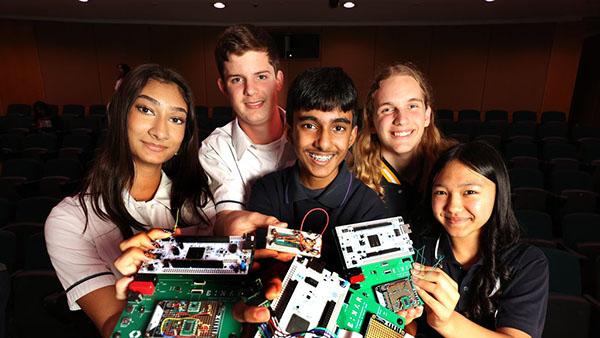
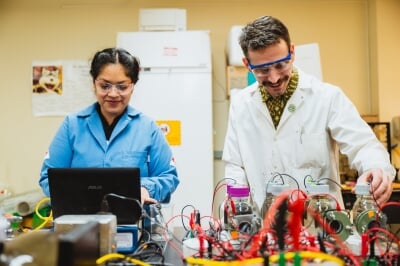
Ms Berry and Curtin University engineering student Rayaan Atif brought a radiation sensor, which was built by the team at Churchlands Senior High School to ANSTO, to test on the high energy microprobe beamline of the ANTARES particle accelerator.
Because the Churchlands students could not travel to ANSTO in Sydney, the day was recorded so they could experience the testing from Perth.
The collaboration was facilitated by Dr Ryan Drury, a physicist in the Irradiations team at ANSTO’s Centre for Accelerator Science, which tests electronics, advanced materials, biological matter, and other components for space missions. The facility can simulate the impact of space radiation on technology and on human cells.
Dr Drury explained that the payload, specifically the dosimeter chip, was mounted on a smaller breakout board and placed it in the end station of the beamline.
“The instrument directs a large ion beam and focuses it down to a one-micron spot size. The beam moves selectively across the face of their device to the radiation sensor within the complex circuit.”
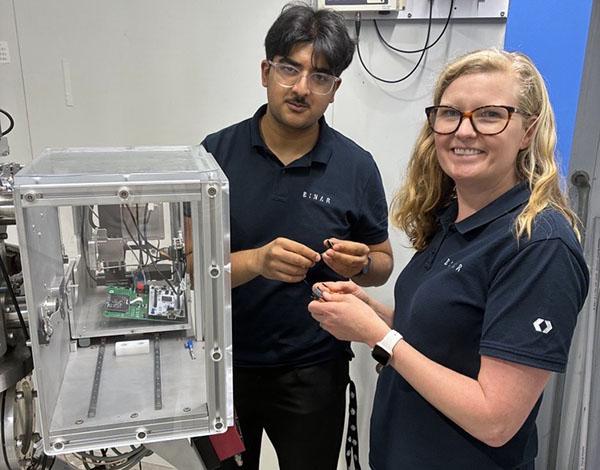
“We selectively irradiate that specific area to induce a charge upon the dosimeter-replicating the effects of radiation in space. But we do it here on the ground, at a fraction of the cost of launching a rocket, and it is very fast and reproducible.”
Out in orbit the hazard is constant: a cocktail of radiation from galactic cosmic rays and from the sun. Technology in space has to be protected from it to prevent malfunction and damage.
The radiation sensor for the CubeSat was originally developed by the Binar Space Program’s lead avionics engineer, Jason Cook.
“We adapted it into a form that students can actually use and solder on their own,” said Rayaan.
“The main circuit operates on a special type of capacitor called a floating gate capacitor. When ionising radiation strikes its small metal plates or the silicon inside, it deposits a small electric charge that builds up over time. We can measure how quickly that charge builds and convert that to a radiation dose rate.”
The test delivered exactly what the team came for: the sensor’s response threshold, and its limits. The payload was tested on the instrument successfully.
“We weren’t getting a response at first, but we just kept dialling up that dose until we got a reaction and then the dosimeter stopped responding. We managed to cook it with radiation, which was awesome,” said Ms Berry.
The timing is apt. The Australian Government’s Statement on Space, released in July, names “radiation testing, supported by national facilities able to qualify electronics and materials for space” among the capabilities where Australia has an edge.
Dr Ceri Brenner, Director of the Centre for Accelerator Science, said BinarX was the kind of project she and the team were happy to support.
“They are providing a real-world experience for students, our next generation of scientists and engineers. They can grasp what research and innovation looks like; what it feels like to do something difficult and challenging within an authentic team. To design and build components, test, fail, and try again and eventually see them in space. What could be more inspirational?”
The BinarX visit was supported by the ANSTO Discovery Centre.