Key points
- CSIRO opens Powder Lab to design, test and refine advanced powders for metal 3D printing.
- Powder Lab gives industry access to world-class powder processing and characterisation equipment, including technologies that are unique in Australia.
- CSIRO’s Powder Lab is ready to help partners develop tailored feedstocks and turn advanced materials into real-world products.
In a new lab at CSIRO’s Clayton site in Melbourne, tiny particles of metal are being transformed into something much bigger: the building blocks for a new generation of Australian manufacturing.
The newly-commissioned Powder Lab is giving industry a place to design, test and refine the advanced powders that make metal 3D printing possible. These powders can be used to manufacture complex, high-performance parts that would be difficult, costly or impossible to make with traditional methods.
At the heart of the lab are two highly specialised pieces of equipment: a Tekna TEK SPHERO 15 system, which uses high-temperature radio-frequency plasma to smooth and reshape irregular particles into more consistent, spherical powders, and a NARA NHS-1 powder hybridisation mill, which can coat or combine different materials at a microscopic level using shear forces and air currents.
Together, the systems allow researchers to experiment with metals, ceramics and composite combinations, and to build powders with properties tailored to the products industry wants to make – from lighter, stronger parts to materials designed for demanding environments.
For Dr Robert Wilson, metallurgical engineer and head of CSIRO’s Powder Lab team, the opportunity is not just to make better powders, but to connect the entire journey from raw material to finished prototype.
“The feedstocks we develop can be used for additive manufacturing and powder metallurgy fabrication of components with enhanced properties,” Dr Wilson said.
“This ranges from forming compactable powders, to preform compacts used for wire manufacturing through CSIRO’s TiWi® technology.”
That capability extends to creating ‘doped’ metals which are materials that are deliberately enhanced to change how a final part behaves, whether physically, mechanically or thermally. In collaboration with partners including A*STAR in Singapore and Romar Engineering in Sydney, the team can use these tailored feedstocks to produce 3D printed composite prototype parts.
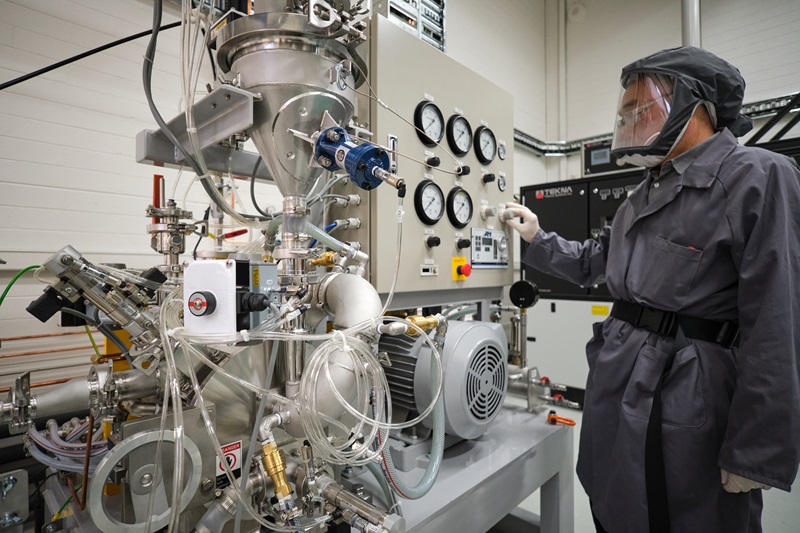
The powders that drive additive manufacturing
It is a capability arriving at exactly the right time. Metal 3D printing is moving from a specialist technology to an increasingly important part of advanced manufacturing, and the powders that feed those machines are no longer a secondary consideration. They are becoming a high-value industry in their own right.
As manufacturers push the technology further, they need powders designed for specific products, performance requirements and production processes. They also need those powders to be more affordable, reliable and accessible if Australia is to compete in a global manufacturing market.
“As additive manufacturing becomes increasingly sophisticated, manufacturers are seeking more bespoke feedstocks that are specifically designed to meet the unique requirements of their custom products,” Dr Wilson said.
“They also want them to be cheaper to drive down their input costs in a global and competitively contested environment. That has created a need for locally produced niche metal powders.”
That need points to a broader national opportunity: building sovereign capability in the design and production of advanced feedstocks, so Australian companies can access the materials they need closer to home and move faster from idea to industrial application.
From feedstock design to the fabrication of prototype devices
With the NHS-1 and TEK SPHERO 15 now in place, CSIRO’s Powder Lab is designed to help bridge the gap between materials research and real manufacturing outcomes.
Early demonstrator components show the materials being produced are moving beyond the research bench and towards practical industrial use.
“We’ve already had some success modifying high-quality metal and battery materials locally,” Dr Wilson said.
Those projects have been delivered with major industry partners and international collaborators, including aerospace and resources companies, the Trailblazer program and Cooperative Research Centres. For industry, that collaboration is critical and helps de-risk innovation, test new ideas faster and create a clearer pathway from laboratory discovery to commercial application.
Together with CSIRO’s Lab22, Powder Lab strengthens an end-to-end capability for metallic, composite and technical ceramics manufacturing – from feedstock design through to the fabrication of prototype devices. It means industry partners can work with CSIRO across the whole development pipeline, rather than solving each challenge in isolation.
“We’re essentially turning cutting-edge materials research into real-world manufacturing outcomes,” Dr Wilson said.
“It is a practical pathway to reduce waste, cut costs and support circular economy outcomes for industry.”
For Australian manufacturers, the message is simple. The future of metal 3D printing will not only be shaped by the machines that print parts, but by the materials that go into them.
CSIRO’s Powder Lab is open for business and ready to work with partners looking to develop tailored feedstocks, accelerate innovation and turn advanced materials into real-world products.