Monash University deep tech spinout ElectraLith has been awarded the prestigious Grand Prix at the 2026 World Materials Forum (WMF) Start Up Challenge, making it the first Australian startup to win the award in more than a decade, and cementing its position as a global leader in sustainable critical minerals innovation.
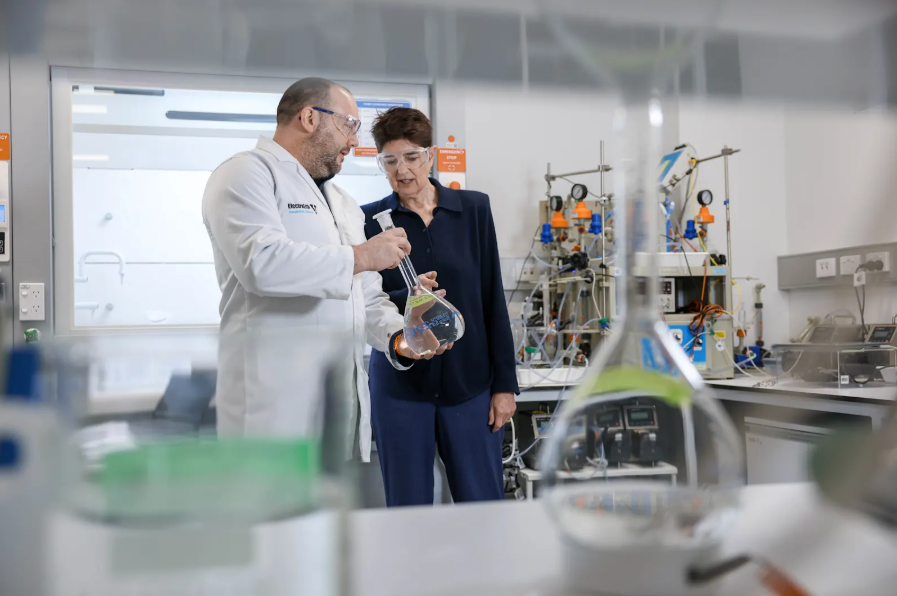
Image: Deputy Vice-Chancellor Professor Robyn Ward with ElectraLith Vice President of Engineering Damien Edwards. Credit: Joe Armao/The Age
The major international accolade was announced over the weekend following the WMF final awards ceremony, held on 4 September, at the historic Paris School of Mines.
Selected from a highly competitive global cohort of deep-tech and advanced materials pioneers, ElectraLith secured the top honour for its revolutionary Direct Lithium Extraction and Refining (DLE-R) technology.
ElectraLith Chief Executive Officer Charlie McGill accepted the award on behalf of the company, expressing gratitude to the WMF jury, chaired by Professor Victoire de Margerie, and acknowledging the foundational role of the Monash University ecosystem.
“Winning the WMF Grand Prix is an incredible validation of our team’s hard work and the global potential of our DLE-R technology,” said Mr McGill. “We are proud to represent Monash and Australia on this prestigious international stage as we work to build a cleaner, faster and more sustainable future for critical minerals.”
Transforming global lithium production
Born out of research at Monash University and scaling rapidly from the Monash Innovation Labs, ElectraLith’s proprietary electro-chemical extraction system addresses one of the green transition’s steepest bottlenecks.
Conventional methods of extracting lithium are extremely challenging to both the environment and local communities. The World Economic Forum (WEF) estimates that more than 2.2 million litres of water are required over an 18-to-24-month period to produce just one ton of lithium in the Lithium Triangle (Argentina, Bolivia, Chile). ElectraLith’s DLE-R shatters these challenges by extracting and producing battery-grade lithium in a single, scalable and modular step that requires no water or chemicals, and that can run entirely on renewable energy. By removing these factors, DLE-R is not only the most sustainable process to extract and refine lithium, but also the most cost-efficient.
The Grand Prix win follows a string of recent milestones for the spinout. It was selected a Top Innovator by the WEF in 2024 and closed a highly successful Series A funding round in 2025 backed by a syndicate of world-class investors including Rio Tinto, Chevron Technology Ventures, Marathon Petroleum Corporation, Main Sequence, In-Q-Tel (IQT) and Monash University.
A beacon of Monash Innovation
Monash University’s leadership team celebrated the international recognition as a testament to the University’s commitment to translating high impact research into commercial solutions for global challenges.
Monash University Deputy Vice-Chancellor (Research and Enterprise) and Senior Vice-President, Professor Robyn Ward AM, said the global accolade highlights the profound impact of the University’s research commercialisation pipeline.
“Becoming the first Australian startup to win the WMF Grand Prix in over a decade is an extraordinary achievement that highlights the global impact of Australian innovation,” Professor Ward said. “ElectraLith’s success shows how research translated directly from our labs can lead the world in addressing critical global challenges and accelerating the clean energy transition.
“By transforming fundamental scientific discovery into a market-ready, zero-water technology, ElectraLith exemplifies our commitment to fostering deep-tech spinouts that drive global economic and environmental impact. We are incredibly proud to see their innovation recognised on the world stage.”
By eliminating reliance on third-party overseas chemical refineries, ElectraLith’s modular on-site processing is set to drastically reduce the carbon footprint and capital costs of battery-grade lithium production globally, while also securing domestic supply chains.