Toyota Motor Corporation (Toyota) today launched the new fuel cell route bus (FC route bus) “Sora,” powered by hydrogen.
Toyota regards hydrogen as an important energy source in realizing a carbon-neutral society. It introduced its first fuel cell electric vehicle (FCEV), the Mirai, in 2014 and has sold it in more than 30 countries and regions. Since 2019, Toyota has also begun supplying fuel cell systems (FC systems) that generate electricity from hydrogen, and has provided more than 3,500 FC systems*1 to over 100 customers worldwide for applications such as buses, rail, and stationary generators. In partnership with others, Toyota has also developed hydrogen cartridge and hydrogen sauna, promoting decarbonization in areas of everyday life as well.
| *1 | As of the end of September 2026. |
|---|
Related articles from Toyota Times
- May 7, 2025, Hydrogen Cartridge
- Trucks Carrying Hydrogen and Prepared Food – A New Challenge Starting at the Expo
- September 17, 2025, Hydrogen Sauna
- Refreshed by Hydrogen! Toyota Made a Sauna?
In 2018, Toyota launched the first-generation Sora, offering a new value for route buses through clean, quiet fuel cell-powered operation. With the introduction of the new, upgraded Sora, Toyota will continue to contribute to realizing a hydrogen society by promoting the use of hydrogen in public transportation.
The new Sora is a next-generation FC route bus jointly developed by Isuzu Motors Limited (hereinafter, Isuzu) and Toyota as part of efforts to achieve zero-emission route buses. It combines Isuzu’s BEV full-flat route bus platform with Toyota’s FC system, further advancing the environmental performance and usability of route buses.
Vehicle Overview
- Evolution of the FC system
- Fuel efficiency has been improved by efficiently using the fuel cell and a large-capacity battery. Compared to the first-generation Sora, the total hydrogen tank capacity has been reduced by about 20%, while the cruising range has been extended by about 100 km to over 300 km*2, meeting the operational requirements of transit buses.
- Building on fuel cell technology developed through previous efforts, Toyota adopted a compact FC stack for commercial vehicles with increased output and durability, contributing to smoother, more stable operation. In addition, a new large-capacity hydrogen tank for commercial vehicles was developed, and by compactly mounting the FC system on the roof, vehicle maintenance by bus operators has been made easier.
| *2 | Reference values based on Toyota’s measurements. Actual values may vary depending on temperature, traffic conditions, the number of passengers, air conditioning use, and other factors. |
|---|
- Enhanced safety functions
- The vehicle is equipped with EDSS (Emergency Driver Stop System), linked with DSM (Driver Status Monitor). If the system detects that the driver is experiencing a problem, the vehicle decelerates and stops, automatically applies the parking brake after stopping, and helps ensure safety even on slopes.
- A front blind spot monitor that detects pedestrians and bicycles ahead of the vehicle and alerts the driver is installed, contributing to helping reduce accidents outside the vehicle.
- Improved usability
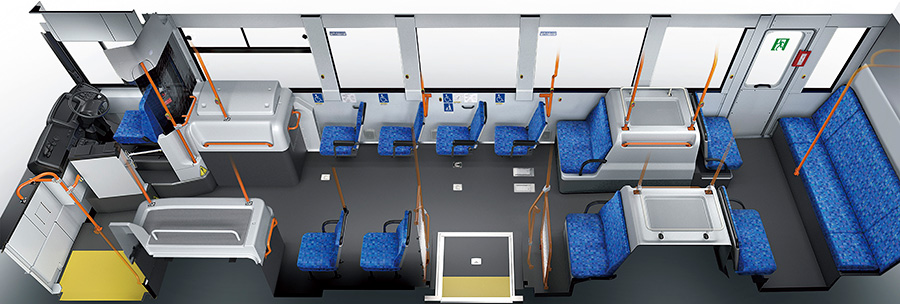
- The passenger compartment uses a full-flat floor with no steps, creating a space where all passengers, including those using wheelchairs or strollers, can move more safely and smoothly.
- A one-touch wheelchair securement system (optional)*3 is available to assist wheelchair users in getting on and off the vehicle and helps the driver secure them smoothly.
- Four variants―two for urban use and two for suburban use―with different seat layouts are offered to meet a variety of operating needs.
- The vehicle can be fully refueled with hydrogen in about 10 minutes*4, supporting operations that require high vehicle utilization. The vehicle complies with a new high-speed filling standard; when compatible hydrogen stations are deployed in the future, refueling time can be reduced by about half.
- By connecting an external power supply unit, the vehicle can be used as an emergency power source during disasters.
| *3 | Options will be available to order from around April 2027. |
|---|---|
| *4 | Reference values based on Toyota’s measurements. Actual values may vary depending on factors such as the hydrogen station’s capacity and ambient temperature. |

- Interior: full-flat floor
Toyota has been working with many partners in producing, transporting, storing, and using hydrogen. Moving forward, we will continue to promote the widespread adoption of hydrogen mobility in collaboration with government agencies and businesses, including through the hydrogen backbone network implementation initiative, a joint public-private effort.
Related article from Toyota Times
Main specifications (urban model)
| Vehicle | Overall length / width / height [mm] | 10,545 / 2,485 / 3,440 mm |
|---|---|---|
| Capacity (seated + standing + crew) | 70 (19 + 50 + 1) persons | |
| FC stack | Name (type) | Toyota FC stack (polymer electrolyte membrane type) |
| Maximum output | 113 kW | |
| Motor | Type | AC induction motor |
| Maximum output | 220 kW (110 kW x 2) | |
| Maximum torque | 970 N・m (485 N・m x 2) | |
| High-pressure hydrogen tanks | Number (nominal pressure) | 3 (70 MPa) |
| Tank volume | 471 L | |
| Propulsion battery | Type | Lithium-ion battery |
Sora-related news
- March 28, 2018
- Toyota Launches Production Model “Sora” FC Bus
- September 29, 2025
- Isuzu and Toyota to Jointly Develop Next-Generation Fuel Cell Route Bus
“Achieving zero, and adding new value beyond it”
As part of efforts to pass our beautiful “Home Planet” to the next generation, Toyota has identified and is helping to solve issues faced by individuals and overall society, which Toyota calls “Achieving Zero,” hoping to help reduce the negative impacts caused by these issues to people and the environment to zero. Additionally, Toyota is also looking “Beyond Zero” to create and provide greater value by continuing to diligently seek ways to improve lives and society for the future.
- About Beyond Zero
- https://global.toyota/en/mobility/beyond-zero/
Toyota Motor Corporation works to develop and manufacture innovative, safe and high-quality products and services that create happiness by providing mobility for all. We believe that true achievement comes from supporting our customers, partners, employees, and the communities in which we operate. Since our founding over 80 years ago in 1937, we have applied our Guiding Principles in pursuit of a safer, greener and more inclusive society. Today, as we transform into a mobility company developing connected, automated, shared and electrified technologies, we also remain true to our Guiding Principles and many of the United Nations’ Sustainable Development Goals to help realize an ever-better world, where everyone is free to move.
- SDGs Initiatives
- https://global.toyota/en/sustainability/sdgs/