Greater Shepparton City Council’s RiverConnect team are protecting vulnerable local turtle nests from predators ahead of a busy turtle nesting season and they need your help.
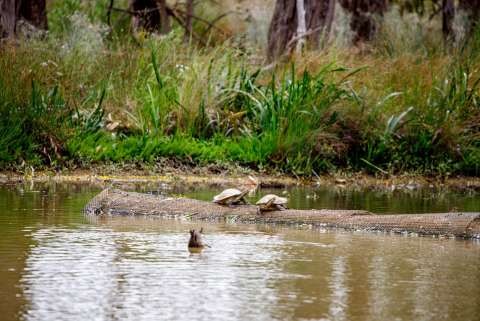
Community members are encouraged to assist staff by reporting turtle sightings and nesting activity so staff can install specially designed mesh covers to protect the nests from threats such as foxes.
Acting RiverConnect Education Officer Ruth Boyd said Greater Shepparton was home to three species of freshwater turtle – the Eastern Long-Necked Turtle, Broad-Shelled Turtle and Murray River Turtle.
“Turtle nesting typically occurs around November and December, often during or following rain. However, this year we have already seen turtles on the move earlier than usual following warmer weather and recent rainfall,” she said.
“Turtles can travel long distances searching for suitable nesting sites and are often active early in the morning.”
Passionate Tatura Turtles volunteer Yvette Williams said residents could use an app called TurtleSAT to record their turtle sightings.
“Every sighting provides valuable information and helps us better understand where turtles are moving and nesting, so we can work together to give our local turtles the best chance of survival,” she said.
“By reporting a turtle nest, community members can help give the next generation of turtles a better chance. It’s simple to arrange protection, and every nest counts.”
Foxes are a major threat to freshwater turtle nests, so protecting nests gives hatchlings a better chance of survival. While female turtles bury their eggs and release a substance that helps to harden the soil over the nest, foxes can still find newly laid eggs and might also target nests when hatchlings start to emerge. A protective cover placed over the nest soon after nesting can greatly improve the hatchlings’ chances of survival.
If you find a nesting turtle:
- Where possible, stay nearby until the turtle finishes laying, which can take from 15 minutes to more than three hours. Mark the location without disturbing her, then return later to confirm nesting is complete. After nesting, she may be tired and vulnerable to predators. If she needs assistance, safely move her to the nearest suitable water body.
- Record the exact turtle nest location, take a photo and contact RiverConnect on
If you find turtle eggs:
- Leave them and report the location to Wildlife Victoria on (03) 8400 7300.
If you find a turtle on a road or in danger:
- Safely carry the turtle (from the top holding the front and back of the shell) in the direction it was heading to prevent it trying to re-cross the road when you have left.
- If there is a water body within a few metres of the turtle, move it to the water. If the water is far away, simply move it out of harm’s way.
- If the turtle appears to be dead, ill, or injured, or if you have any concerns at all, call Wildlife Victoria for rescue or advice.
If you find a hatchling turtle:
- Pick the hatchling up and place it in plants on the edge of the nearest suitable water body. Please do not take it home – it is illegal to remove native animals from the wild.