A high-throughput ceramic processing method developed at Institute of Science Tokyo uses cellulose nanofiber dispersions for rapid preparation of ceramic samples. The simple, low-cost approach allows researchers to explore materials of varying compositions while eliminating several time-consuming steps. Using this method, the team successfully identified a dielectric ceramic with excellent temperature stability, demonstrating its potential in the discovery of advanced functional materials.
Accelerating Ceramics Discovery Using Cellulose Nanofiber Dispersions
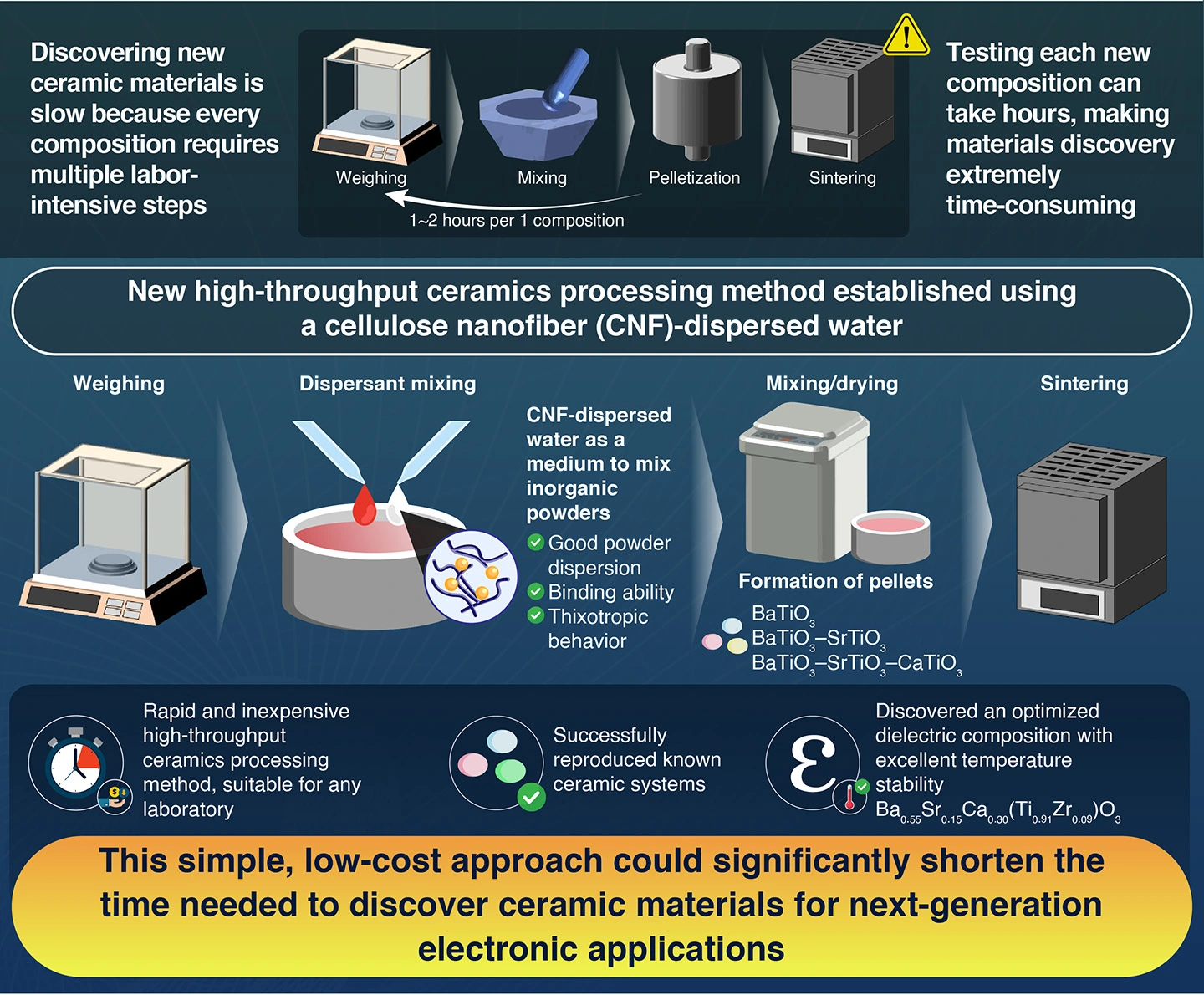
Ceramic materials are used everywhere, from smartphones and computers to electric vehicles and renewable energy systems. These materials are used in a wide range of technologies owing to their unique electrical, magnetic, and thermal properties. However, discovering new ceramic compositions with better performance remains a significant challenge because each candidate material must typically be synthesized and tested individually, involving multiple labor-intensive steps.
A team of researchers from Institute of Science Tokyo (Science Tokyo), Japan, led by Assistant Professor Sou Yasuhara along with Professor Takuya Hoshina, graduate student Yosuke Sugita, and graduate student Masaki Tozuka from the Department of Materials Science and Engineering, School of Materials and Chemical Technology, Science Tokyo, developed a simple high-throughput method for ceramic processing using cellulose nanofiber (CNF) dispersions. Their study was published in the Journal of Materials Chemistry C on June 26, 2026.
Instead of preparing every composition from scratch, the researchers first dispersed ceramic powders in water containing CNF. These nanofibers served many purposes simultaneously, including even distribution of the powder, providing sufficient binding strength and improving thixotropy, so that the mixture flows easily during mixing and becomes more stable afterwards. These prepared dispersions can then be mixed in different ratios prior to drying and sintering to prepare different ceramic compositions.
As a result, preparing new compositions only requires about three minutes of hands-on work, while eliminating the weighing, powder mixing, and pelletization steps that are required in conventional ceramic processing.
“Developing new ceramic materials requires preparing and testing hundreds of compositions, making synthesis a major bottleneck,” explains Yasuhara. He adds, “We wanted to create a simpler method to accelerate materials exploration.”
To ensure that the new approach produces high-quality materials, the researchers first synthesized barium titanate (BaTiO3), a well-known dielectric ceramic widely used in capacitors. The resulting ceramics exhibited dense microstructures, crystal structures, dielectric constants, and phase transition temperatures that closely matched those produced by conventional solid-state processing.
Further, the team extended the method to increasingly complex material systems. They successfully produced barium titanate-strontium titanate solid solutions and a ternary barium titanate-strontium titanate -calcium titanate system. The measured structural and dielectric properties closely reproduced previously reported results, demonstrating similar material quality while significantly simplifying sample preparation.
Once validated, the researchers used the technique for exploring improved dielectric materials. They explored different ceramic compositions based on barium, strontium, calcium, titanium, and zirconium, focusing on improving the temperature stability of the dielectric constant, which is an important property for capacitors used under varying operating conditions.
Through rapid composition screening, they identified Ba0.55Sr0.15Ca0.30(Ti0.91Zr0.09)O3. This ceramic material maintained a high dielectric constant of approximately 4,000 while exhibiting excellent stability between 30 °C and 125 °C. This discovery demonstrates how the developed method can also accelerate the identification of promising functional materials while requiring relatively little starting material.
“Our approach makes high-throughput ceramics processing accessible without specialized or expensive equipment, accelerating the discovery of functional materials for electronic devices and many other applications,” notes Yasuhara.
Beyond dielectric ceramics, the researchers believe that the method could benefit the broader field of inorganic materials. Since the technique simplifies sample preparation, it can allow researchers to rapidly generate multiple compositions of materials with improved electrical, magnetic, optical, and energy-storage properties. Moreover, its reliance on inexpensive equipment also makes high-throughput experimentation more accessible to laboratories without the need for sophisticated automated systems.
In the future, the researchers plan to expand the method to other classes of ceramic materials and contribute to the faster discovery of advanced materials for electronics, energy, and other emerging technologies.
Reference
- Authors:
- Sou Yasuhara1*, Yosuke Sugita1, Masaki Tozuka1, and Takuya Hoshina1
*Corresponding author
- Title:
- High-throughput ceramics processing method using cellulose nanofiber dispersions for rapid materials exploration
- Journal:
- Journal of Materials Chemistry C
- Affiliations:
- 1School of Materials and Chemical Technology, Institute of Science Tokyo, Japan