Key points
- Australian waterbirds like ibis, spoonbills, egrets and pelicans can fly vast distances and gather in groups of thousands at a time.
- If H5 avian influenza (bird flu) takes hold in Australia’s largest river system, significant losses of susceptible wildlife will be unavoidable.
- CSIRO research helps build the evidence base to inform rapid decision-making about water management, should outbreaks occur within the Basin.
Throughout spring and summer, all sorts of waterbirds are making their way to the vast wetlands of the Murray–Darling Basin. From ibis to herons, egrets to pelicans, bitterns to swamphens – many Australian species gather there en masse to nest and raise their young.
CSIRO Principal Research Scientist Dr Heather McGinness said that the sight of thousands of birds densely clustered across the landscape usually inspires awe.
But with H5 high pathogenicity avian influenza – commonly called H5 bird flu – now detected in wildlife across Australia, she’s also worried.
Dr McGinness and her team have been tracking the movements of waterbirds from the Murray–Darling Basin for nearly 10 years to inform water and wetland management, and now to support H5 bird flu preparation and response.
“If there are really large-scale breeding events – which happen every few years – we might get thousands of birds in the same place at the same time, putting them all at risk of catching it,” Dr McGinness said.
“We still don’t know what the impacts of H5 bird flu might be on many of our native species.”
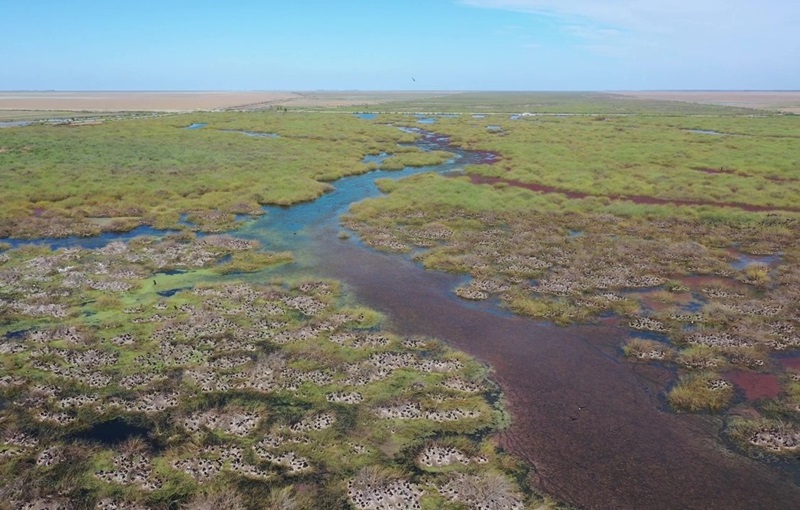
While the mass mortality risk is much higher when birds aggregate high densities, these breeding events are critical to maintaining bird populations.
The majority of confirmed H5 bird flu events have been along Australia’s coastline. To date, only isolated cases of the virus have been detected inland, including in the Murray–Darling Basin. Overseas experience has demonstrated that outbreaks can have substantial impacts on wild bird populations and some wild mammals.
Waterbird monitoring is one activity that can provide insights into the interactions between wetlands, waterbirds and potential disease risk, supporting surveillance, preparedness planning and evidence-based water management.
Tracking bird movements with GPS ‘backpacks’
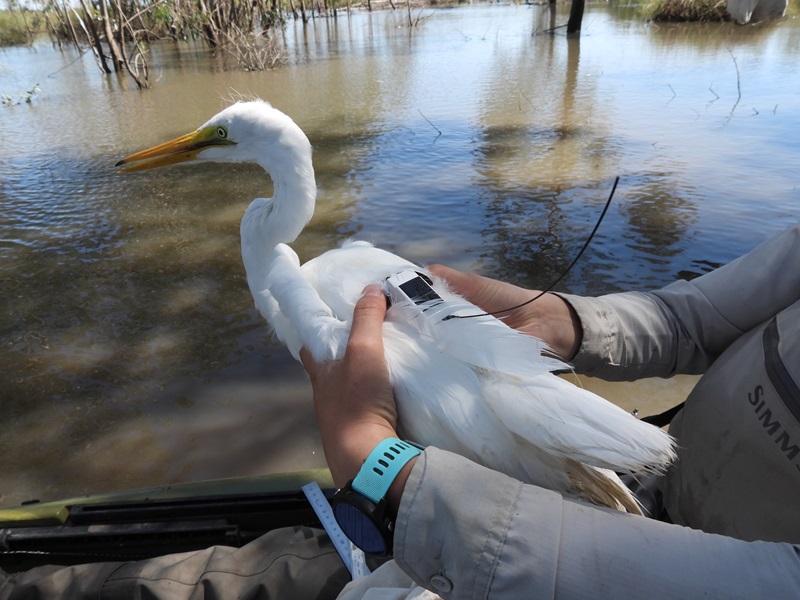
Using lightweight bird ‘backpack’ GPS satellite-trackers, custom-fitted with special hand-sewn harnesses, Dr McGinness and her team have mapped the movements of hundreds of birds.
As part of previous work, the team tracked one young plumed egret named Yurru through an astounding 38-hour-straight flight. Dr McGinness and her team tracked Yurru for 5 months and only lost touch because the 3G network, which the GPS used, was decommissioned in Australia.
The team has also tracked other birds for several years continuously, with the record so far being nearly 9 years for a straw-necked ibis named Benji, tagged as a juvenile.
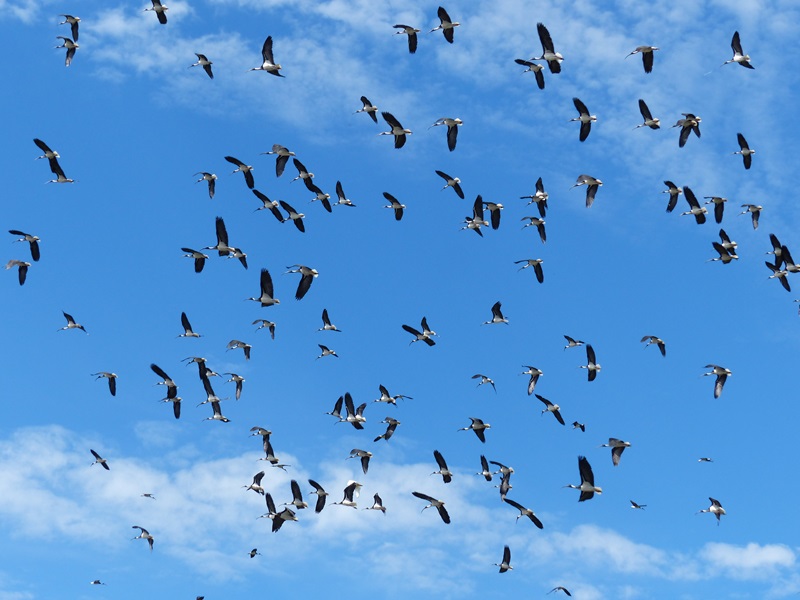
Research shows that waterbird movements occur along a spectrum but fall broadly into 3 broad categories.
They can be ‘sedentary’ (generally staying in one area); ‘nomadic’ (moving irregular distances and directions, responding opportunistically to favourable conditions in the environment); or ‘migratory’ (moving predictably between the same locations seasonally or annually, often over long distances).
Dr McGinness said that lots of research has been done on how H5 bird flu might be carried from overseas into Australia by migratory birds. By contrast, little is known about how it might travel from the Australian coast inland, or how it might affect Australia’s nomadic and sedentary birds.
“When we’re tracing bird movements, we’re interested in how far they travel and how fast, as well as what routes they take and whether there’s a pattern to that,” Dr McGinness said.
“Our research has uncovered a key inland flyway from South-Eastern Australia to Queensland – which multiple bird species use. It also shows common bird movement routes from the coasts to the Murray–Darling Basin.
“We’ve mapped how they can move vast distances in a matter of days, through the Murray–Darling Basin and then on to other locations to breed, roost or feed,” she said.
By identifying which species are nomadic, sedentary or migratory, and understanding what drives their movements and analysing where their movements intersect, Dr McGinness’ research offers valuable clues about which environmental factors might influence bird movements across the Basin and where H5 bird flu may be more likely to be detected.
Sampling scat for science
That detective work is the focus of new collaborative research coordinated by Senior Research Technician Dr Micha Jackson.
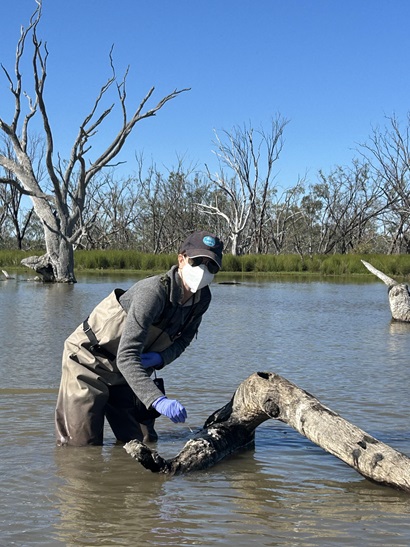
Dr Jackson and a team of CSIRO scientists travel long distances to remote wetlands across the Murray–Darling Basin. There, they collect scat, or faecal samples, from birds and arrange transport to state-based laboratories, where they are tested for bird flu.
Just like the flu that humans get, there are many strains of bird flu – and some make birds more ill than others. So far, the team has only detected low pathogenicity strains in samples from the Murray–Darling Basin, which generally don’t cause illness in wild birds.
The next step is working together with virus experts from laboratories and universities to sequence and analyse the genome of the virus in the sample.
The resulting genetic blueprint helps the team to understand how it’s related to other bird flu strains, where it’s come from, and which populations of birds have contracted similar strains.
“Thanks to researchers collecting and publishing genetic sequencing in Australia and around the world – including our colleagues at the Australian Centre for Disease Preparedness – we can better understand how bird flu viruses have travelled between continents, as well as between different populations of birds,” Dr Jackson said.
“Understanding virus dynamics of other bird flu strains gives us an idea of how H5 bird flu might spread, and between which species and populations.
With most national surveillance efforts focused in coastal areas, Dr Jackson said there’s a knowledge gap when it comes to inland wetlands.
“Monitoring and surveillance, especially in remote areas which people don’t visit as regularly, are touchpoints for early detection,” Dr Jackson said.
“If we detect when H5 bird flu has spread to new sites or species – especially those that don’t show as many symptoms – then there may be more options on the table for how to respond.”
Collaboration across the Basin
Doing this science is rarely straightforward. Figuring out where waterbirds are likely to be within the vast river system depends partly on insights from behavioural research like Dr McGinness.
But the team also relies on regular updates and strategic coordination with people on the ground including wetland managers, private landholders and local council staff.
Dr Jackson recalled misty mornings spent in kayaks on the water, trying to locate distant flocks they had spotted on reconnaissance the day before.
“We need to gather fresh samples as close to sunrise as possible, otherwise the virus degrades under the sun’s UV rays,” Dr Jackson said.
“Then we need to get the samples shipped off for testing in a timely manner, at the right temperature.
“Other times, we might be doing shore-based work, using a spotting telescope to count the different species of birds and map out where they are, before we set out to pick up samples.
“One of the reasons these areas are less researched is because they are a lot more logistically challenging to work in, so I feel really pleased and proud that we got hundreds of samples done.”
Bringing bird flu insights to the Basin and beyond
Both tracking birds and monitoring for H5 bird flu generates valuable insights that help governments and partners in the Murray–Darling Basin and beyond assess risks and target actions.
Supported by the Australian Government’s H5 bird flu investment and the Commonwealth Environmental Water Holder, in 2025 and 2026, CSIRO carried out research to help build the evidence base informing decision-making about water management, should outbreaks occur within the Basin.
Principal Research Scientist Dr Rebecca Doble, who leads the H5 bird flu project, said the work provides critical evidence to support H5 bird flu preparedness and response.
“We know that the transmission and spread of H5 bird flu are inherently unpredictable, but this research contributes to a broad evidence base, which supports decision-makers in their response planning,” she said.
If you see sick or dead birds or other animals, do not touch them. Avoid contact, record your location and report multiple sick or dead birds or other animals to the Emergency Animal Disease Hotline on 1800 675 888 from anywhere in Australia.