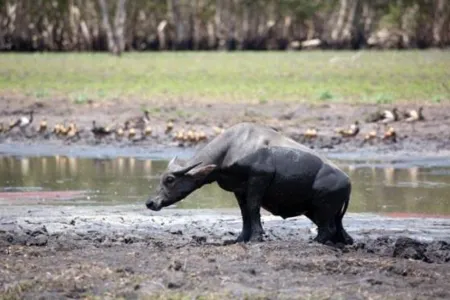
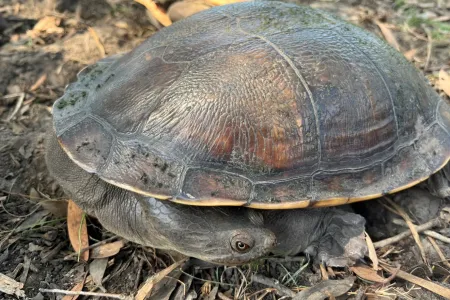
A study examining how feral water buffalo interact with landscapes has uncovered how the pest is having disastrous impacts on northern long-necked turtles in the Top End’s tropical wetlands.
The Charles Darwin University (CDU) study examining buffalo in the Arafura Swamp Indigenous Protected Area in Arnhem Land, Northern Territory modelled the impacts of the pest on the habitats used by the turtle across its life stages and during the area’s flooding and dry phases.
Feral water buffalo (Bubalus bubalis) are a major invasive pest in the Northern Territory and are considered ‘ecosystem engineers’, a term for species that create, significantly modify, maintain or destroy a habitat.
Northern long-necked turtles (Chelodina rugosa) are found across Northern Australia and hold both nutritional and cultural significance to First Nations peoples in the habitat areas.
The modelling found during the flooded phase changes to the habitat caused by the buffalo would reduce food availability and thus decrease reproductive success of the turtle.
This would prevent the turtle from accumulating the necessary nutrients to survive aestivation (summer hibernation).
During the dry phase, the modelling predicts the buffalo’s modifying of the soil would further impact aestivation and developing embryos in buried nests. It also shows turtles and their eggs to be at risk of crushing from buffalo wallows and pugging.
Lead author Helen Truscott is a CDU Research Institute for the Environment and Livelihoods PhD candidate and the Chief Executive of the Arafura Swamp Rangers Aboriginal Corporation.
She said given the persistence and abundance of feral buffalo across a region as remote and immense as Arnhem Land, reducing its immediate impact while longer term plans for removal are in progress would require a nuanced approach, with this modelling being a crucial step forward.
“For example, to address reduced embryo survival, an increase in woody debris at sites may reduce the impact from direct crushing and raised soil temperatures,” Ms Truscott said.
“This strategy would be most useful in select areas of the coastal habitat where there is currently no woody cover, and while we work on long terms buffalo reduction programs.
“Fencing, while found to be useful in other locations on smaller scales, has likewise is not a feasible conservation action. The amount of fencing needed would be prohibitive for landscapes the scale of the Arafura Swamp.
“This modelling approach is valuable in clarifying pathways leading to detrimental effects and revealing likely points of mitigation.”
Ms Truscott said further research into the impacts on northern long-necked turtles was needed to develop long-term, large-scale conservation measures.
“The approach we have described here is particularly useful for the management of native species where removal of the feral species is not practical or indirect impacts are dominant,” she said.
The study was co-authored by CDU Professor of Freshwater Ecology Jenny Davis, CDU Senior Research Fellow Dr Erica Garcia, and CDU Associate Professor in STEM Pathways Carla Eisemberg.
Impact Pathways Derived From Conceptual Modelling Reveal the Impacts of Feral Water Buffalo on Northern Long-Necked Turtles in Tropical Wetlands was published in the journal Ecological Management & Restoration.