In the 18th century, a headmaster in Schlüchtern owned a First Folio, the first complete edition of Shakespeare’s dramas. Researchers from Würzburg and Oxford now investigate this book and its international journeys.
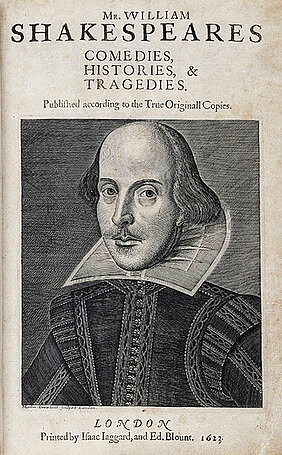
The first complete edition of the dramas of William Shakespeare (1564-1616), known as the First Folio, was printed in London in 1623. From there, some folios gradually made their way to other countries. There are currently 234 known copies of the First Folio scattered around the globe.
In Germany, the presumably earliest First Folio did not turn up in Weimar or another urban centre, but in the small Hessian town of Schlüchtern. The book belonged to the local grammar school principal Johann Heinrich Hadermann (1710-1785). It became part of his library and moved with him into the school, where Hadermann lived as headmaster.
Tracing the journey of the Schlüchtern First Folio
Today, the Schlüchtern First Folio is in the Morgan Library in New York. When and how did it get there? And when and how did it get to Schlüchtern in the first place? Who read it in the local school, how was it used, and what was the course of its subsequent journey around the world?
This ‘biography’ of the book is the topic of the research project ‘Follow the Folio: Digital Reconstruction of the Transnational History of Shakespeare’s First Folio (PML 5123)’.
The project is led by Professor Kirsten Sandrock, Chair of English Literature and Cultural Studies at the University of Würzburg, in cooperation with Emma Smith, Professor of Shakespeare Studies at the University of Oxford. The Centre for Philology and Digitality (ZPD) at the University of Würzburg will design and implement the digital components of the project.
The German Research Foundation (DFG) funds the project, which will commence on 1 March 2027 and run for three years.
Hadermann’s name was misread for a long time
There are currently three First Folios in public libraries in Germany: one each in Stuttgart, Cologne and Berlin. These books did not arrive in Germany until the 20th century. The Schlüchtern First Folio, by contrast, was presumably the first of its kind in Germany, as the Shakespeare scholar Emma Smith has established in her research into the global journeys of the First Folios.
The specific journey of the Schlüchtern copy remains a mystery until now. Johann Heinrich Hadermann manually signed the book as ‘Ex Bibliotheca J.H. Hadermanni’ (From the Library of J.H. Hadermann). His name was misread, however, for a long time, as ‘Handenmanni’ or ‘Hadenmanni’. In 2016, Smith succeeded in deciphering the name correctly, thereby identifying it for the first time as part of Hadermann’s historical library in Schlüchtern.
“The identification of Hadermann also proved that this was one of the first Shakespeare First Folios to have travelled outside of the United Kingdom,” Kirsten Sandrock explains. The First Folios contain 36 plays by the English playwright, as well as several Shakespearean dramas that would otherwise have been lost.
Archival research in New York and Schlüchtern
For the new DFG project, the German-British research team investigates the local archives in Schlüchtern while also doing research at the Morgan Library in New York. “In Schlüchtern there are further books and materials by and about Hadermann that have not yet been examined,” Kirsten Sandrock adds.
This work could yield some fascinating insights – for example, into how Shakespeare’s works were received in Germany prior to the great period of Shakespeare translations in the 18th century. So far, most scholars have concentrated on prominent 18th-century figures such as Wieland, Lessing, Herder, Tieck and Goethe. A headteacher from a rural area has not yet been the focus of Shakespeare research, but he will move into the centre now.
Virtually recreating historical libraries
Methodologically, ‘Follow the Folio’ aims to show how digital methods can expand and internationalise literary and archival studies.
Kirsten Sandrock, in collaboration with the Centre for Philology and Digitality (ZPD), will develop solutions to virtually reconstruct the historical library that is now scattered across the globe along with its contexts. The ide ais that historical libraries can be turned into active research environments again online. The Hadermann library will serve as a pilot project for this.
Project partners
- Centre for Philology and Digitality (ZPD) at the University of Würzburg, Dr Claudia Esch and PD Dr Christian Reul, for the digital reconstruction of the Schlüchtern library.
- Schlüchtern Municipal Archives, Kerstin Baier-Hildebrand, which facilitates archival research on Hadermann and the Schlüchtern library.
- Ulrich-von-Hutten Gymnasium, Schlüchtern, deputy principal Andreas Schneider. The school is interested in research on its former director, Johann Heinrich Hadermann, and details on his library for the anniversary celebrations in 2028.
- The Morgan Library in New York, which will grant access to research on the Hadermann First Folio in New York.