- Haruka Ueda from Japan leads emergency response and recovery efforts at International Organization for Migration (IOM) in Mozambique.
- She participated in the one-week FY2025 Mid-Career Course of the Program for Global Human Resource Development for Peacebuilding and Development, commissioned by the Ministry of Foreign Affairs of Japan.
- Through the Course, Haruka gained greater clarity on her career aspirations, reflected on her leadership style and explored new ways to strengthen communication and team leadership.
- The Program is commissioned by the Ministry of Foreign Affairs of Japan and implemented by Hiroshima University in collaboration with the United Nations Institute for Training and Research (UNITAR.)
An Early Motivation to Work in Humanitarian Response
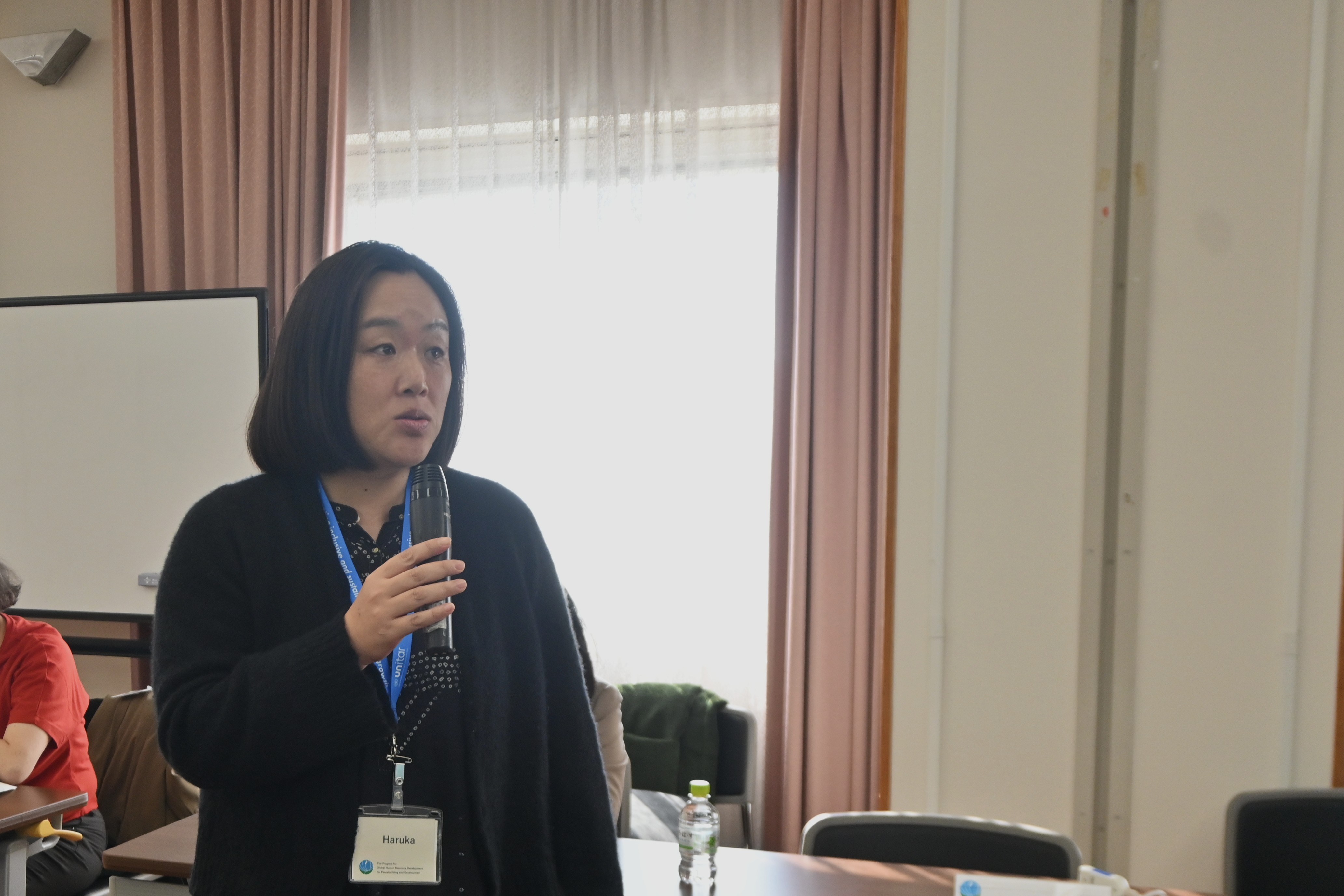
26 August 2026, Hiroshima, Japan – For more than 15 years, Haruka Ueda has supported communities affected by conflict, displacement and disasters across Africa, the Middle East and Asia. Today, she leads emergency response and recovery efforts for the International Organization for Migration (IOM) in Mozambique.
Haruka’s commitment to humanitarian work began after she experienced the 1995 Great Hanshin Awaji Earthquake that devastated her hometown, Kobe, Japan. The experience influenced her decision to pursue her career in humanitarian action and international development.. She joined the International Organization for Migration (IOM) and steadily gained experience in emergency response, recovery programming and team leadership.
Making Time to Reflect on Next Steps
Amid a demanding period of work and organizational change, Haruka realized the importance of reflecting on her own professional development. She discovered the Mid-Career Course and saw it as an opportunity to step back and consider her professional development.
Established by the Ministry of Foreign Affairs of Japan, the program strengthens the capacities of professionals working in peacebuilding and development. Since fiscal year 2024, Hiroshima University has implemented it in cooperation with UNITAR. Haruka joined its Mid-Career Course for professionals aspiring to management positions. The course combined online preparatory learning in December 2025 with in-person training in Hiroshima from 7 to 13 January 2026. Eight participants from Japan and one each from Austria, Cameroon, France, Guatemala, India, Indonesia, Morocco, Nepal and Pakistan took part.
Discovering New Perspectives on Leadership
While Haruka joined the Course to focus on career development, she unexpectedly found the opportunity to reflect on leadership invaluable. It encouraged her to examine her leadership style, identify areas for growth and consider how she can lead more effectively in complex professional environments. The course provided a structured setting in which Haruka could reflect on the demands of her role and identify practical areas for continued learning and development.
Applying the Learning at Work
The learning extended beyond personal development. Haruka has begun applying communication and emotional intelligence skills from the course in her work, including while navigating organizational change – – demonstrating the immediate impact of the training on her day-to-day.
Looking ahead, Haruka remains committed to supporting communities affected by crises while continuing to grow as a humanitarian leader. Drawing on lessons from both her professional experience and the Mid-Career Course, she plans to continue strengthening her leadership and team-support skills while contributing to humanitarian response and recovery efforts.
About the Human Resource Development Program by the Ministry of Foreign Affairs Japan
In response to then Foreign Minister Taro Aso’s policy speech, “Let Us Create a ‘Terakoya’ for Peacebuilders,” the Ministry of Foreign Affairs of Japan has implemented a human resource development program in the field of peacebuilding since 2007.
In fiscal year 2015, the program was renewed and expanded to provide comprehensive support for identifying, developing, and fostering the careers of professionals in international organizations, and was relaunched as the Program for Global Human Resource Development for Peacebuilding and Development.
Since fiscal year 2024, Hiroshima University has been commissioned by the Ministry of Foreign Affairs of Japan to implement and manage the program in cooperation with UNITAR.
Ministry of Foreign Affairs of Japan: https://www.mofa.go.jp/fp/ipc/pagewe_000001_00215.html
Global Peace and Development Career Network: https://gpad.hiroshima-u.ac.jp/en/
About Hiroshima University
Hiroshima University is a national comprehensive research university established in 1949 in Hiroshima, the first city in human history to experience an atomic bombing. In fulfilling its mission as a national university, Hiroshima University has adopted the Hiroshima University Charter as the foundation of its activities. Guided by five core principles, namely the pursuit of peace, the creation of new knowledge, education that fosters rich humanity, coexistence with local and international communities, and continuous self-renewal, the University strives to realize a free and peaceful society and contribute to the well-being of humankind.
Hiroshima University also respects the human rights and dignity of every individual and contributes to both local and global communities through education and research. In pursuit of a peaceful and sustainable future, the University pioneers innovative solutions to global challenges, including poverty, conflict, human rights violations, infectious diseases, environmental issues, and resource and energy sustainability, taking a leading role in addressing these issues on a global scale.