What the research is about
Our bodies are made up of many cells. Inside each cell, a wide variety of molecules are constantly at work. Enzymes produce molecules that cells need, while other proteins transport them or exert forces that rearrange them, helping to create the complex structures within cells. Many of these processes are powered by energy released through chemical reactions.
By contrast, researchers seeking to build artificial materials from molecules have often relied on self-assembly, in which molecules spontaneously come together to form structures. Living systems, however, do more than simply produce molecules and let them assemble. They also move them and apply forces to organize them into complex structures. Incorporating such processes into artificial material design has been challenging. Techniques for producing long strands of DNA and for using proteins to move microscopic objects have both been studied, but they have largely been used separately.
A research team led by Assistant Professor Shogo Hamada (tenure track) at Institute of Science Tokyo (Science Tokyo) and Professor Akira Kakugo at Kyoto University wondered whether combining the processes of making molecules and moving them, as living systems do, could offer a different way to build materials. Using DNA as their building material, the researchers set out to grow DNA strands and then actively move them using energy to create interconnected network structures.
Why this matters
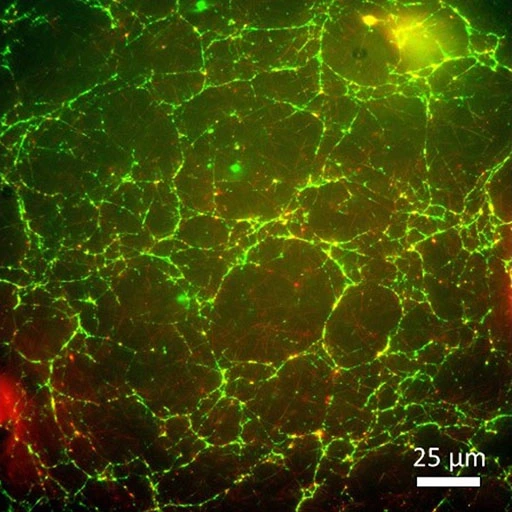
The researchers first attached DNA to tiny protein tubes called microtubules and used an enzyme to extend the DNA into long strands. They then used motor proteins, which normally help transport materials inside cells, to move the microtubules. As the microtubules moved, the attached DNA strands came into contact with other DNA strands, connected with them, and were stretched out. Within minutes, an interconnected network formed (Image 1).
This process depended on both energy and the machinery that converts that energy into motion. When the motor proteins were absent, or when ATP (adenosine triphosphate), their energy source, was removed, the microtubules did not move and no DNA network formed. The results showed that self-assembly alone was not enough. Forces generated by active movement were essential for stretching and organizing the DNA into a network.
The team also found that once the DNA growth time or the microtubule density exceeded a certain level, the connectivity and complexity of the network rose sharply. The structure did not become gradually more complex as the amounts of DNA and microtubules increased; instead, it changed dramatically beyond a particular threshold.
What’s next
The study demonstrates a way to create materials not only by allowing molecules to come together spontaneously, but also by using energy to actively synthesize, move, and organize them. Developing this approach further could eventually lead to new types of materials that can rebuild their own structures or change their properties in response to their surroundings.
Comment from the researcher
Living organisms take in matter and energy from their surroundings to build the components of their bodies, move them, and continually renew them, thereby sustaining themselves. I hope to bring some of these life-like processes into artificial systems built from molecules. I see this research as a step toward new materials that can move, process information, change, and build structures on their own, and toward molecular robots and molecular computers using such materials.
(Shogo Hamada, Assistant Professor (Tenure Track), Department of Computer Science, School of Computing, Institute of Science Tokyo)

Dive deeper
Explore more research in Science for All
Science for All showcases cutting-edge research at Science Tokyo and highlights the ideas, people, and possibilities shaping the future.
Follow Science Tokyo research on X
Our Research Frontiers account features selected stories from Science for All and regularly shares research from across Science Tokyo.