
A one-off training session increased how much time fathers spent with their children and on chores by about two hours a week, reports a new study from the University of Tokyo. A team in Japan provided male employees and their managers with either information on positive office attitudes towards paternity leave or a work-life balance training session. The former corrected common misconceptions, but fathers who attended the training reported real behavioral change. This unexpectedly freed up 3.6 hours of time which mothers used for their own work. This study shows how small workplace interventions can have wider positive impacts, for families and businesses.
It takes a village to raise a child, so goes the phrase, but for many mothers, the responsibilities of child-raising and domestic work still fall mainly on their shoulders.
Japan is known for its traditional societal expectations, and Japanese women do four times as much unpaid care work as men, one of the largest gender gaps globally. So, it may be surprising to read that Japan actually has one of the most generous parental-leave policies in the world, offering both parents (if they qualify) up to one year of paid leave following childbirth or adoption.
Uptake of paternity leave has risen dramatically in recent years, from only 2.65% in 2015 to 40.5% by 2024, and the government hopes to increase this figure to 85% by 2030. But most dads don’t take a full year, if they take any time at all, so what still holds many new fathers back?
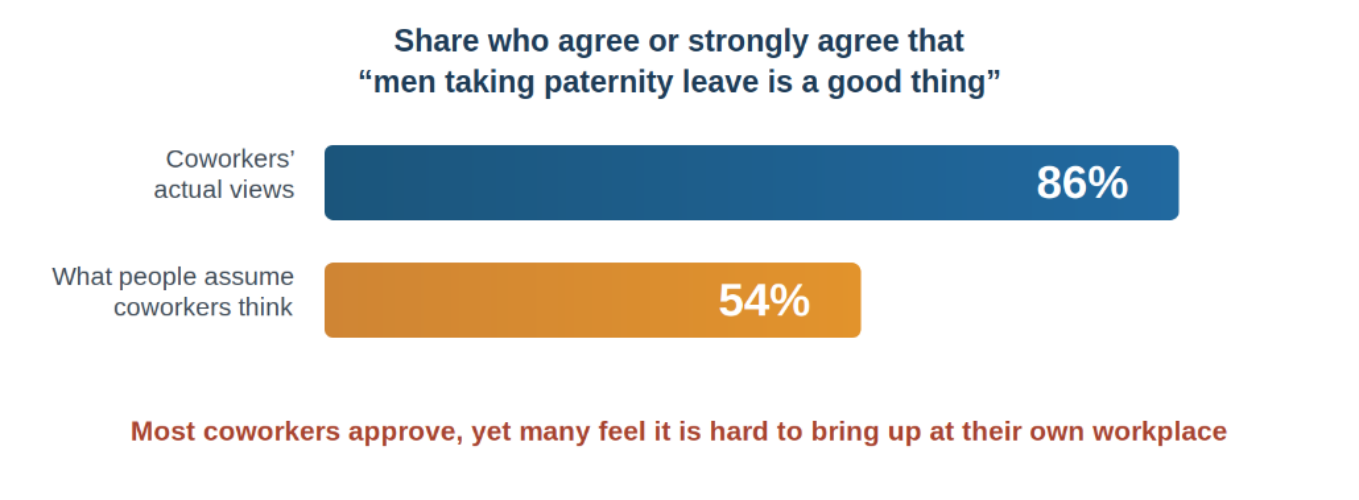
“Japan’s employment system was built in the high-growth era around a male breadwinner who could devote unlimited hours to one firm, with a wife handling everything at home. Long hours and visible commitment are still how loyalty is signaled in many workplaces. Norms like these are self-perpetuating: People observe that few men take leave, conclude that taking leave must be frowned upon, and stay silent themselves,” explained Professor Shintaro Yamaguchi from the Graduate School of Economics at the University of Tokyo. “In fact, our data shows that private attitudes have already changed a great deal. It is the perception of others’ attitudes that lags behind.”
As a researcher, Yamaguchi repeatedly saw how policies which focus solely on mothers (such as more flexibility at work) can only go so far to improve gender equality when fathers are not supported to adjust their roles and responsibilities. So, the team enrolled 1,200 male employees from four Japanese organizations into one of two interventions, either:
1) they participated in a two-hour, work-life balance training session, targeting fears about career risks when taking paternity leave and led by working fathers; or
2) they received information detailing coworkers’positive attitudes towards paternity leave, to overcome “pluralistic ignorance” (when people privately disagree with something but think everyone else accepts it).
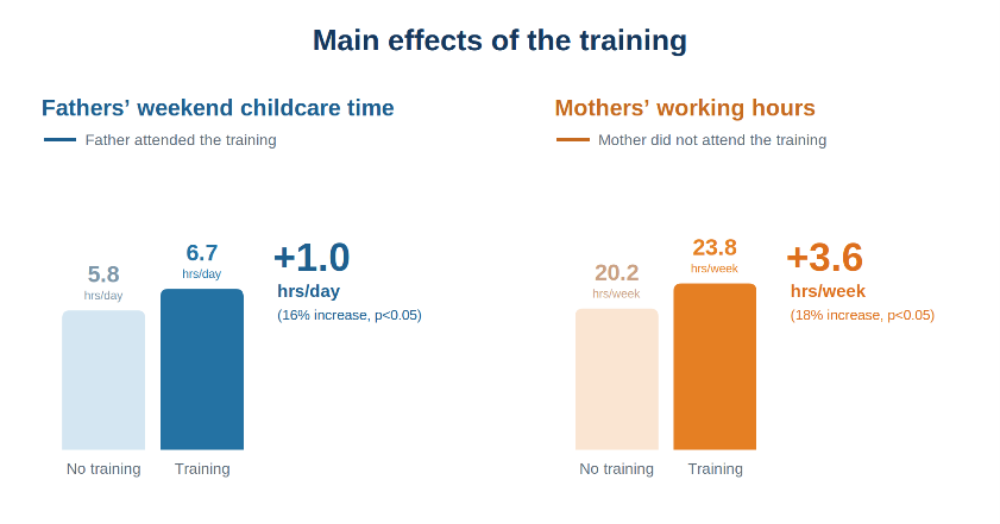
While the second intervention did correct misconceptions, it was the brief training session which led to significant behavioral change.
“Fathers who participated in the session spent about one more hour per day on childcare on weekends, and their wives, who never attended the training, increased their working hours by 3.6 hours per week,” said Yamaguchi.
“Much of the fathers’ new involvement happened when parents were with the children together, so what actually freed up mothers’ time was a reduction of roughly 2.6 hours in their housework. The training triggered a renegotiation of the overall division of labor at home, not just a transfer of childcare.”
Participants completed surveys before the interventions, and then twice afterwards within the following year. To avoid bias, the team guaranteed strict anonymity and received replies directly. They also accounted for some people’s tendency to give socially desirable answers, to ensure that results provided evidence of real change.
Whether these changes last and the long-term impact on families, businesses and society are questions for future research. In the meantime, Yamaguchi hopes that training like this could be utilized as a practical and low-cost tool in workplaces, one which policymakers might consider supporting, given the country’s concerns around declining birthrates, an aging population, dwindling labor supply and closing the gender gap.
“The next step is for fathers to take sole charge of children for meaningful stretches of time, which builds the skills and confidence that shared care does not. Longer leave-taking and more flexibility in weekday working hours would help make that possible,” said Yamaguchi. “Given the importance of managerial attitudes to parental leave, ensuring that supervisors have a positive and supportive mindset is key for success.
“For me, becoming a father completely changed my priorities. I believe that fatherhood is genuinely good for men, but its value is underestimated and underappreciated in Japan. I personally want to promote fatherhood and for other men to experience the same joy.”