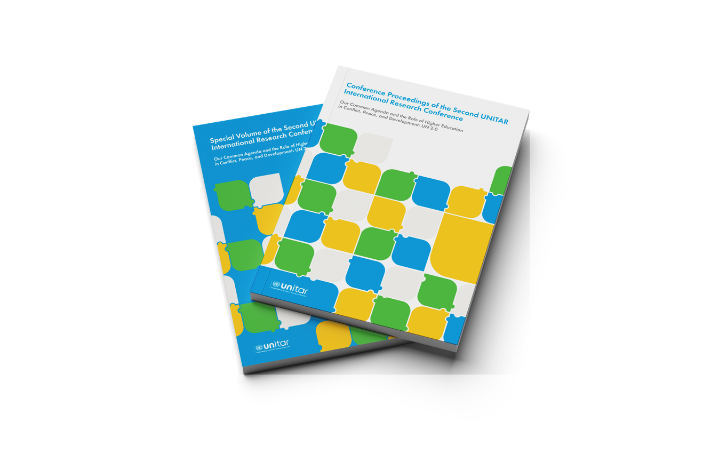
Bonn, Germany – The United Nations Institute for Training and Research (UNITAR) has released the publication of two volumes stemming from the 2nd UNITAR International Research Conference (2UIRC) .
Held at the UN House in Brussels under the theme “UN 2.0: Our Common Agenda and the Role of Higher Education in Conflict, Peace, and Development”, the conference convened leading global scholars, policymakers, and practitioners to examine the role of higher education in addressing conflict, fostering peace, and advancing sustainable development. The newly released publications translate those intensive high-level dialogues into actionable academic resources aimed at driving global cooperation, resilience, and innovation.
Developed in collaboration with the Technical University of Sofia, the two volumes offer a comprehensive look at how higher education institutions can actively support the Sustainable Development Goals (SDGs) and the Pact for the Future.
“The 2nd UNITAR International Research Conference volumes affirm a transformative vision for higher education, one that does not merely observe the world’s challenges but actively shapes solutions,” said Evariste Karambizi, Director of the Division for Peace at UNITAR. “They call on universities and applied research institutions to become engines of peace, sustainability, and inclusive governance, grounded in collaboration across disciplines, sectors, and regions. This vision demands that we move beyond participation toward true cocreation, elevating voices from the Global South and ensuring that innovation, including artificial intelligence, advances equity rather than deepens divides. Aligned with the UN 2.0 Agenda, these publications inspire a globally connected community of scholars and practitioners committed to turning knowledge into action and ideas into lasting societal impact.”
Explore the New Publications
The research has been published in two distinct, complementary volumes designed for policy and academic impact:
1. Conference Proceedings: A Blueprint for Dialogue
The Conference Proceedings provide a comprehensive record of the event, documenting its structure, sessions, and the breadth of contributions presented. Structured around the principles of UN 2.0, Our Common Agenda, the SDGs, and the Pact for the Future, the volume reflects the diversity of perspectives and themes explored during the conference.
It highlights critical discussions on topics such as digital learning, human security, climate resilience, and governance in conflict‑affected contexts, offering both academic insights and practical considerations for those working on peace and sustainable development.
2. Special Volume of Selected Papers
The Special Volume of Selected Papers brings together a curated selection of scholarly papers that build on the ideas and debates explored during the conference. This volume advances the discussion through expanded research contributions that have undergone editorial screening and peer review with papers submitted by participating researchers following the conference, including conference speakers, participants, and associated scholars. Contributions address topics such as the role of higher education in countering extremism, promoting social equity, navigating the ethical implications of artificial intelligence, and integrating climate resilience into educational systems.
3. Main findings
The two 2UIRC volumes converge on a clear trend: higher education must evolve into a more action‑oriented, collaborative, and transdisciplinary force capable of addressing complex global challenges. They emphasise the need to move beyond theory by linking research to real‑world impact, particularly in peacebuilding, sustainability, and governance, while strengthening partnerships across sectors and amplifying voices from the Global South. At the same time, the publications highlight persistent inequalities, especially in access, representation, and digital capacity, and stress that inclusion should involve participation and co‑creation. Technology, including AI, is seen as an enabler and a risk factor that can reinforce existing disparities if not governed carefully. Overall, the findings point to a shared direction: a more inclusive, practice‑driven, and globally connected model of higher education, aligned with the UN 2.0 vision and focused on translating knowledge into meaningful societal change.
UIRC: A Sustained Platform for Global Research and Impact
The publication of these two volumes marks an important milestone in the UNITAR International Research Conference (UIRC) series representing its first comprehensive synthesis of global data and further cementing its status as a premier platform bridging research, policy, and practice.
Building on the outcomes of the 2UIRC, the editorial process for the 3rd UNITAR International Research Conference (3UIRC) volumes is already well underway. Following a rigorous double‑blind peer review process by our independent Editorial Board, authors will soon be contacted individually with submissions outcomes and next steps.
Join us for 4UIRC
UNITAR invites researchers, practitioners, and partners to engage with the upcoming 4th UNITAR International Research Conference (4UIRC) , “Educating for Futures,” taking place on 18-19 November 2026 at UN House, Brussels, Belgium. The upcoming edition will focus on Empowering Individuals and Institutions for Innovation in the Domain of Human Security, Peace, and Sustainable Development.
Discover collaboration and participation opportunities: Visit the Official 4UIRC Platform
Join us for 4UIRC
UNITAR invites researchers, practitioners, and partners to engage with the upcoming 4th UNITAR International Research Conference (4UIRC) , “Educating for Futures,” taking place on 18-19 November 2026 at UN House, Brussels, Belgium. The upcoming edition will focus on Empowering Individuals and Institutions for Innovation in the Domain of Human Security, Peace, and Sustainable Development.
Discover collaboration and participation opportunities: Visit the Official 4UIRC Platform
Our partners
This global research initiative was made possible through the collaboration of leading academic institutions and organizations, including:
- Key Partners: Technological University Dublin (TU Dublin), Universitat Oberta de Catalunya (UOC), and the Technical University of Sofia.
- Academic Coalition: ÇAĞ University, Polytechnic University of Cartagena, Oxford Brookes University, University of Derby, and the Technical University of Cluj-Napoca.
- Institutional Partners: World Association for Disaster and Emergency Medicine, Diplomats Without Borders, the Portuguese National Institute of Administration (INA, I.P.), and the Irish Economic Association.