Benjamin Franklin understood something fundamental about money that still shapes modern economies: Money only works when people believe it is real.
In the early 18th century, the British colonies suffered from a chronic shortage of gold and silver coins , forcing local governments to rely on paper bills for trade and everyday commerce. But paper currency created a dangerous new problem: Unlike metallic coins, paper money could be easily copied, altered and faked.
Long before his experiments with electricity or his role in the American founding now 250 years ago, Franklin spent years working with paper , ink and printing. In the process, he developed a practical understanding of materials and manufacturing.
Nearly three centuries later, modern scientific analysis reveals how sophisticated some of his anti-counterfeiting strategies were. My colleagues and I in materials science recently analyzed hundreds of surviving colonial American bills, including notes printed by Franklin.
Using modern imaging and scientific methods, we examined fibers, pigments and microscopic structures hidden in the paper. The results suggested that Franklin approached currency as a practical materials problem.
Printing money that people could trust
Although paper money originated in China more than a thousand years ago , it did not appear in Europe until the 17th century. By the early 18th century, the American colonies lacked enough gold and silver coins to support a growing economy. To keep commerce moving, many colonies began issuing paper money instead. But paper currency also created anxiety because the colonial bills were relatively easy to fake.
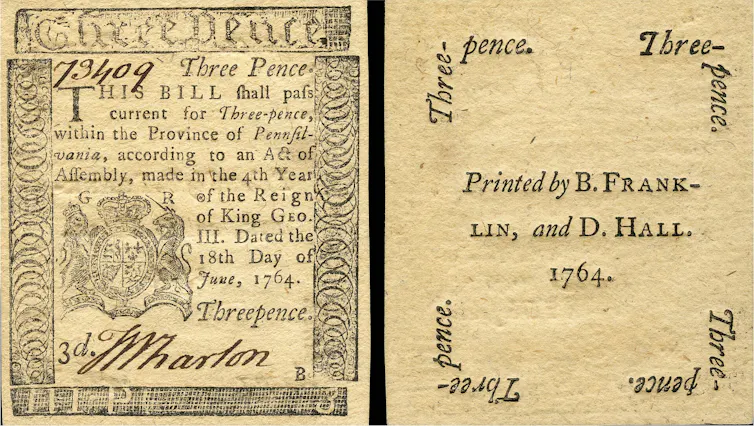
Forged notes circulated widely. Printers even put variations of the phrase ” To Counterfeit Is Death ” on colonial money and detailed harsh punishments for counterfeiters in their newspapers.
Franklin became involved in money printing in the early 1730s, soon after establishing himself as a printer in Philadelphia. During his career, Franklin printed millions of pounds worth of paper money for Pennsylvania and several other colonies. In 1749, he brought in the printer David Hall as a business partner. Hall carried on the practice with William Sellers after Franklin left the practice in the mid-1760s.
Franklin also created a network of printers in other colonies , supplying them with printing presses, paper and ink. This network printed paper notes for the Delaware, New Jersey, New York, Maryland and South Carolina colonies. Printing money required greater precision than printing newspapers or pamphlets. Franklin understood that a bill’s physical characteristics and the materials used to prepare it could shape whether people trusted it.
A printer who experimented with materials
Franklin approached printing as a craftsman, constantly experimenting with new printing techniques and materials.
Colonial papermakers produced paper sheets by pulping old linen and cotton rags in water, lifting the suspended fibers onto screens, and compressing the wet pulp by hand.
Under magnification, this old paper resembles a dense network of tangled fibers. Franklin explored ways to make his bills harder to copy by embedding additives into the paper. Some notes included indigo-colored fibers or threads mixed into the pulp.
Those innovations forced counterfeiters to reverse-engineer the paper, not just the printed image. Franklin also experimented with imitating designs from natural objects. For example, by pressing leaves into soft material, he captured complex vein patterns with high precision.
He later printed those patterns on colonial bills, producing designs that were difficult to copy because no two leaves share the same structure.
Franklin had written a famous pamphlet to advocate for paper money, though it did not record his exact techniques. Alongside his main account book, he kept a separate ledger – never found – to record dealings with the papermaker Anthony Newhouse in 1742 and 1743. In the mid to late 1740s, he purchased “money paper” from Newhouse.
Historians have speculated that Franklin was developing this new money paper with Newhouse and separated the accounts to keep its security features confidential.
What modern analysis reveals
When my colleagues and I began investigating nearly 600 colonial bills , we wanted to understand the materials they contained. We employed imaging methods capable of examining structures thousands of times thinner than human hair. Those techniques allowed us to reveal the chemical makeup of the inks, fiber colorants and mineral particles used.
Some findings surprised us. Franklin’s black ink differed from many conventional printing inks of the period, which often used soot-based black pigment produced by burning vegetable oils or charring animal bone.
Instead, in many of Franklin’s bills, we found layered carbon structures similar to graphite , the naturally occurring form of carbon used in modern pencils. Unlike soot-based pigments, graphite consists of stacked layers of carbon atoms that give it distinctive physical and optical properties. These results suggested that Franklin experimented with ink composition more extensively than historians previously thought.
We also identified mica particles embedded in the paper. These particles reflect light, producing a faint shimmer. Whether added intentionally or introduced during papermaking, they created another visual feature that would have been difficult for counterfeiters to reproduce consistently.
Under advanced microscopes, the fibers revealed differences in manufacturing techniques, paper quality and material preparation. What appeared to be a simple colonial bill became a complex engineered object under the microscope.
Today, many banknotes contain similar particles, specialized threads and layered optical features designed to deter counterfeiters. Franklin’s materials were simpler than modern security technologies, but they relied on similar principles .
The material science of trust
Franklin never described himself as a materials scientist. Yet his work on colonial money reflected many of the ideas that guide secure printing today. He understood that an object’s physical properties could help build trust. The bill’s texture, fibers, pigments and printed details all helped convey authenticity.
That insight proved important far beyond the printing shop. Paper money provided a practical way to support trade, public projects and economic growth in the face of coin shortages. But paper currency could only serve those purposes if people trusted it. By making bills more difficult to counterfeit and easier to recognize as genuine, Franklin helped strengthen confidence in a financial system that supported a rapidly growing colonial economy.
Modern analysis now reveals details that earlier generations could not see: Franklin’s paper money was more than a financial instrument. It embodied a principal effort to engineer trust directly into everyday materials, an idea that still informs the design of modern money.
It is perhaps fitting that Franklin’s portrait appears on today’s US$100 bill. Long before becoming one of the faces of American money, he helped develop some of the ideas that made paper money trustworthy in the first place.