Conservation projects often focus on protecting a threatened species from predators and habitat destruction. But as our research shows, restoring food webs can be as important to supporting ongoing recovery.
Authors
- Simon Stewart
Freshwater Scientist, Cawthron Institute
- Robin Holmes
Freshwater Ecologist, Cawthron Institute
This may require ecological restoration of several sites that connect an endangered species with its food.
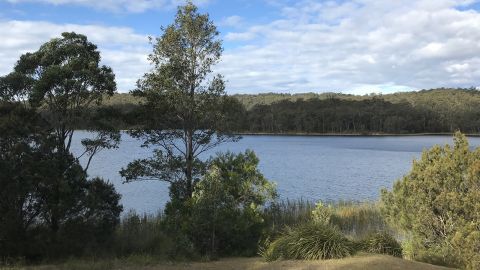
Our recent study focused on Waituna Lagoon , a site in the South Island long recognised under the Ramsar Convention for its outstanding biodiversity values as an internationally important wetland area.
The research demonstrates the lagoon’s significance as an important food source for longfin eels, which are classified as at risk, with declining populations.
The lagoon is formed by a barrier beach. When it overflows this barrier, either naturally or through excavation, it remains open to the sea until big swells block the opening again. This can take anywhere between a month and a year.
During the open state, īnanga – small migratory native fish which form the majority of whitebait – run freely from the ocean and become extremely abundant.
This supercharges the wider catchment’s food web, including eel populations living upstream in surrounding creeks.
How īnanga support eel growth
The duration of open conditions varies between years, and so does the abundance of īnanga. We think of this as a “natural experiment” that manipulates food supply. Our study shows how important changes in īnanga abundance are for longfin eels.
We analysed a small set of otoliths (fish “ear” bones) collected from local iwi (tribal groups). Otoliths have annual rings that record age and growth rates in much the same way as tree rings.
We found that during open years, Waituna Creek eels grew faster than during closed years when īnanga were scarce, confirming the key role īnanga play as a prey fish.
Large īnanga runs boosted the abundance of eels in the catchment to far higher levels than typically occur in coastal streams that don’t have large downstream wetlands.
Our findings are significant because New Zealand’s main eel conservation strategy is to protect eels from fishing within the conservation estate. However, the Waituna Creek produces almost ten times the biomass of eels per year and kilometre of stream length than streams within the conservation estate (on average).
The value of growing big eels
Boosting eel growth is a critical lever for eel conservation. Having bigger, faster growing and more abundant eels in steams means more females reach their spawning grounds in the equatorial Pacific Ocean.
Eels return from their spawning grounds as tiny leaf-shaped and transparent juveniles. The journey back into rivers is perilous and the more females make it to the spawning grounds, the more juveniles will be returning to Aotearoa.
Larger eels are also more likely to make it to the spawning grounds . Even more importantly, large eels produce a disproportionately large load of eggs .
A single four-kilogramme longfin eel can produce around eight million eggs, whereas a female of half that weight may only produce about two million eggs.
Creating landscapes rich in wetlands that provide lots of high quality, energy-dense food in the form of īnanga can help eels reach a larger size and better support the New Zealand-wide population.
Wetlands support wider ecological restoration
Understanding how wetlands benefit the wider surrounding landscape opens a new avenue for ecological restoration. This includes protecting and creating food-producing habitats which then disperse the benefits throughout a catchment.
Previously, if a project’s goal was to enhance biodiversity in a particular location, it usually focused on that site. But our research suggests it might in fact be better to focus restoration efforts on adjacent sites that produce a food source to improve ecological conditions for a threatened species.
In our study, the goal was to improve conditions for eels living in a lowland agricultural stream with elevated nutrients, little riparian planting and an engineered channel designed for convey flood waters with little consideration for fish habitat.
There are many streams like this across New Zealand and these systems have proven stubbornly resistant to restorations efforts .
At Waituna Creek, the biomass of longfin eels more than doubled two years after efforts to restore the stream through riparian planting and creating woody habitat in the stream channel. But the restoration was successful because the eels had enough food in the form of īnanga swimming upstream from the wetland to support the population increase.
We are increasingly appreciating the ecological role of wetlands as we recognise their value as critical natural infrastructure that slows down water to prevent flooding, locks up carbon and traps sediment and nutrients. Now our study shows they are also hotspots that can fuel fish growth in distant sites through connected systems.
Like many areas around the world, New Zealand lost about 90% of wetlands over a period that coincided with large declines in many native freshwater fishes . Fortunately, we are now actively restoring and creating wetlands.
The recently completed Jobs for Nature programme restored more than 6,000 hectares of wetland . It will be exciting to see the benefits of this work transferring through to native fishes.
Protecting wetlands doesn’t just preserve the plants that live there. It protects highly valued predatory fish and bird species in connected systems.