We don’t all understand the same words in the same way, and this can affect the choices we make, according to researchers including those from the University of Tokyo. A team sought to compare how people with an autism spectrum disorder (ASD) and people without ASD interpret probability terms. They found that people with and without ASD could be divided into three groups of decision-makers, whose judgment varied depending on the relative influence of positive or negative framing and the numerical probabilities they inferred from verbal expressions. This work highlights the importance of dialogue to check whether people have understood information as intended and to support informed decision-making.

Communicating about uncertain situations is not easy, as we can see from debates around climate change, the economy, and how to help people make decisions in a world where it feels like everything is shifting. Researchers at the University of Tokyo wanted to find out how our understanding varies when probabilities are expressed in words, such as “it is likely”, or in numbers as a “30% chance.” In particular, they wanted to compare people with and without an autism spectrum disorder, to see if there were any noticeable trends.
“ASD is often associated with differences in communication and information processing, so we wondered if people with ASD might interpret expressions of uncertainty differently,” explained Professor Kazuhiro Ueda from the Graduate School of Arts and Sciences. “While we found that participants with ASD tended to assign more similar numerical meanings to different verbal phrases, we more importantly identified three distinct patterns of decision-making, revealing variation both within and across the groups.”
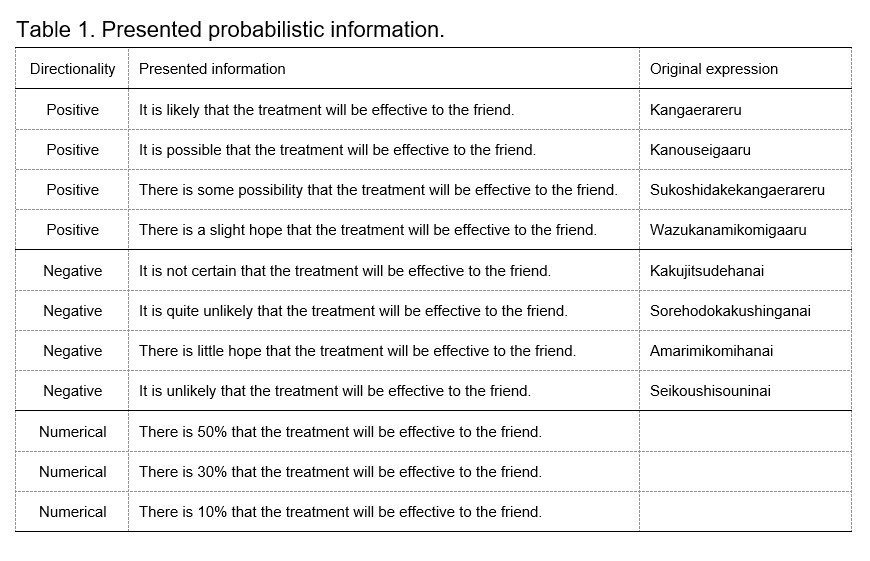
The participants included 48 people with ASD and 90 people without. They were given a hypothetical scenario where a friend was considering an expensive treatment for migraines and they had to decide how strongly they would recommend the treatment, based on a doctor’s statement about its chance of success. The language used to explain the treatment varied, from numerical probabilities (such as “a 30% chance the treatment will be successful”) to positive and negative probability words (such as “it is possible” or “it is unlikely to succeed”). The participants were also asked to assign a numerical value to the verbal terms.
Their answers revealed three groups of decision-makers:
- Group 1 consisted mostly of people with ASD. Their decisions were relatively strongly influenced by positive or negative framing and less strongly influenced by the numerical probabilities they inferred from the verbal expressions.
- Group 2 consisted mostly of people without ASD. Their decisions were relatively less influenced by wording and more strongly influenced by the numerical probabilities inferred from verbal expressions.
- Group 3, a combination of people with and without ASD, was similarly influenced by both numerical interpretations and wording.
Although these distinct decision-making patterns were found, the team says further research is needed to find out what causes people to fall into each group and the underlying psychological processes involved. Also, as the current participants included a range of ages and intellectual abilities, they could not conclude that the observed differences were attributable solely to ASD.
“Even so, our findings suggest that the way we communicate uncertainty deserves more attention, especially when people make important decisions about health, education or everyday life. We could see that even subtle differences in wording can influence people’s decisions,” said Ueda.
“We would like to see greater awareness that communicating uncertainty is not simply a matter of choosing understandable words. It is important to clearly explain the context and background of the information being provided and to understand which aspects of that information influence each person’s judgments and decisions. We hope our findings will encourage professionals, particularly in healthcare and education, to explain uncertain information more explicitly and check whether their intended meaning has been understood.”