Like a hack writer or a friend rehashing their glory days over and over, artificial intelligence tends to tell the same old story. For AI agents instructed to write fiction, that tale usually involves lighthouses and a keeper named Elias, according to new Cornell research.
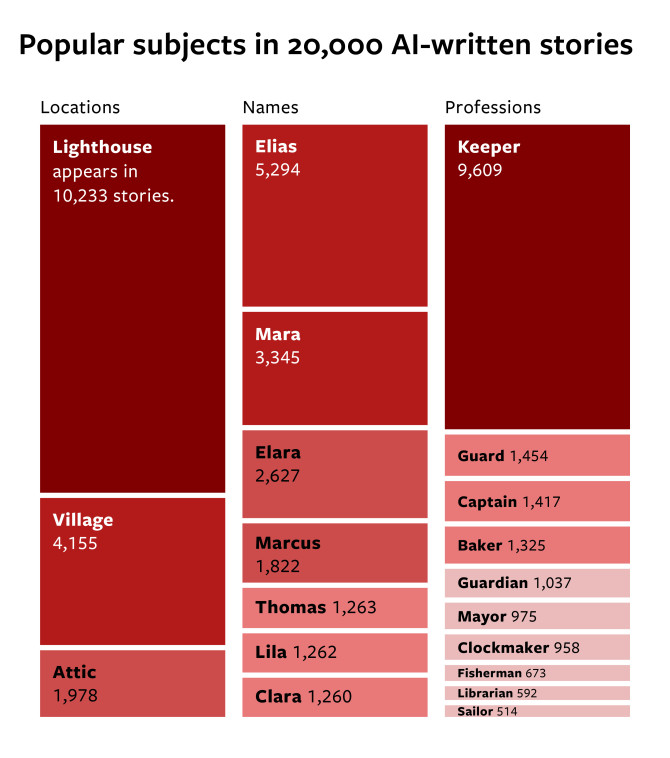
Nearly 90% of AI-generated fictional stories written by current large language models (LLMs) like ChatGPT and Claude include at least one of 11 reoccurring words, including “lighthouse,” “keeper” and the names “Elias,” “Mara” and “Elara,” researchers found when directing LLMs to tell stories. More than half of AI-generated stories featured a lighthouse.
They also found part of the reason for these reoccurrences may be that many AI developers have trained LLMs on an important dataset created by Cornell researchers.
The team’s findings highlight the homogenous nature of AI-generated text when powerful LLMs are trained on increasingly similar datasets, researchers said.
“When you ask a language model to tell you a story, they all tend to write the exact same one,” said Sil Hamilton, a doctoral student in the field of information science and lead author of “Elias in the Lighthouse, Again? Diagnosing Low Diversity in LLM Stories.” He will present the work Oct. 24-29 at the 2026 Conference on Empirical Methods in Natural Language Processing in Budapest, Hungary.
“You think you’re getting a unique story,” he said, “but at scale it’s the same thing over and over again.”
Hamilton and David Mimno, professor of information science in the Cornell Ann S. Bowers College of Computing and Information Science and the paper’s co-author, typed some variation of “tell me a story” into four current LLMs: ChatGPT, Claude, Gemini and the Allen Institute for AI’s OLMo. A pattern emerged from the ensuing 20,000 AI-generated stories – LLMs tend to use the same names, include some kind of profession like keeper, baker or mayor and were based in a specific location, like a workshop or lighthouse.
“The lighthouse at the edge of the world did not guide ships; it signaled to the stars,” reads one story sample. “Elias had been the keeper for 40 years. He was a man composed of salt, solitude and the rhythmic ticking of gears.”
“The mood is always vaguely pre-contemporary,” Hamilton said.
Although these familiar themes materialize in AI-generated stories, they don’t often appear in existing literature nor in the datasets used to train the models. Specifically, “lighthouse” stories, as the researchers call them, are an anomaly in the training data. So why do they show up so frequently?
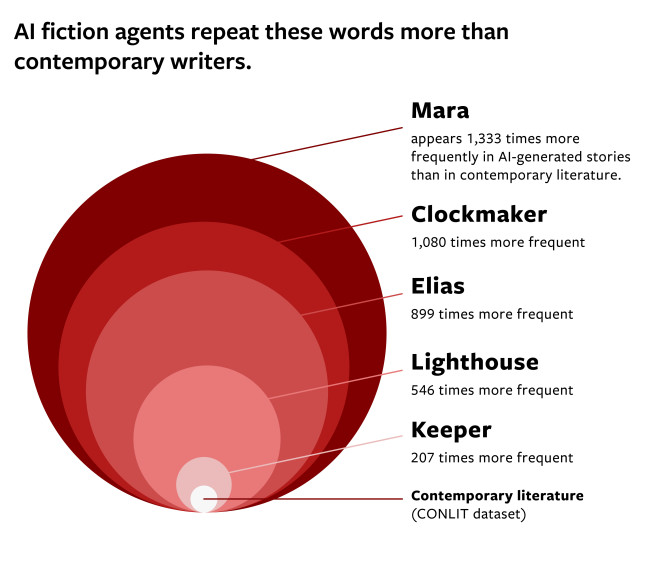
Researchers can’t say definitively just yet and intend to explore this question in future work. But they suspect the culprit is “mode collapse” – when LLMs default to similar topics or themes because developers trained them on the same datasets and rolled them into newer LLMs. Further, since current LLMs were designed to write code, not engaging fiction, they tend to be repetitive storytellers, researchers found.
“Things like creative writing get shunted in LLM development,” he said. “There doesn’t seem to be a prioritization from model developers to tune these models for creative output.”
Where did Elias the lighthouse keeper first emerge in the training data? Researchers have a hunch: at Cornell.
They have reason to suspect he’s an artifact of the WildChat dataset, which Cornell computer scientists developed in 2024. WildChat includes 1 million real conversations between people and ChatGPT and has been used to train or “seed” other training sets that in turn helped build and refine today’s most powerful LLMs.
There, within WildChat’s data, Hamilton and Mimno found a small sample of conversations that included Elias and familiar tales of lighthouses.
“Based on the timeline, we’re fairly certain WildChat is an original source of this phenomenon,” Hamilton said, adding that future work will explore why LLMs prefer these lighthouse stories.
“LLMs are trained on a fair number of stories, and these stories are very diverse with lots of different kinds of genres and names,” Hamilton said. “There’s nothing as compact and tight in the training data as the stories that these LLMs end up producing. We want to know why.”
Louis DiPietro is a writer for the Cornell Ann S. Bowers College of Computing and Information Science.