‘Any translocation is only as good as the monitoring, evaluation and follow-up that comes after’.
That’s what Parks Victoria Conservation Scientist Floret (Flo) Meredith said back in August last year, after joining partners and volunteers to plant more than 800 Burrowa-Pine Banksia seedlings at Burrowa-Pine Mountain National Park.
Eight months later, it was time to find out whether those words would hold true. In April this year, Flo alongside community members and staff from Parks Victoria, Department of Energy, Environment and Climate Action (DEECA), and Royal Botanic Gardens Victoria returned to assess the seedlings for the first time since the large-scale restoration effort. Their hope was modest: if 60 per cent survived their first summer, the project would be considered a success.
After one of the driest springs in recent memory and a hot, rain-starved summer across Northeast Victoria, expectations across the group were low. What they found instead, was something few expected.
An extraordinary 88% of the translocated seedlings had survived, and even more encouraging, most weren’t simply hanging on – they were thriving.
Little banksias ‘tougher than nails’
‘Our hopes were tempered by the dry spring and hot summer that followed planting,’ Flo said.
The conditions couldn’t have been much worse. Creeks stopped flowing. Springs dried up. Gardeners across the region struggled to keep vegetables alive. The landscape felt “crispy”, Flo recalled.
‘We’d barely had any rain. It was one of those springs where everyone was talking about how dry it was. The creeks weren’t running, the soaks were dry, and we’d just planted all these seedlings into the ground.’
Given the conditions, the team braced for disappointing results. Instead, the little Banksias proved remarkably resilient.
‘Honestly, I don’t know how they made it,’ Flo laughed.
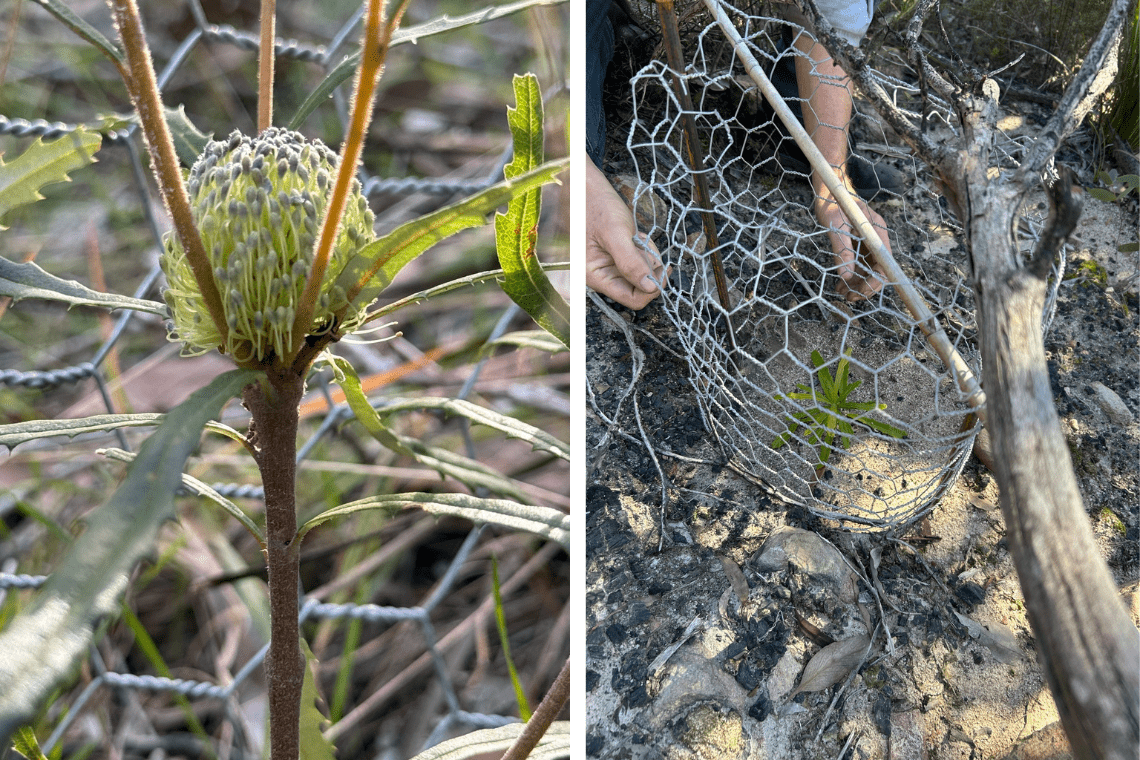
Left to right: A flowering Mountain Banksia. Normally, it takes 3-5 years before plants commence flowering. One of the 88% of surviving Mountain Banksia plants. Credit: Laura Simmons
Part of the answer may lie beneath the surface.
Mountain Banksia belongs to a group of plants with specialised proteoid root systems – dense clusters of roots that form partnerships with microscopic organisms in the soil. These relationships help plants access water and nutrients in some of Australia’s poorest and driest soils.
‘It’s a really lovely relationship,’ Flo said.
‘The seeds essentially start life with these microorganisms. They grow together from the beginning.’
This underground partnership helps the Mountain Banksia survive in nutrient-poor soils on Burrowa-Pine Mountain, though it comes with a trade-off: the growth is slow.
‘Everything’s a bit of a battle for them,’ Flo explained.
‘They’re slow growing, but they’re tough as nails’
The health of the nursery-grown seedlings also played an important role. Many arrived with strong root systems, and volunteers carefully formed small earth basins around each plant to capture any rainfall.
Ultimately, Flo believes the result came down to many factors working together.
‘Good healthy plants, good volunteers, and a bit of good luck.’
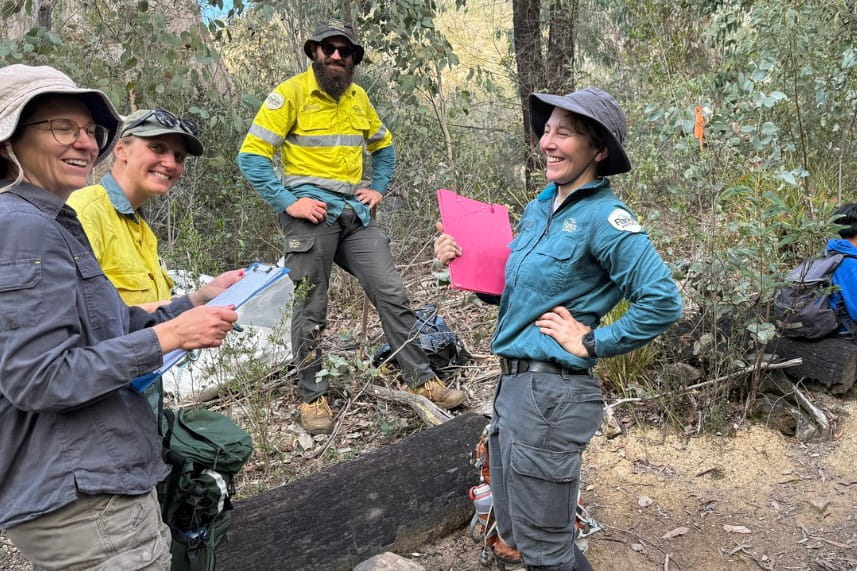 Flo pictured with others on site back in April 2026, at the first monitoring trip since the initial planting.
Climate conditions change the questions we ask
While the survival rate was the headline result, Flo says it was never the only thing they were looking for.
‘The obvious question is: did they survive or not?’ she said.
‘But that’s only part of the story.’
Every monitoring visit is also a round of data collection, helping researchers understand where the species might be able to persist into the future.
Historically, Burrowa-Pine Banksia occupied a very small and fragmented range. But conservation scientists are increasingly asking whether the places a species occupies today, are necessarily the places where it will thrive tomorrow.
Some of the translocation sites were deliberately selected to test those assumptions.
‘We planted in places that might not be optimal based on where the species currently occurs,’ Flo said.
‘Species grow where they grow because of historical and biogeographical events. Maybe they were once more widespread during a colder, drier climate and now they’ve run out of places to be except these mountains.’
Those questions are becoming increasingly important as climate conditions change.
‘We have rapid changes in temperature and rainfall patterns,’ Flo said.
‘And plants can’t move. Once they’re in the ground, they can’t just pull up stumps and walk away.’
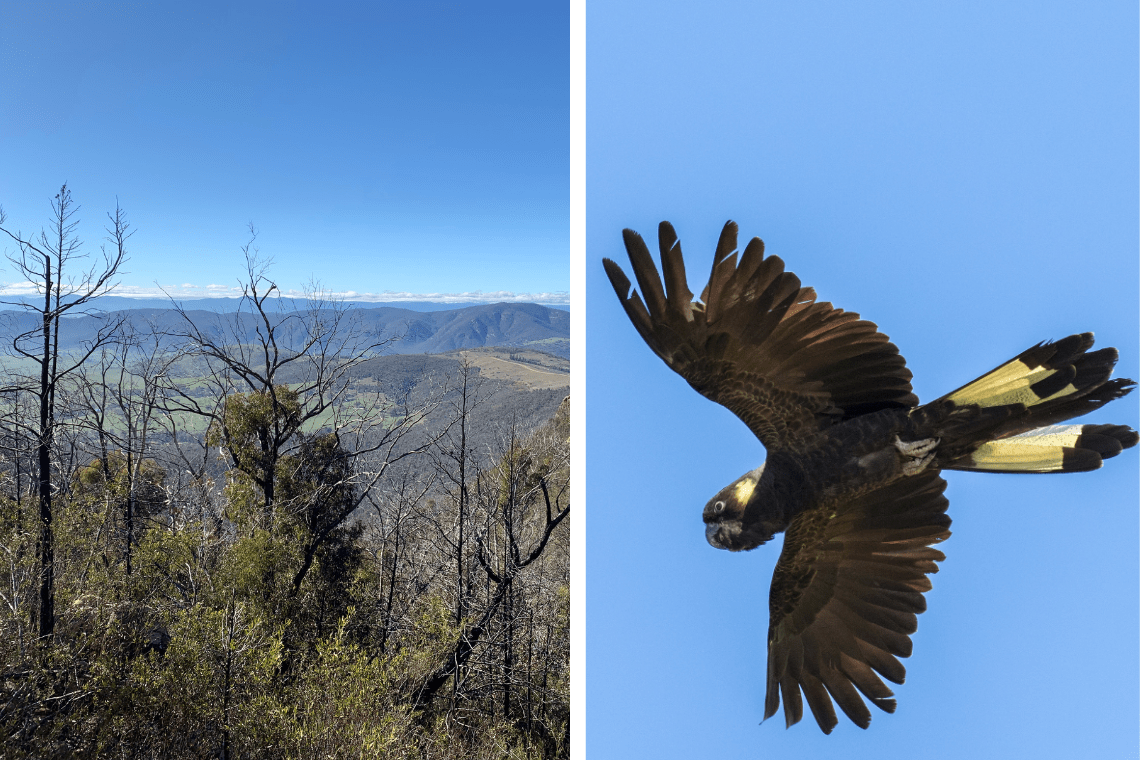
Left to right: Close to the heart of the Upper Murray, Burrowa-Pine National Park is located in Northeast Victoria. Park Ranger Team Leader Kelton Goyne suspected Mountain Banksia seeds were being devoured by yellow-tailed black cockatoos almost two decades ago.This observation would eventually lead to the Mountain Banksia restoration project.
For a species that already exists in only a handful of populations, that creates additional risk. Climate change is only one part of the picture. Historical habitat loss, fire, browsing pressure and even seed predation from cockatoos all interact to shape the species’ future.
‘The cockatoos absolutely love them,’ Flo said.
‘But then you start asking bigger questions. Why are the cockatoos hammering them so hard? Maybe they’re under pressure too. Maybe they’ve got fewer food sources available.’
For Flo, understanding those connections is just as important as counting surviving plants.
‘It’s not about one threat. It’s about understanding how all these things work together.’
A window of ‘perfect fire’
Fire adds another layer of complexity.
Like many Australian plants, Mountain Banksia has evolved with fire but requires a surprisingly narrow window between burns.
Too much time without fire and older plants become less productive. Too little time between fires and young plants don’t have enough opportunity to mature and build up seed reserves before the next blaze arrives.
‘It’s almost like they have a perfect fire window,’ Flo said.
‘Too long and it’s not ideal. Too short and it’s not ideal.’
Finding that balance is becoming increasingly difficult as fire behaviour changes and habitat becomes more fragmented.
The next challenge: avoiding becoming lunch
Surviving drought is one thing, but surviving hungry animals is another.
For now, each young Banksia is protected by a small cage while the seedlings establish.
‘Once they grow taller than those, they might get munched,’ Flo said.
One of the advantages of ongoing monitoring is that different animals leave different signatures behind.
“You can actually tell who’s doing it based on what the damage looks like.”
If deer are responsible, that could trigger additional deer control efforts.
‘Deer don’t belong in that system. Native browsers such as wallabies, are a different story. Wallabies will definitely have a nibble,’ laughs Flo.
But once the Mountain Banksias establish stronger root systems and grow beyond browsing height, occasional grazing becomes much less of a concern. For now, deer remain the team’s biggest worry.
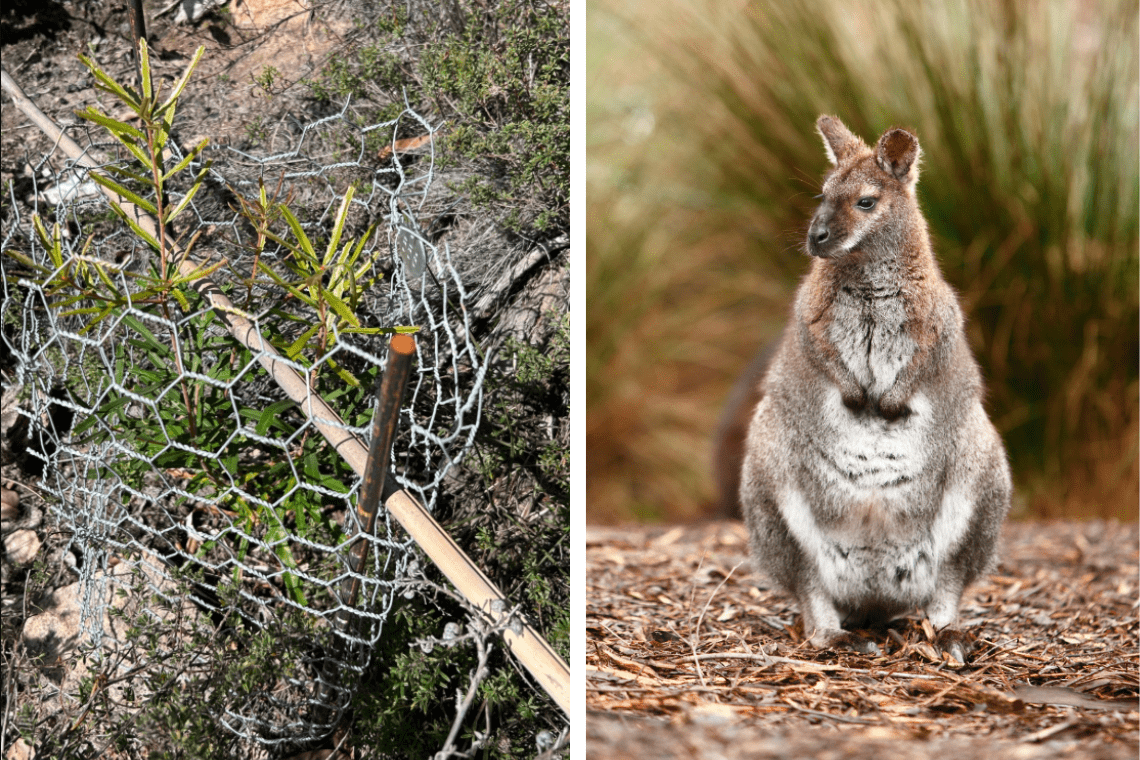
Left to right: A transplanted Mountain Banksia, overtopping its guard, Credit: Laura Simmons. Wallabies are native browsers, likely to nibble on young and vulnerable plants.
A story of hope
For Flo, the early success of the translocation is both a story of hope and a reminder of the value of deeply knowing a place.
This story really began years before the planting project, when Parks Victoria Ranger Team Leader Kelton Goyne noticed something wasn’t right with the Mountain Banksias on Burrowa-Pine Mountain.
‘What happened was Kelton knew his patch really well,’ she said.
‘He saw something was going on with these Banksias and immediately found his people and brought a team together around the problem.’
Flo is quick to emphasise that the translocation was the result of years of work by many people – from collecting seed and undertaking genetic research, to growing plants, planning, and bringing the right people together. She points to the contributions of Royal Botanic Gardens Victoria‘s Laura Simmons, Parks Victoria’s John Silins, DEECA‘s Elizabeth Wemyss, and Wild Research‘s Glen Johnson as instrumental in making this translocation a reality.
‘The community of care built around the Banksia is the real reason any of this could happen. It’s a sustained effort, requiring in-depth understanding, commitment and purpose’
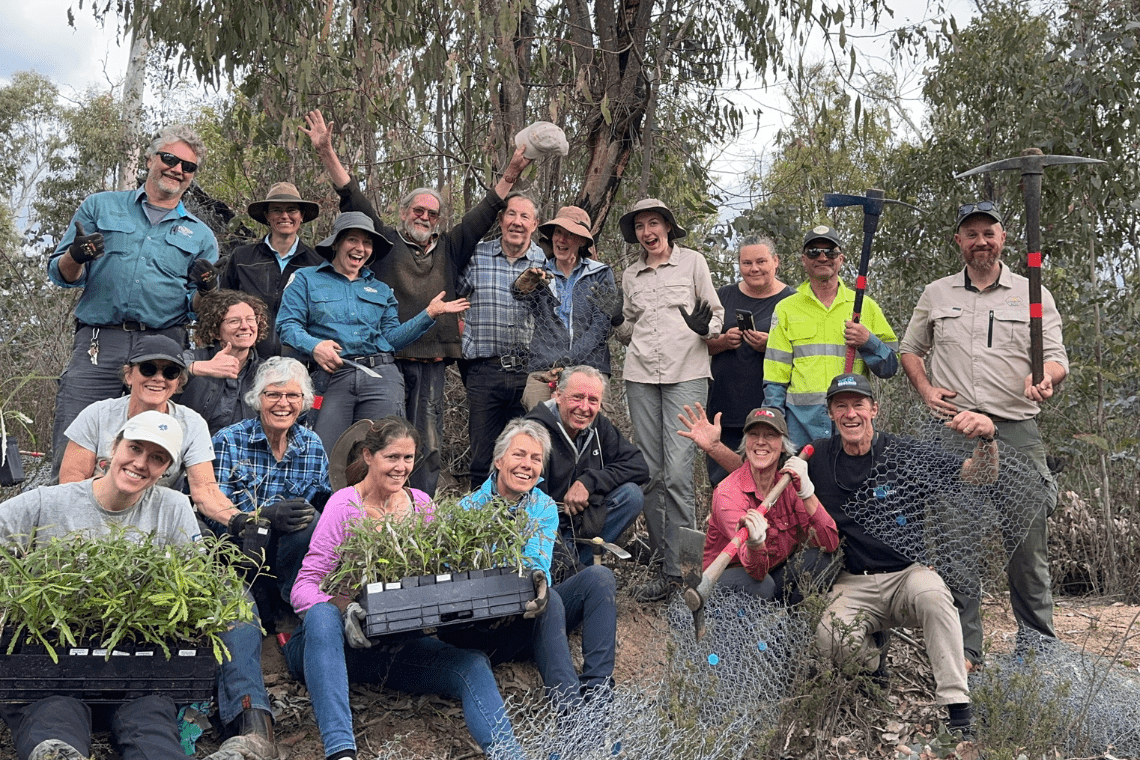
Some of the group behind the restoration project, ahead of planting back in August 2025.
The next few years will be critical. The seedlings may have survived their first summer, but they’re still in what Flo describes as their most vulnerable stage of life.
Monitoring will continue regularly over the next two years before shifting to annual check-ins, with the team watching survival, growth, browsing pressure, flowering and eventually seed production.
‘Little babies can’t fend for themselves very well, right? You need someone to look after them. It’s a bit like that.’
But Flo is optimistic about what comes next.
‘Once they establish their roots, they’ll have a lot more resilience and a lot more innate strength. They are survivors. They are battlers.’
‘They’re out here surviving freezing winters and parched summers, conditions that could kill me or you – especially if we couldn’t move!’
If all goes well, researchers expect the plants could begin producing flowers and seed within the next eight years, creating the next generation of Burrowa-Pine Banksias. The team also plans to collect seed in the future as a safeguard against future threats.
For now, the approach is simple.
‘We’re resisting extinction. We’re saying we think Banksia can persist in this landscape,’ Flo said.
‘It’s about understanding the story, and then trying to write a better ending.’