Building an accurate model of how atoms interact is a complicated process. Researchers must choose new calculations, test successive models, and track the mechanisms behind each interaction. But a newly developed AI agent called MLP Copilot has made this process much easier by bridging computational tools and scientific evidence with human supervision.
“Just like auto-pilot makes life a lot easier for pilots, our general-purpose framework is designed to make materials science more efficient, without disregarding the need for actual humans to be at the reigns,” says Hao Li, Distinguished Professor at the Advanced Institute for Materials Research (WPI-AIMR), Tohoku University.
MLP Copilot learns atomic energies and forces from quantum calculations, the models of which can go on to make larger simulations feasible. The framework’s coordination methods can be reused across materials systems, with calculations, training data, and validation tailored to each application.
The study was published as a Direct Submission in the Proceedings of the National Academy of Sciences (PNAS) on October 15, 2026.
To demonstrate the framework, the team investigated aluminum nanoparticle oxidation. These particles store substantial chemical energy, but a surface oxide shell can limit their reaction with oxygen. Understanding how that shell changes could guide future efforts to control oxidation and energy release.
Across approximately 80 active-learning iterations, the researchers assembled 88,833 atomic configurations. Uncertain configurations guided additional quantum calculations and model training. Comparisons with reference results, thermodynamic properties, and independent cluster tests helped assess the model before its use in oxidation simulations.
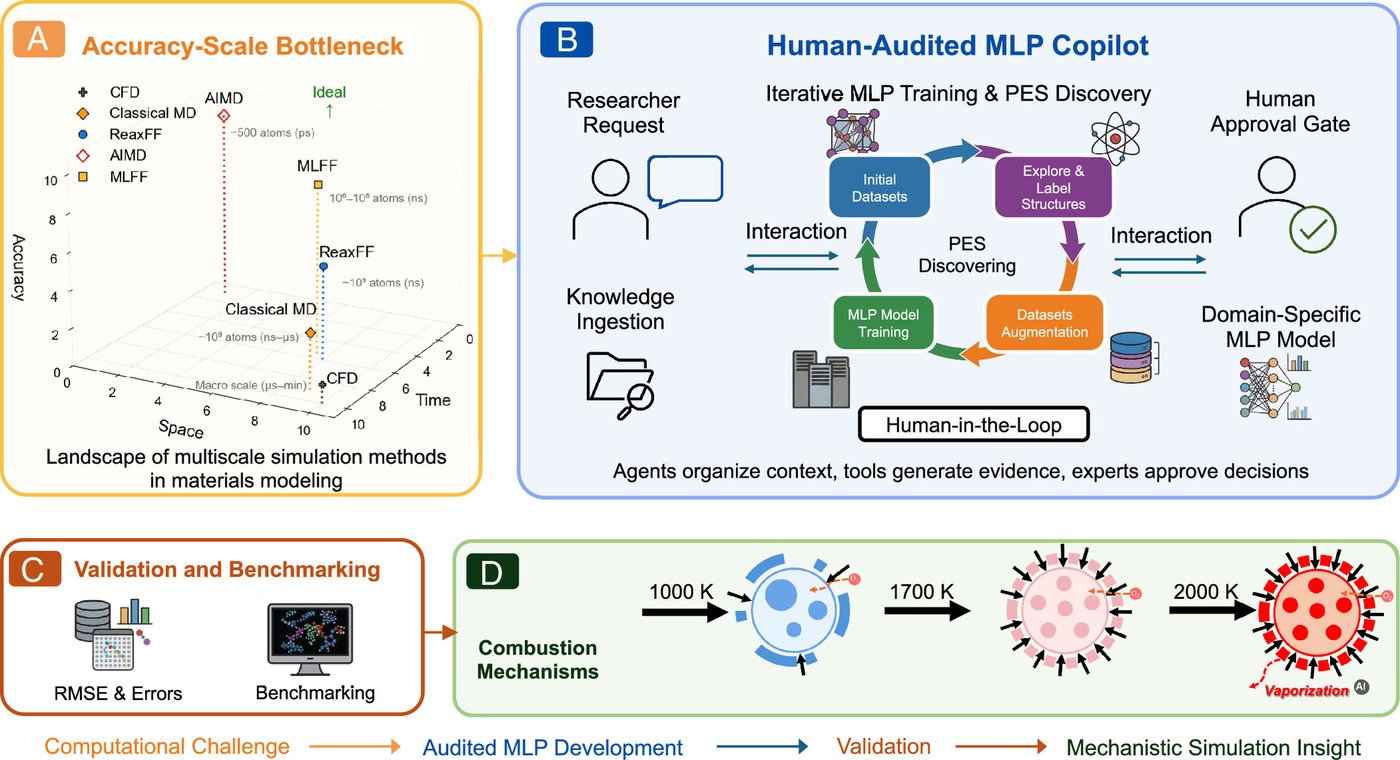
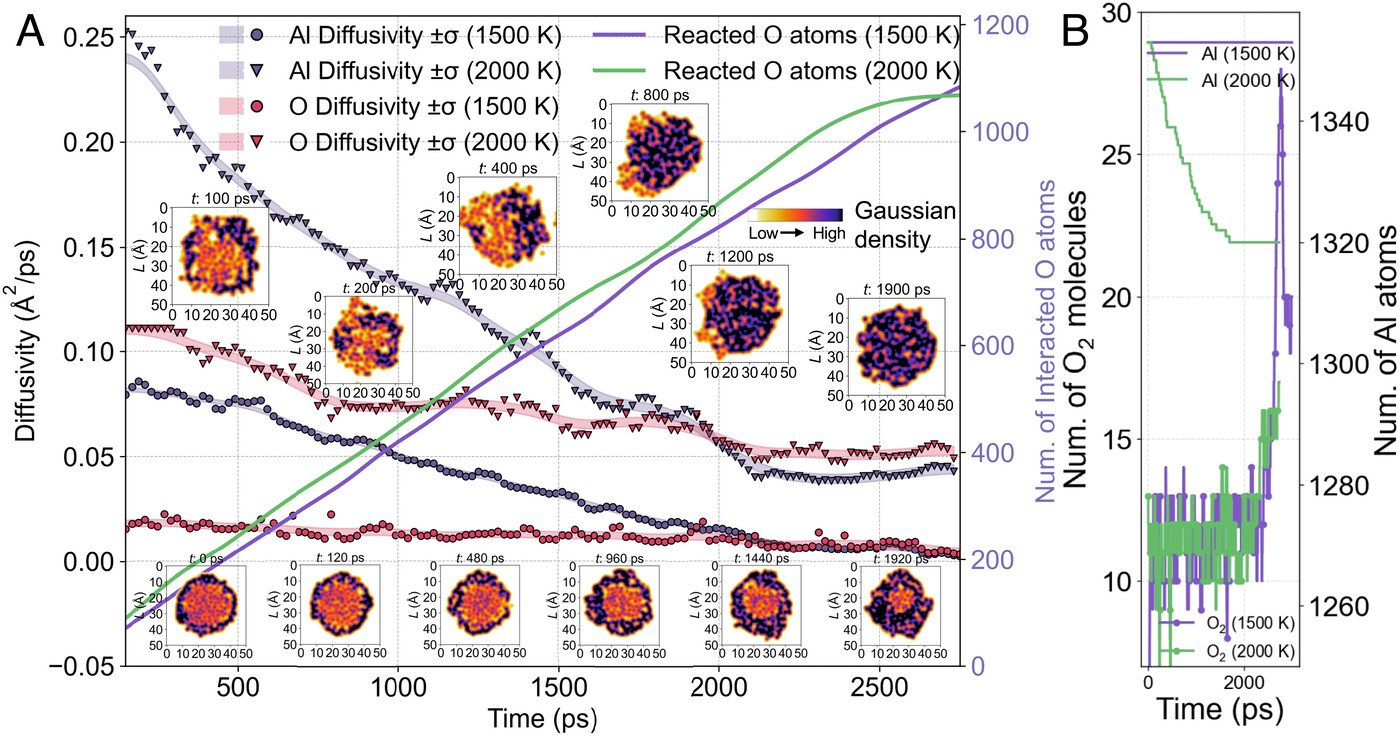
The simulations revealed two behaviors of particles with an existing oxide shell. At moderate temperatures within the study, temporary nanoscale pathways allowed oxidation to continue while limiting material transport – a “breathing mode.” At higher temperatures, shell rupture exposed the aluminum core to oxygen and accelerated oxidation. Analyses supported outward aluminum transport as the dominant pathway under the conditions studied.
Throughout the workflow, AI agents organized project knowledge, retrieved evidence, and supported validation planning. Computational tools retained datasets, model versions, and evaluation reports. Still, researchers decided which models to accept, where to use them, and how to interpret the results.
The work reflects a broader shift from using AI for individual calculations to organizing research through human-agent collaboration. Such workflows could support future research into recursive self-improvement (RSI), in which feedback improves both a system’s capabilities and its ability to make further improvements. Future agents could learn from validated outcomes to refine their planning and tool use, with each change assessed by researchers.
For materials science, the promise is that each investigation can yield both new physical insight and reusable knowledge to improve the next research cycle.
- Publication Details:
Title: Multi-AI agent framework reveals the “oxide gatekeeper” in aluminum nanoparticle oxidation
Authors: Yiming Lu, Tingyu Lu, Di Zhang, Lili Ye, Hao Li
Journal: Proceedings of the National Academy of Sciences (PNAS), 123 (42), e2537780123 (2026)