A group of engineering students spent years chasing a shared dream: to complete the first coast-to-coast American road trip fully powered by the sun. What could possibly go wrong?
Even on a sunny day in June, there are few more unspectacular places in America for a dream road trip to limp to an end than the Holiday Inn parking lot in Logansport, Indiana. This is especially true-and the sunshine especially ironic-when you’re driving a homemade solar car, attempting to complete the first solar-powered trip across America.
So it was for Kyle Samluk ’24, Danny Ezzo ’25, and Will Jones in the summer of 2021. The friends had spent nearly a year dreaming up, designing, and building what they hoped would be the first car fully powered by sunlight to complete the infamous cross-country road race known as the Cannonball Run. Conceived in 1971 by late Car and Driver editor Brock Yates and popularized in a series of Hollywood films in the 1970s and early ’80s starring Burt Reynolds, the renegade road race between New York and Los Angeles has since evolved into a self-guided contest of dodging police and suppressing bowel movements using military-grade tactical dehydration pills while averaging speeds well above any speed limit in America.
“We’re car guys, so early on during the pandemic, we started seeing reports and tales of people breaking Cannonball Run speed records, because there was no traffic,” Will says. “So we had the idea of doing a Cannonball Run in a solar car. It seemed like sort of a safe, legal way to participate in this outlaw event. We thought it might inspire people to get more interested in solar power and other alternative energy sources. Plus, no one had ever driven a solar car from New York to Los Angeles. It seemed like an epic adventure and an epic challenge.”
While the rest of the world was doomscrolling and Netflixing their way through Thanksgiving break of 2020, the three friends were maxing out the monthly Wi-Fi data at Will’s parents’ house during a marathon computer-aided drafting session. Once they had their design sussed out, they holed up in a shop in DeWitt, Michigan, and got to work. The shop belonged to Russ Pline, Kyle and Will’s math teacher at Okemos High School, from which they had graduated in 2019. Prior to housing the solar car, Pline used the space to restore vintage hot rods and campers from the 1930s.
“Just before spring break, I get a call from the guys, and they say they have an idea,” Pline recalls. “So we go out to lunch, and they’ve already designed the car. I could tell it had some shortcomings. The design-an aluminum monocoque body setup, good execution of a design-showed they lacked some experience. But there’s also just no substitute for experience. I said, ‘You guys are trying to do something big here. Shame on me if I don’t help you.'”
With Pline’s assistance, the trio built the car in a hurry and gave it a name to match their rose-colored optimism: Pink Skies. It looked like a cross between a ping-pong table and a hovercraft-and during the car’s first test run, it performed more like the former than the latter. The aluminum frame on which the solar panels were mounted was sturdy but heavy, as were the three ill-positioned motorcycle tires supporting the frame. One of the few components that did not show clear room for improvement was the maximum power point tracker, or MPPT-the electrical device responsible for converting DC power from the solar panels and delivering it to the battery powering the motor. The same MPPT had been among the best-performing elements of the first solar car that Kyle and Will had built together in high school. That car had come in second place at the annual Solar Car Challenge, an international competition for high schoolers held at Texas Motor Speedway. Pink Skies, however, gave up the ghost after a mere five miles on the test track.
With only a month left to fix major suspension issues and rebuild the entire front end of the car, the guys dove back into work. They were ambitious and enthusiastic, but their self-imposed start date of June 24 forced them to rush. They cut some corners but managed to make all the necessary repairs just in time, then tossed all the tools and spare parts they owned into the trailer and headed to New York.
“We tried to plan for everything, but at that point we had no experience with doing something crazy like that,” Danny says. “But nobody else did either. There was nothing really to learn from. So we were cautiously optimistic.”
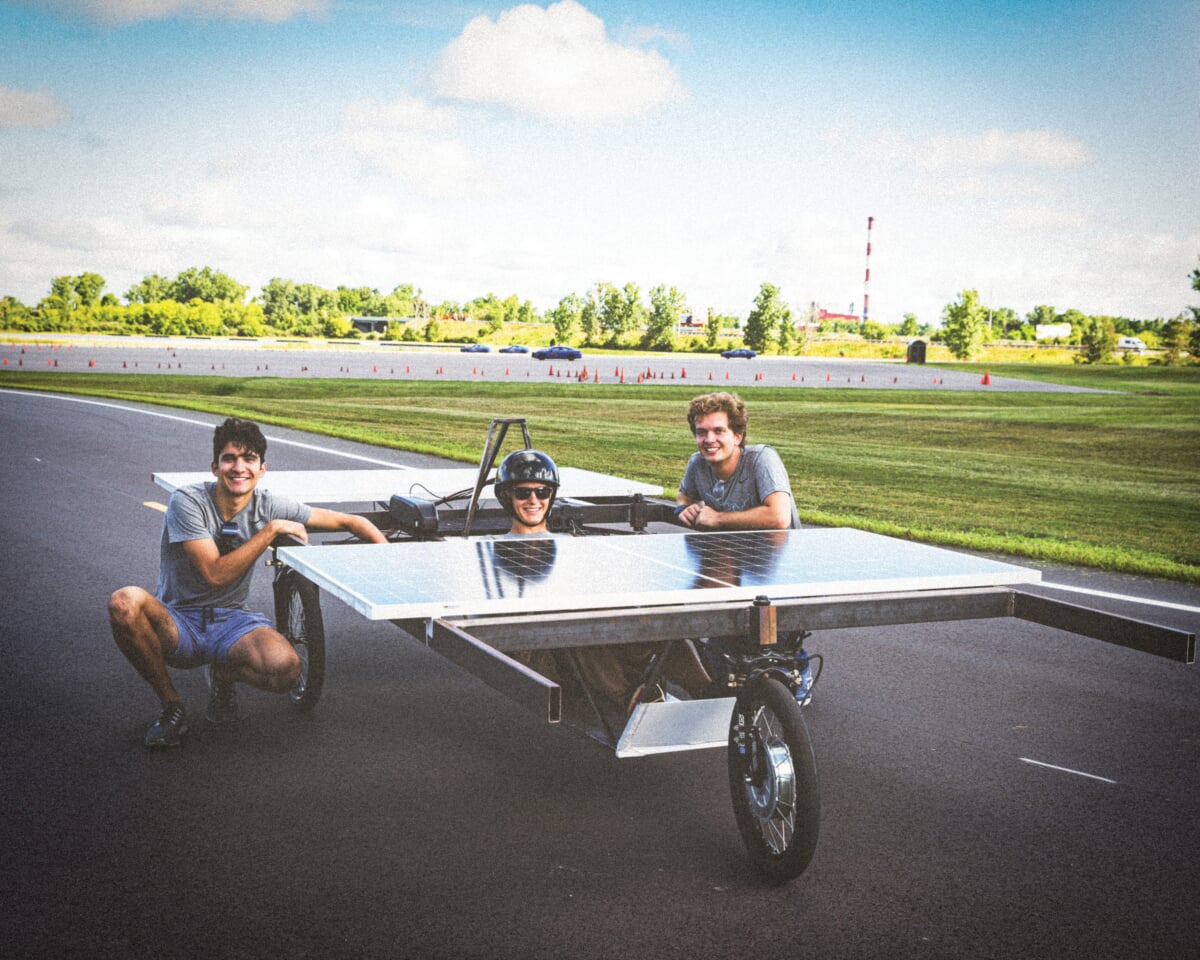
On June 24, the Pink Skies team set out from the Red Ball Garage in Manhattan. By the time they reached the Lincoln Tunnel, cautious optimism had given way to pure stress. New York City drivers were none too thrilled to be stuck in traffic behind the Jetsons’ recumbent tricycle, which cruised at speeds between 25 and 30 miles per hour.
Once out of the city, the team settled into something like a rhythm, inching their way across the highways of New York, Pennsylvania, and Ohio. Along the way, while struggling to service Pink Skies during its many roadside breakdowns, they longed for the shelter and well-stocked tool selection of Pline’s shop. By the time they crossed into Indiana-where they spent two full days dodging thunderstorms, fretting as a few essential electrical components got wet from the rain-morale was bottoming out.
Then, the death knell: In Logansport, the motor controller failed.
The team had no backup motor controller with them. Even if they had, they lacked many of the technical skills needed to install one on the fly. They shuffled the car into the parking lot at the Holiday Inn and considered what to do. Pink Skies had made it some 760 miles, but the team was still more than 2,000 miles from the finish line at the Portofino Hotel in Redondo Beach.
With the remaining distance dragging their dreams down into cold, hard reality, they made the call to scrap the attempt.
“That was pretty devastating,” says Kyle. “You spend countless hours working, only to achieve nothing, right?”
Crestfallen, they pushed the banged-up solar car into the trailer, strapped it in, closed the door, and headed north-back to Michigan. The ride home was spent in brooding silence. When they got back to DeWitt, the three friends went their separate ways and took a few weeks to lick their proverbial wounds. They reflected on all that had gone wrong. They thought about how they could have prepared better. And they considered, each in his own way, the question that eventually faces anyone who dares to chase a dream, only to come up well short of making it a reality:
Again?