Maintaining salt concentration in body fluids is crucial for fish to adapt to changing salinities. Researchers from Science Tokyo have uncovered a molecular mechanism involving Kcnj15 as a potential recycling channel in the kidneys and intestine of marine tiger pufferfish. They found that Kcnj15 expression and localization change in response to environmental salinity, providing new insights into how fish regulate electrolyte balance and adapt to different aquatic environments.
Understanding Seawater and Freshwater Acclimation in Fish
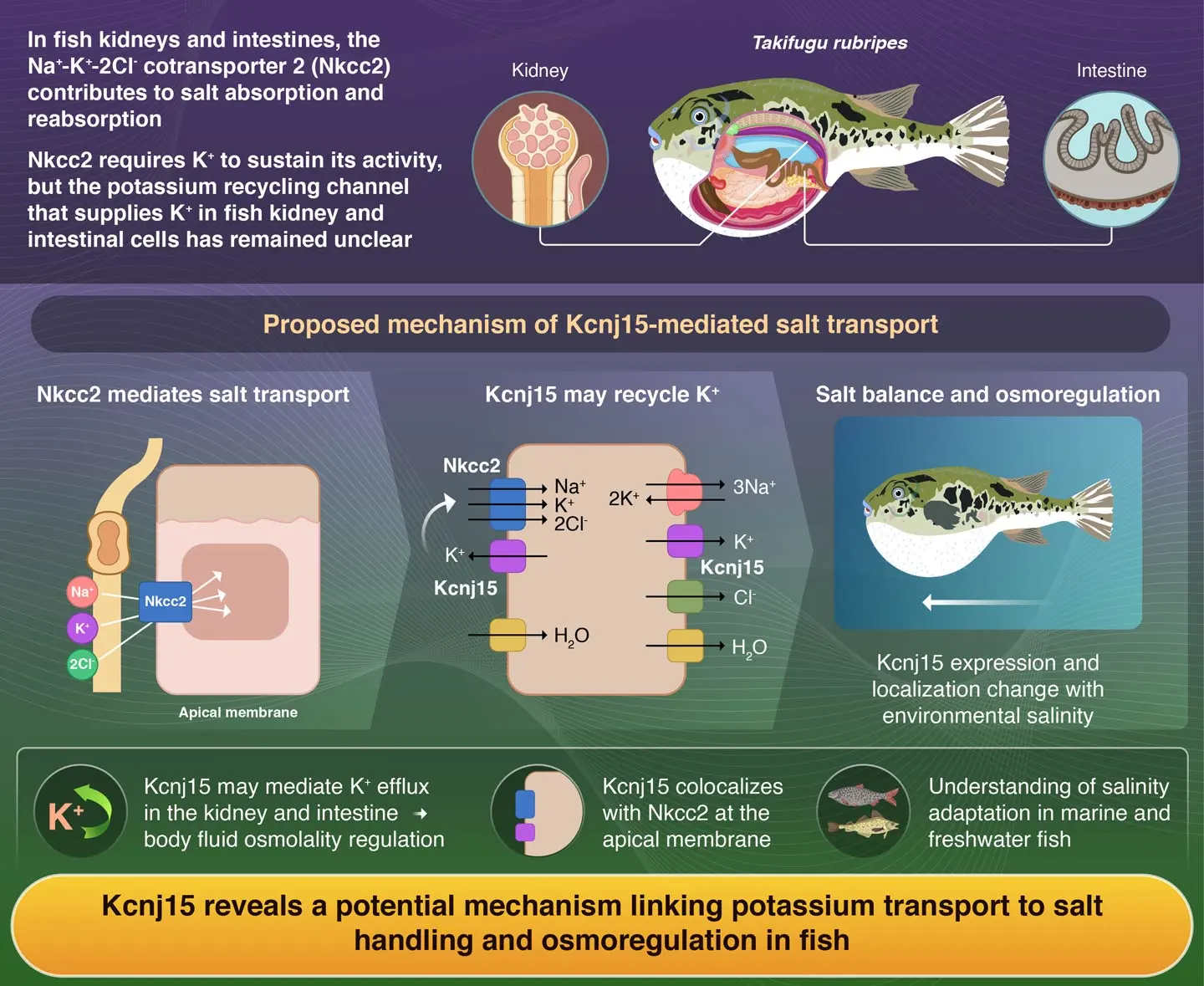
Freshwater and seawater fishes face different challenges in maintaining the balance of salts and water in their bodies. To survive these changing conditions, they rely on specialized transport proteins in organs like the kidneys and intestine to regulate electrolyte transport. However, important questions regarding the molecular mechanisms that support salt transport and acclimatization to different environmental salinities persist.
In the kidneys and intestine, the Na+-K+-2Cl– cotransporter 2 (Nkcc2) plays an important role in absorbing and reabsorbing sodium chloride (NaCl). However, the identity of the potassium (K+) recycling channel that supplies the potassium needed to sustain Nkcc2 activity has remained unclear.
Against this backdrop, a research team led by graduate student Yohei Sakamoto and Associate Professor Akira Kato of the School of Life Science and Technology, Institute of Science Tokyo (Science Tokyo), Japan, in collaboration with Professor Yutaka Suzuki of the Graduate School of Frontier Sciences, the University of Tokyo, Japan, has uncovered a new molecular mechanism involving Kcnj15, a potassium channel expressed in fish kidneys and intestines, in salt absorption, reabsorption, and osmoregulation. Their findings, made available online on September 30, 2026, and published on October 1, 2026, in Volume 331, Issue 4 of the American Journal of Physiology-Regulatory, Integrative and Comparative Physiology, demonstrate an advanced understanding of how fish acclimate to seawater and freshwater.
Kato says, “The primary aim was to understand osmoregulatory mechanisms in marine and freshwater fish.”
The researchers analyzed gene expression and immunohistochemistry results to examine the expression levels and localization of Kcnj15 and Nkcc2 in the epithelial cells of the marine pufferfish, Takifugu rubripes. They also found that unlike in mammals where Kcnj1 is known to colocalize with Nkcc2 in renal epithelia, Kcnj1 in pufferfish was expressed predominantly in the gills and was not detected in the kidney or intestine. This suggested that a different K+ channel might support Nkcc2-dependent salt transport in these organs. They found that Kcnj15 colocalizes with Nkcc2 at the apical membrane of renal collecting ducts and intestinal epithelial cells, suggesting that Kcnj15 may recycle K+ into the lumen, maintaining the potassium supply required for Nkcc2-mediated NaCl absorption. Kcnj15 was also detected in basolateral regions of epithelial cells, suggesting that its role may extend beyond apical potassium recycling.
The team further investigated how environmental salinity affects Kcnj15. When the fish were transferred from seawater to low-salinity water, the expression of kcnj15, nkcc2, and ncc increased in the kidneys. The subcellular localization of Kcnj15 also changed within renal collecting duct cells, becoming restricted to the basolateral membrane. At the same time, its localization in the intestine remained similar across salinity conditions. These findings suggest that Kcnj15 expression and membrane localization may be regulated differently across tissues to support acclimation to changing environmental salinity.
“Our lack of understanding of how marine and freshwater fish adapt to changes in environmental salinity and maintain body fluid osmolality was the main motivation of our study. Our investigations also helped understand the evolution of electrolyte transport mechanisms from fish to mammals and may provide a foundation for future studies aimed at elucidating previously unrecognized roles of Kcnj15 in salt handling and blood pressure regulation in humans,” says Sakamoto.
Together, these findings identify Kcnj15 as a potential component of the salt-transport machinery in marine tiger pufferfish and provide new insights into how fish regulate electrolyte balance in different salinity environments. Further research is needed to establish the precise role of Kcnj15 in potassium transport and determine how its movement between cellular membranes is regulated. The findings may also shed light on the evolution of electrolyte transport mechanisms from fish to mammals and aid future studies into the functions of Kcnj15-related pathways in human electrolyte and blood pressure regulation.
Reference
- Authors:
- Yohei Sakamoto1,2, Keiichiro Fujimori2, Yutaka Suzuki3 and Akira Kato1, 2*
- Title:
- Kcnj15, but not Kcnj1, localizes with Nkcc2 in the apical membranes of renal tubular and intestinal epithelial cells of marine pufferfish, Takifugu rubripes
- Journal:
- American Journal of Physiology-Regulatory, Integrative and Comparative Physiology
- Affiliations:
- 1School of Life Science and Technology, Institute of Science Tokyo, Japan
2School of Life Science and Technology, Tokyo Institute of Technology, Japan
3 Graduate School of Frontier Sciences, The University of Tokyo, Japan