It’s January 2020, and Penrith has just been declared the hottest place on Earth.
The streets lie empty beneath a relentless sun. Melted tar glimmers in the heat, and air conditioners strain, while those without access search for any relief they can find. Even after sunset, temperatures remain stubbornly high, offering little respite from the scorching day.
Six years later, extreme heat is no longer an anomaly but a reality – one that Western Sydney remains particularly vulnerable to.
As heatwaves become longer, more frequent and intense, a combination of rapid urban development, reliance on heat-absorbing materials, and a need to continue increasing tree canopy is driving higher temperatures across the region.
Concerningly, it’s only on track to get worse.
As climate change drives more extreme weather, the official declaration of El Niño for the summer of 2026 has heightened concerns about another season of above-average temperatures.
But for researchers at Macquarie University, the question is not simply how to endure hotter summers, but how we can use research to make cities more resilient.
Their solution lies in understanding the relationship between trees and recycled water.
In collaboration with Sydney Water, researchers from Macquarie University and Botanic Gardens of Sydney created a research arboretum at the Australian Botanic Garden Mount Annan, where they have spent the past three years monitoring 600 trees across 15 species to assess whether recycled water can successfully support tree growth in urban environments.
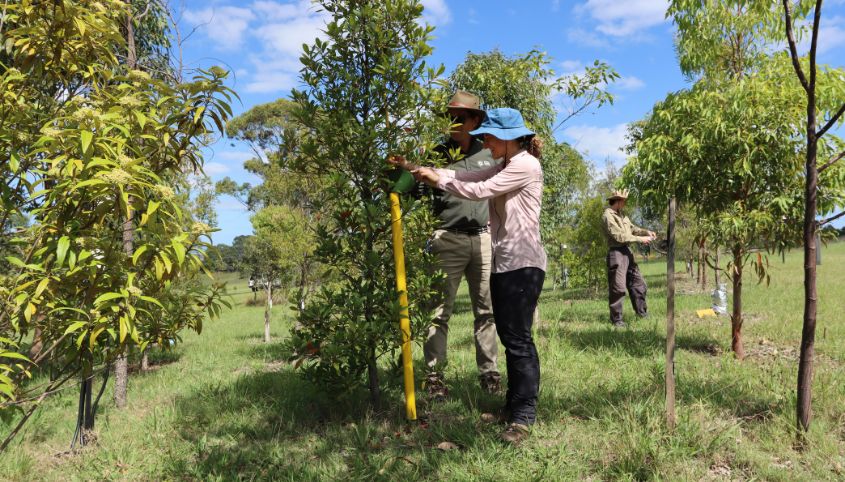 Macquarie University are testing the use of recycled water to irrigate trees, helping to cool Western Sydney. Image: Sophie Daniel (Manager Interpretation and Placemaking, Botanic Gardens of Sydney)
Dr Laura Fernandez is a Research Fellow at Macquarie University who co-leads the project along with Professor Michelle Leishman and Dr Martyna Kotowska.
Dr Fernandez explains that understanding how recycled water can support and maintain urban green space is critical – particularly in cities like Sydney, where heat and population growth are colliding – and every drop of water counts.
“Western Sydney is very hot and dry,” says Dr Fernandez.
“That means recycled water presents a valuable opportunity to irrigate parks, gardens and urban green spaces. The challenge is that there has been very little research into how recycled water affects the soil or plants themselves.”
“In this project, we planted 15 native tree species and watered half with recycled water and half with potable water. We then monitored how the trees responded over time.”
To collect this data, the team used a network of sensors across the site – building a detailed picture of how recycled water is affecting the environment and long-term health of the trees.
“Although we can’t be in the field all the time, we are able to get data every 15 minutes from a smart sensing system which measures things like air temperature and humidity as well as soil water content and salinity. We can then compare the microclimate of the plots planted with trees to the unplanted areas to see the impact of the growing trees.”
But it’s only when you step into the field that the importance of the data is visualised.
Rows of young eucalypts, paperbarks and bottlebrushes stretch across the site, their canopies gradually thickening under the Western Sydney sun. To those wandering through, it’s hard to tell which trees have been irrigated with recycled water – which, is exactly the point.
“The data is showing that, so far, recycled water is not having a negative impact on soil salinity or on tree growth, and the growing urban forest is reducing ambient temperature,” says Dr Fernandez.
The project is also seeking to build a stronger connection between the community and the resources that sustain the city.
In collaboration with Sydney Water and Botanic Gardens of Sydney, researchers have developed educational signage and a Flow Trail at the Australian Botanic Garden, allowing visitors to build greater awareness of the role water and trees play in adapting to a warmer future.
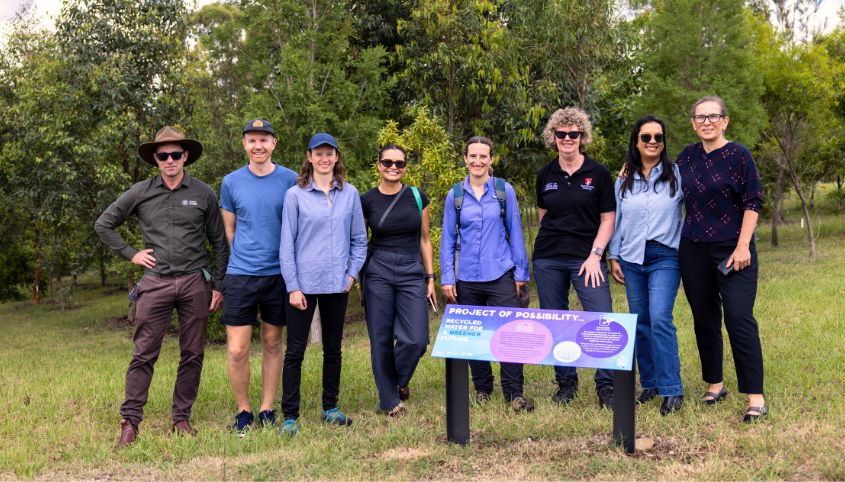
Mike Elgey, Manager of the Australian Botanic Garden Mount Annan, Distinguished Professor Michelle Leishman, and staff from Sydney Water. Image: Sophie Daniel (Manager of Interpretation and Placemaking at Botanic Gardens of Sydney).
“There are 11 signs around the garden, and two at the Arboretum, with QR codes, to help people understand how important water is, but in particular, water in Western Sydney.”
With El Niño looming and another hot summer on the horizon, the researchers are now turning their attention to the next phase of the project.
Recently extended until 2028, the trial will continue to explore how different species respond, grow and thrive – helping to grow hope for Western Sydney setting a different kind of record: not for how it became the hottest place on Earth, but for how it learned to stay cool.
“As we move into summer, we’re considering what other variables are important to understand the impact the recycled water is having,” says Dr Fernandez.
“We’ve also changed how we’re using the sap flow sensors. Initially, we installed them on one species for a week and then moved them to another species. This summer, however, we’re testing five species simultaneously to compare how they respond to the same temperature conditions.”
“The past summers have been quite wet and mild, so it will be fascinating to see the impact of the more extreme summer conditions that are expected under the coming El Niño period.”
The findings will be shared through industry conferences and scientific publications, as well as with partners such as Sydney Water, to help guide landscape managers, horticulturalists and urban planners in selecting resilient species and optimising irrigation for Western Sydney’s future.