Four research teams involving five Max Planck scientists will receive around 40 million euros in EU funding for their projects

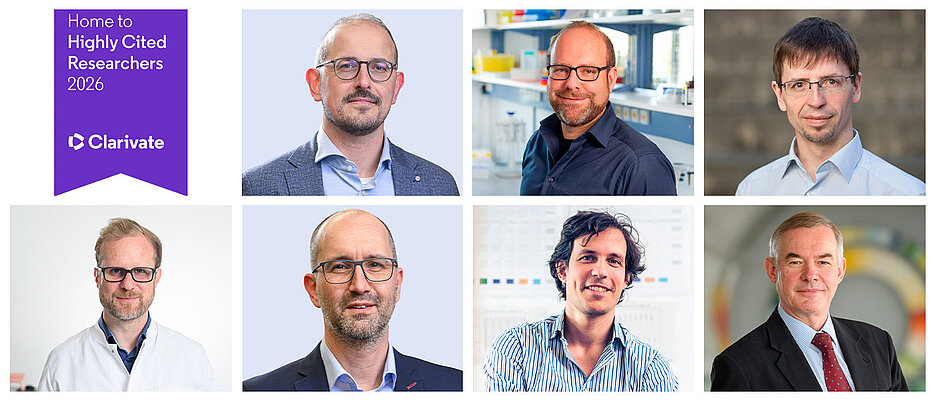
The grantees, clockwise (from left to right): Guido Meier (MPI for the Structure and Dynamics of Matter), Alissa Mittnik (MPI for Evolutionary Anthropology), Markus Werkle-Bergner (MPI for Human Development), as well as the team led by Stefan Raunser (MPI for Molecular Physiology) and Gerhard Hummer (MPI of Biophysics)
© Composite image: MPG
This year’s five ERC Synergy Grantees from the Max Planck Society have big plans: they want to find out how recurring everyday activities, such as grinding grain, weaving textiles or working with metal, gradually became associated with a particular gender. They are researching how proteins respond to electric fields, how the brain stores experiences of inflammation and how these memories shape later responses of the immune system, or how muscle cells work at the molecular level.
An overview of the projects
- Have men always gone hunting and women gathering? Was pottery ‘women’s work’ and metalworking ‘men’s work’? Alissa Mittnik of the Max Planck Institute for Evolutionary Anthropology in Leipzig and her colleagues Katharina Rebay-Salisbury (University of Vienna), Laura Dietrich (Austrian Academy of Sciences) and Fiona Jordan (University of Bristol) aim to get to the bottom of these questions with the ERC-funded project ‘GenderTech’. To do so, they look far back into Europe’s past. The project spans the period from the Neolithic to the Iron Age and examines how the tools people used, and the work they carried out, shaped entire societies. By combining archaeology, genetics, biomechanics, osteology and cross-cultural anthropology, the team aims to reconstruct how recurring everyday activities, such as grinding grain, weaving textiles or working with metal, gradually became associated with a particular gender, and what effects this had on power and status in early European communities.
- How do proteins respond to electric fields? Proteins are the building blocks of life, and important docking sites for pharmaceutical compounds. Understanding how proteins function and respond to external stimuli therefore opens up new possibilities for pharmaceutical research. Four researchers, among them Guido Meier of the Max Planck Institute for the Structure and Dynamics of Matter (MPSD), have now been awarded a prestigious ERC Synergy Grant to study how proteins respond to electric fields. The new method is to be developed and tested first at SwissFEL, the Swiss X-ray free-electron laser of the Paul Scherrer Institute (PSI), before being transferred to further large-scale research facilities. For this purpose, Meier’s team will develop the precision electronics that deliver fast, well-defined electric field pulses to the protein crystals. Also involved are John Beale of the PSI Center for Photon Science, Doeke Hekstra of Harvard University, Thomas J. Lane of the German Electron Synchrotron (DESY) in Hamburg, and Guido Meier of the MPSD in Hamburg.
- Is there such a thing as an immune memory? The neuroscientist Markus Werkle-Bergner of the Max Planck Institute for Human Development has been awarded an ERC Synergy Grant, together with three international research partners, for the project ‘Immune Memory’. Together with Tomás Ryan of Trinity College Dublin, Staci Bilbo of Duke University and Claudia Buss of Charité – Universitätsmedizin Berlin, Werkle-Bergner is investigating how the brain stores experiences of inflammation and how these memories shape later responses of the immune system. At the heart of the project is the question of how early-life experiences influence the interactions between the brain and the immune system, and what consequences this has for health and development later in life.
- Watching muscles at work. Our heart beats around 100,000 times every day, without a break, for a whole lifetime. A European research team now wants to make visible what happens in the heart’s muscle cells, right down to the individual molecule. The MAROCO project involves Stefan Raunser of the Max Planck Institute of Molecular Physiology in Dortmund, Gerhard Hummer of the Max Planck Institute of Biophysics in Frankfurt am Main, Anne Houdusse-Juillé of the Institut Curie in Paris and Fan Liu of the Research Institute of Molecular Pathology (IMP) in Vienna. “So far, we have only seen muscle at the molecular level in still images,” says project coordinator Stefan Raunser. “Now we want to capture it in motion for the first time.” This knowledge is urgently needed. Cardiovascular diseases are the most common cause of death worldwide. Many hereditary heart and muscle disorders arise because a single building block of the muscle machinery is altered.
The 2026 funding round at a glance
ERC Synergy Grants fund research projects that can only be realised through close collaboration among several scientists with complementary expertise. For the current call for proposals, 957 applications were received. Forty-eight international research teams were selected and will share a total of 500 million euros in funding.
In an international comparison, the Max Planck Society ranks fourth among host organisations. As in the previous year’s call for proposals, the French CNRS leads the ranking with nine grants. The Helmholtz Association is in second place with seven grants, followed in third place by the University of Oxford with five grants.