Understanding and predicting new phenomena in crystals with quantum geometry. This is the goal Dr Johannes Mitscherling is working towards. He is establishing a new Emmy Noether Group at the University of Würzburg.
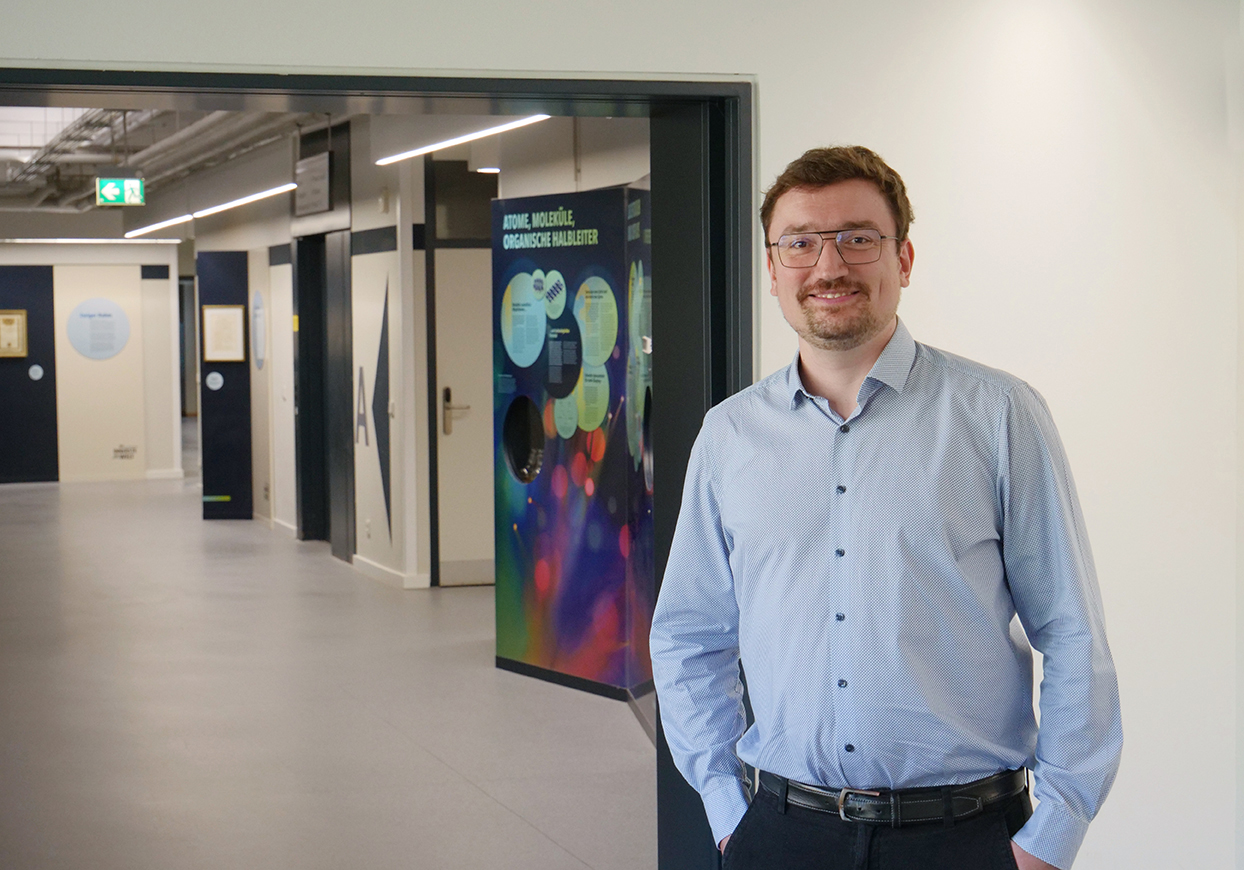
Dr Johannes Mitscherling has been establishing a new Emmy Noether Group at the University of Würzburg since August 1st, 2026, which is based at the Chair of Theoretical Physics IV. Together with his team, the theoretical solid-state physicist will investigate novel quantum materials and the associated phenomena using geometric methods. Most recently, he conducted research in the groups led by Dr Libor Šmejkal at the Max Planck Institute for the Physics of Complex Systems in Dresden and Professor Joel Moore at the University of California, Berkeley, USA.
The German Research Foundation (DFG) is funding the work of Dr Mitscherling and his group with 1.9 million euros over the next six years. Through the Emmy Noether Programme, the DFG enables outstanding researchers to qualify for a university professorship early in their careers by leading their own research group.
Focus of the new group: Geometric quantum matter
“It is impressive to see the experimental progress that has been made in quantum simulators and materials research in recent years. Researchers are now able to specifically generate and control the wave functions of electrons. To better understand and predict the quantum physics of these systems, we need intuitive yet quantitative theoretical methods that go beyond the global properties of the wave functions – their topology,” says Dr Mitscherling, describing the motivation behind his work.
His group is moving closer to this goal by combining established concepts from solid-state physics with ideas from geometry and quantum information. The aim is to find materials whose wave functions exhibit particularly unconventional geometric properties.
Geometric classification of wave functions aims to predict new phenomena in crystals
“The atoms and symmetries of a material constraint which quantum states the electrons can assume. We interpret and analyse the totality of all possible states geometrically. We ask ourselves: do the states form rings or spheres? How far apart are they? How are they distributed across the state space? These properties give us clues, for example, as to whether a material is particularly good at converting light into electricity,” says Dr Mitscherling, explaining his group’s geometric approach.
The new group has an ambitious goal: it aims to develop a complete geometric classification of wave functions for crystalline systems.
“With this classification, we will be able to predict much more accurately which materials are the most promising – for photovoltaics, for example – and how their properties can be specifically induced and controlled by external influences, such as pressure or light. In this way, we are approaching the very exciting many-body and non-equilibrium physics, as observed in experiments, in a systematic and controlled manner.”
Dr Mitscherling is focusing in particular on two fields of research: unconventional magnetism, for example in altermagnets, and materials with exotic quasiparticles in two-dimensional heterostructures.
Close collaboration planned with the Würzburg physics departments and the ctd.qmat Cluster of Excellence
The new Emmy Noether Group will be closely integrated into the research landscape in Würzburg. The University of Würzburg has made a name for itself internationally, particularly in the field of topological quantum materials.
“Whilst topology provides important insights into the overall shape of wave functions, quantum geometry enables us to characterise wave functions in much greater detail. We are delighted to be able to contribute this new approach through close collaboration at the University of Würzburg and within the framework of the Würzburg-Dresden Cluster of Excellence ctd.qmat, and to benefit from the strong local expertise,” emphasises Dr Mitscherling.
The new group leader’s career
Johannes Mitscherling, born in 1991, grew up in Mönchengladbach. From 2011, he studied physics at RWTH Aachen University. During an Erasmus placement in Paris and as part of his Master’s thesis at the Jülich Research Centre, he specialised in theoretical solid-state physics. For his doctoral thesis, the scientist moved to the Max Planck Institute for Solid State Research in Stuttgart in 2016, where he completed his PhD in 2021 with the distinction ‘summa cum laude’.
For his initial ideas on quantum geometry, Johannes Mitscherling was awarded the DFG’s Walter Benjamin Fellowship and the postdoctoral fellowship from the German National Academy of Sciences Leopoldina. This funding enabled him to conduct research as a Leopoldina postdoctoral fellow at the University of California, Berkeley, USA, from 2022 to 2024. He subsequently returned to Germany to the Max Planck Institute for the Physics of Complex Systems in Dresden. There, he successfully secured funding for his Emmy Noether Group.