Key points
- Gold is Australia’s second most valuable mineral export commodity after iron ore.
- With widespread gold-bearing geology, Australia is one of the largest gold producers in the world.
- CSIRO’s exploration tools are helping industry discover gold faster and more sustainably, including beneath soil, sediment and weathered rock cover.
Gold has long held a special place in Australia’s history, shaping the nation’s economic fortunes and driving waves of migration since the 1850s gold rushes. Today, Australia stands as one of the world’s largest gold producers , with the precious metal a key driver of both regional development and national prosperity.
As global uncertainty rises, gold has once again come into sharp focus. Prices have reached record highs, driven by geopolitical instability and a search for safe‑haven assets.
But beyond markets and history, Australia’s gold story is fundamentally a geological – and scientific – one.

Gold’s role in the world today
Gold is often described as a commodity, but its role is unusual. Unlike many metals, relatively little gold is consumed in industrial processes. Instead, its value lies in trust, stability and longevity.
CSIRO Research Director, Dr Sandi Occhipinti , understands the influences on gold demand are deeply human.
“Gold is literally just a currency,” said Dr Occhipinti.
“When we’re really uncertain with what’s going on in the world, when we feel unsettled, we switch to gold because it’s a safe haven. It’s something physical you can hold on to.”
While gold is used in high‑end technologies, electronics and medical applications, those uses account for only a small proportion of global demand. The majority of gold is held as bars, coins or jewellery, valued because it does not corrode, degrade or lose its physical integrity over time. That durability is one reason gold has retained cultural and economic significance across civilisations.
Why Australia is so rich in gold

Australia’s importance as a gold producer is no accident.
“We have one of the richest gold resources globally because of our geology,” said Dr Occhipinti.
Gold does not occur randomly in the Earth’s crust. Its distribution is controlled by deep geological processes that played out billions of years ago and some of the world’s best examples of those conditions are in Australia.
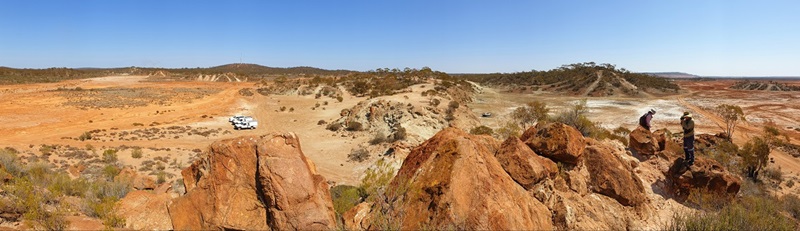
Much of Australia’s gold endowment is linked to very ancient parts of the continent, particularly Archean cratons such as the Yilgarn and Pilbara in Western Australia. These regions formed when the Earth itself was very different.
“The Earth was still evolving,” Dr Occhipinti explained.
“The atmosphere was different. There wasn’t enough oxygen in the atmosphere to breathe and sustain life as we know it. A lot of different metals were moving within the Earth at that time and gold is just one of them.”
Gold is typically transported by hot, metal‑rich fluids moving through fractures and structures in the crust. Under the right pressures, temperatures and chemical conditions, gold precipitates out of those fluids and becomes concentrated in deposits.
In regions like the Yilgarn Craton, those conditions were exceptionally favourable.
“The gold fertility in parts of Australia is extraordinarily high compared to other parts of the world,” Dr Occhipinti said.
Different parts of Australia host gold for different geological reasons. In some regions, gold formed deep in the crust and was later preserved as rocks that were uplifted and eroded. In others, younger tectonic processes created pathways for fluids to move and deposit gold. The result is no single story but a continent‑wide tapestry of geological opportunity.
Beyond a lucky find
For much of history, gold exploration relied heavily on luck and surface clues. But modern geoscience has overturned the idea that gold is simply a chance find.
“That’s one of the myths because there is a science behind why gold is where it is. That evolution is what we try to understand,” said Dr Occhipinti.
As easily discovered deposits are mined, Australia’s remaining gold resources are increasingly hidden beneath soil, sediment or rock cover. Finding them requires more sophisticated tools and a deeper understanding of geology.
Finding gold faster and with less environmental impact
CSIRO has spent decades developing tools to help industry find high‑quality gold deposits more efficiently and with less environmental disturbance.
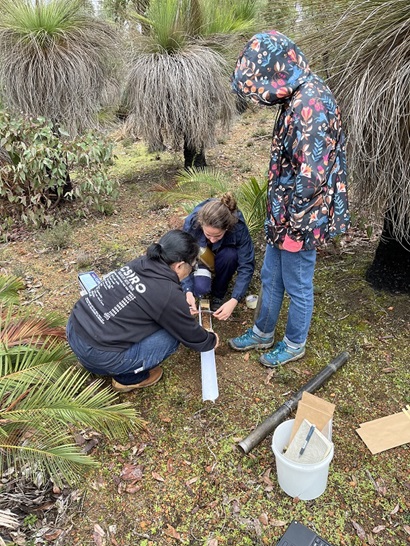
One major shift has been moving beyond chemistry alone to focus on mineralogy, where understanding how minerals change around a deposit can be used to guide exploration.
“Sometimes the geochemistry doesn’t change much around a deposit,” said Dr Occhipinti.
“It’s the mineralogy that alters. The elements reorganise themselves into different minerals, and that’s the footprint we can use to point us towards deposits.”
Technologies such as UltraFine+‑based geochemical methods , scanning electron microscopy (SEM) and laser‑induced breakdown spectroscopy (LIBS) have allowed CSIRO and its partners to detect subtle signals associated with gold systems.
The value extends beyond discovery. In operating mines, better mineralogical understanding helps companies model ore bodies more accurately, understand ore variability and improve processing outcomes, lifting the overall value of a deposit.
Finding gold can unlock critical minerals
Gold is often discussed separately from critical minerals but underground they are frequently linked.
“Sometimes gold is associated with critical minerals,” said Dr Occhipinti.
“If you look at the Victorian goldfields, there’s a lot of arsenic associated with gold. But we didn’t look for those deposits to find arsenic. We looked for gold.”
Rather than forming economic deposits on their own, many critical mineral elements occur within larger mineral systems.
“Critical minerals are mostly by‑products and co‑products of other commodities such as gold,” she said.
Gold’s strong economics can therefore play an enabling role, allowing critical minerals to be recovered where they occur together. In this way, gold enhances Australia’s broader resource capability rather than competing with critical minerals.
The next frontier for gold exploration

Despite its long history, gold exploration still faces major challenges, particularly exploring beneath cover and at depth.
“Exploring beneath consolidated cover at scale brings significant challenges,” said Dr Occhipinti.
Future progress will depend on integrating multiple data types – geophysics, geochemistry, mineralogy and modelling through time – into unified exploration frameworks. It will also require collaboration.
“We need multi‑sponsored projects, shared data and test sites that allow industry and researchers to tackle big problems together,’ said Dr Occhipinti.
Predictive modelling, including understanding how geological processes evolved over billions of years, will play an increasingly important role.
“What we find now may not be mined for many years. We need to think now for the future.”