As climate change and widening inequality intensify, economists are increasingly questioning whether endless economic growth is compatible with a healthy society and a finite planet.
Author
- Junaid B. Jahangir
Associate Professor, Economics, MacEwan University
The degrowth movement has put this question at the centre of public debate. Advocates such as anthropologist Jason Hickel argue that we need to move away from the pursuit of ever-increasing production and consumption and towards meeting human needs within ecological limits.
But this line of economic thought has a much longer history than the contemporary degrowth movement.
Islamic economics , a largely overlooked tradition in the West, has long placed limits on consumption, condemned the concentration of wealth and treated economic activity as a matter of morality.
As a specialist in heterodox economics education, I think this tradition offers a useful way to reconsider some of the assumptions that underpin modern economics.
What is Islamic economics?
There is no single definition of Islamic economics. One scholar, Asad Zaman , notes there are about 30 definitions .
It’s sometimes described as as a form of capitalism without interest (known as riba), combined with zakat, or wealth tax. But that description misses much of what Islamic economics is concerned with.
The field has developed through several generations . Early Islamic economists initially responded in part to European colonialism, seeking to articulate an economic system rooted in Islamic values. A later generation worked within capitalism, giving rise to the field of Islamic finance . More recent thinkers have returned to the broader questions of Islamic values and morality.
These values include moderation ; the recognition that the poor have rights to shared wealth ; and that wealth should not circulate among the rich . Greedily amassing wealth , being stingy with it and not urging the feeding of the poor are condemned. The Qur’an challenges the idea that more necessarily means success .
I would define Islamic economics as provisioning the needs of people, informed by values from the Qur’an and Sunnah (prophetic practice), without inducing economic imbalance, ecological damage or inequity.
Here, the consumer avoids israf (extravagance) and tabzir (waste). The producer centres service over profits. And the central problem is distribution, not growth. This is where Islamic economics connects with contemporary debates about degrowth.
An overlooked economic history
Much of the history of Islamic economic thought has been overlooked in the West. Histories of economics often move from ancient Greece to European scholasticism and then to modern European economists, giving relatively little attention to Muslim thinkers.
But scholars like Islamic economist Abdul Azim Islahi challenge Joseph Schumpeter’s “Great Gap” thesis , which leaves little room for Muslim contributions between the Greeks and European economists.
As he explains, Christian scholastics did not cite Islamic sources, and instead redacted Muslim scholars, inserted their own names, viewed Islam and Muslims with contempt and exaggerated their dependence on Greek heritage.
Both Islahi and the late economist Muhammad Umer Chapra highlighted the work of Muslim thinkers whose contributions have received relatively little attention.
The Persian scholar and polymath Al-Ghazali (c. 1058-1111) used needle-making to illustrate the division of labour, centuries before Adam Smith’s famous pin-making example . He also argued that rulers should be “crane slayers, not sparrow slayers” when taxing; in other words, take nothing from the poor.
Ibn Taymiyyah (1263-1328) discussed prices in terms of supply and demand and argued that intervention could be justified where there was injustice or market power.
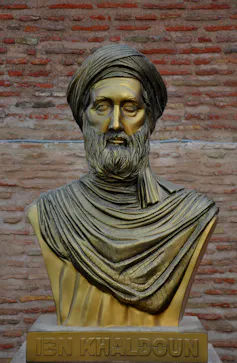
Likewise, Ibn Khaldun (1332-1406) considered prices in terms of supply and demand, in contrast with 18th and 19th-century European thinkers who focused on the labour cost of production. He was the forerunner of economic ideas including division of labour, specialization and comparative advantage.
Other economic ideas appeared much earlier. Abu Yusuf , writing in the 8th century, critiqued flat taxation, while Abu Abd Allah al-Shafi’i wrote on ideas later associated with diminishing marginal utility.
What happened to the Muslim world?
If Islamic economics is so great, then why did parts of the Muslim world experience economic decline? As with all things related to history, there are multiple answers, and even the meaning of “stagnation” is contested.
Timur Kuran argues that egalitarian inheritance laws, the lack of corporations and the inflexibility of awqaf (Islamic trusts) contributed to economic stagnation. He argues that the rigidity of Islamic institutions became a constraint on their ability to adapt to a changed world.
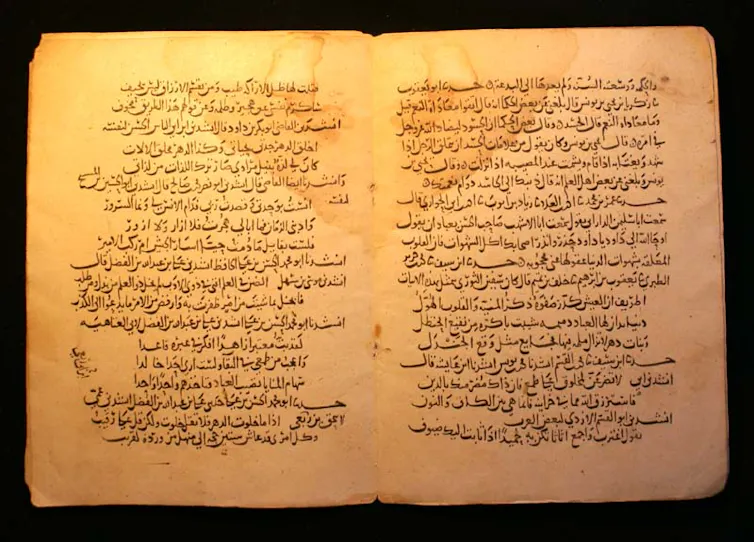
However, economist Arshad Zaman counters that growth cannot be the sole criterion of development. Lower growth may be acceptable if it produces a higher quality of life, and privileging equity over commerce is not necessarily a weakness. He also points to military technology, colonialism and slavery in explaining western economic success, as well as the colonial dismantling of Islamic institutions.
Chapra, meanwhile, looks within the Muslim world. He points to a lack of political accountability, excessive military campaigns, court extravagance and neglect of education and well-being as factors in economic decline.
These competing explanations show that Islamic economics is not a single, settled doctrine. It is a contested intellectual tradition, with disagreements over markets, institutions, development and even the meaning of economic progress.
An alternative to limitless growth
Despite criticisms and its internal disagreements, Islamic economics offers an alternative to mainstream capitalist economics and rampant growthism .
For a world facing climate change and widening inequality, it provides a useful starting point for rethinking what we mean by economic progress.
Islamic economics offers a distinctive challenge to some of the assumptions of mainstream economics. It condemns the concentration of wealth, promotes moderation and condemns exploitative and extractive systems. It shifts the focus from consumerism towards values and morality.
Most importantly, it questions whether growth should be treated as an end in itself. Economic activity, in this tradition, is about meeting human needs, distributing wealth fairly and avoiding waste and excess. It is not just about economic governance , but also about small acts of kindness and inner moral transformation.