The story of the universe is written across the cosmos.
It carries the markings of its birth in ancient light, the remnants of dead stars that live within our bodies, and clues to its evolution scattered across billions of galaxies like celestial time capsules.
And yet, one chapter remains largely unwritten.
In the first fractions of a second after the Big Bang, the universe existed in an unimaginably hot and dense state, with the fundamental particles and forces that govern everything – from galaxies to human life – only beginning to emerge. These earliest moments continue to pose some of the deepest questions in modern physics, mysteries scientists have spent decades trying to understand.
That search has led beneath the Swiss French border, where the Large Hadron Collider – the world’s most powerful particle accelerator 100 metres underground in a 27-kilometre tunnel, – centred on a detector the size of a three-storey building.
It is one of humanity’s most ambitious scientific instruments, bringing together thousands of physicists, engineers and computer scientists from more than 70 countries, all working towards a shared goal: understanding how the universe came to be by recreating the conditions of its earliest moments.
Among those contributing to that global effort is Macquarie University.
Recently granted Technical Associate Membership of CERN’s LHCb experiment, Macquarie has joined an international collaboration developing the next generation of particle detector technology.
A/Professor Jafar Shojaii is leading the University’s contribution, designing semiconductor chips that will sit just millimetres from where particles collide. For Dr Shojaii, the collaboration reflects the level of expertise that has established Macquarie as an international leader in semiconductor technology.
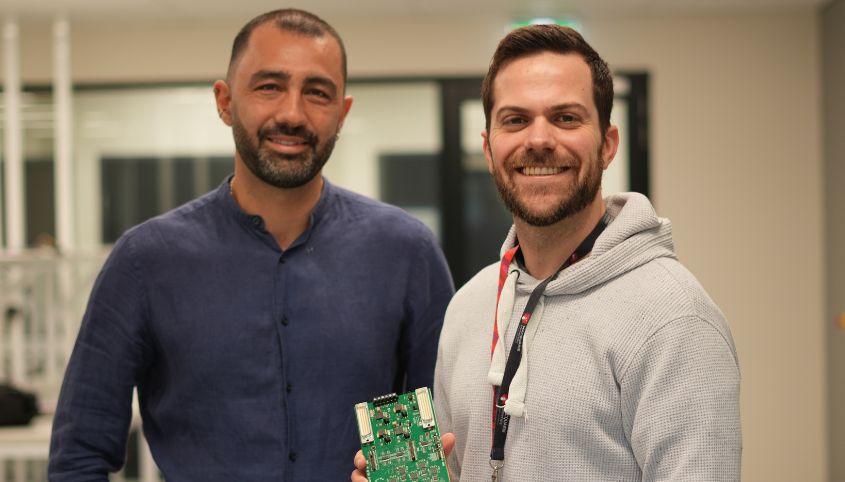
Left: Professor Jafar Shojaii, who is leading Macquarie University’s Technical Associate Membership of CERN’s LHCb experiment. Right: Dr Andrea Mazzanti, a postdoctoral researcher and member of the team. Photo: Amy Shidiak
“CERN selected us to deliver this project, and becoming an official technical member shows that we are one of the leading universities in chip design internationally,” A/Professor Shojaii explains.
“Macquarie is unique in that it is the only Australian university with a strategic research priority in semiconductor technology. There is no other university in Australia operating at this level, both in terms of the scale of the research and the expertise of the people involved.”
While the Large Hadron Collider stretches for kilometres beneath the Earth, the technology being developed to interpret its collisions measures in mere centimetres.
Small enough to fit in the palm of a hand and light enough to be carried on the wind, these chips may appear unassuming. Yet, within their tiny architecture lies a design that has never been built before – technology engineered to detect and record the traces left behind as particles emerge from high-energy collisions.
Their journey begins years before they reach CERN, inside laboratories where the team simulates, tests and refines every component.
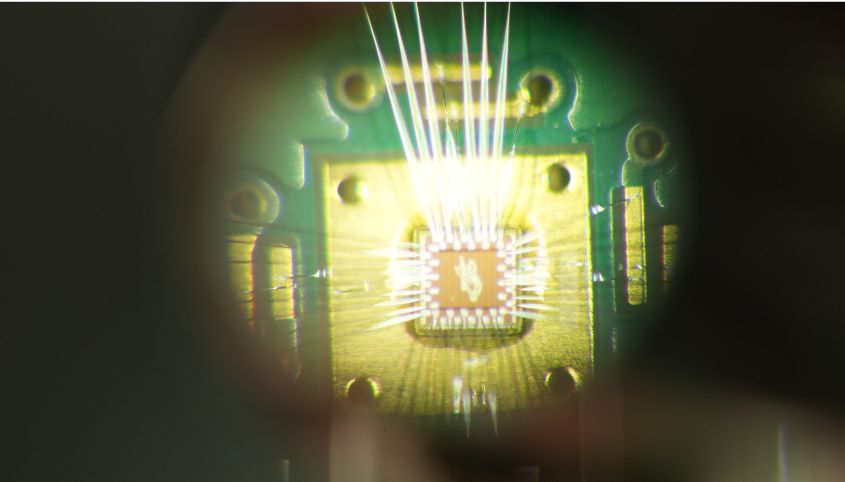
A close-up of the semiconductor chip being developed by Macquarie University researchers for CERN’s LHCb experiment. Image: Amy Shidiak
“Delivering such a complex and advanced technology requires years of fundamental research. We need to start with simulations of nuclear radiation effects in materials -the very fundamentals of science,” explains A/Professor Shojaii.
“Based on that understanding, we need to find solutions for how we deal with these effects when we have millions of transistors integrated onto a single device. We then have to make sure the device can operate while mitigating these effects under extremely demanding requirements.
“Only once we’ve gathered all that evidence can we deliver the final functional device. Then we work with CERN on commissioning the chips into the particle detectors, and we remain involved in operating them over the decade that the detector is running.”
For a team working on technology where the margin for error is non-existent, the pressure inside the semiconductor laboratory is not immediately visible.
Each 1cm² chip contains billions of transistors – painstakingly designed by hand to withstand extreme radiation while processing information from quadrillions of particles travelling at near the speed of light.
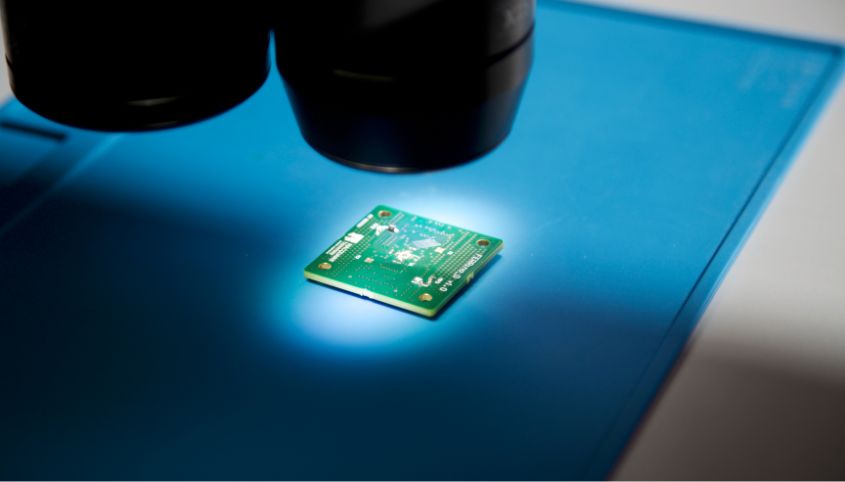 The technology being developed to interpret its collisions measures in mere centimetres. Image: Amy Shidiak
This work is mission-critical because these tiny chips must withstand the most intense radiation environment ever created by humans in a laboratory—far exceeding the conditions experienced by satellites and spacecraft in Earth orbit.
As A/Professor Shojaii explains the complexity of the engineering and science, he appears calm and methodical – walking through simulations, testing processes and design challenges with the quiet confidence of a researcher who understands that breakthroughs are built incrementally over time, through patience and persistence.
For Dr Andrea Mazzanti, a postdoc researcher in the team, part of navigating that pressure lies in trusting that what he’s designing on his computer screen will eventually become a fully formed, functioning chip.
“The engineering challenge is extraordinary,” says Dr Mazzanti.
“These chips are designed for one of the most demanding environments in science. They need to detect extremely small signals, operate at very high speed and continue performing reliably under intense radiation. That requires precision at every stage – it is painstaking work, but it is also what makes this project so exciting.”
But it is not only the expertise of the team that is shaping this extraordinary technology.
From the beginning of the collaboration, Macquarie has placed students at the centre of the project, selecting 10 researchers over the coming decade to work alongside some of the world’s leading scientists and engineers.
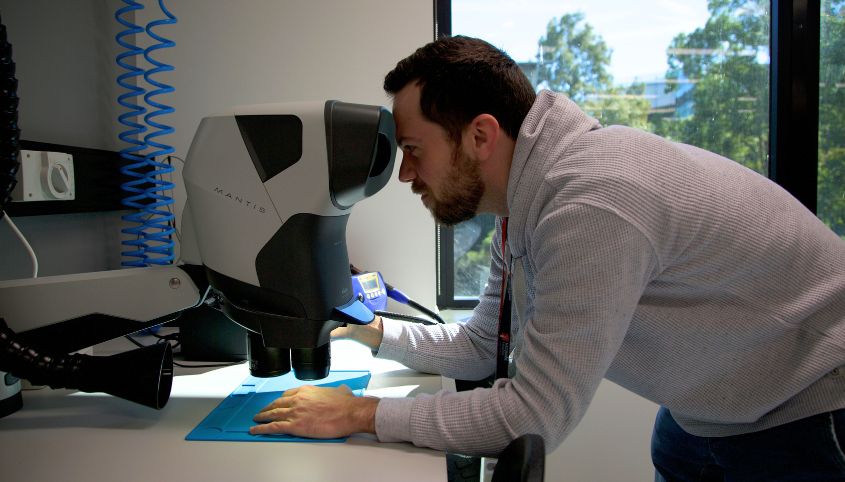
Dr Andrea Mazzanti, part of the Macquarie University team developing cutting-edge semiconductor technology for CERN’s LHCb experiment. Image: Elaine Obran
“Through our strong engagement with universities in Italy and Switzerland, we’re providing students with the opportunity to go to Europe and work with some of the best chip designers and scientist in the world, along with distinguished academics working with CERN,” says A/professor Shojaii.
“After completing their PhDs, they will each have a very unique set of skills that will set them apart from the rest of the world.”
The first student selected for the program is Ollie Salman, whose path into the project began not through a formal application process, but through the relationships and mentorship built inside Macquarie’s semiconductor community during his master’s degree. His selection for the CERN project is a natural progression of that journey.
“I was relatively new to chip design when I started, but working with such a strong team gave me the ability to develop quickly,” says Salman.
“Working on technology for CERN is an incredible opportunity. It combines cutting-edge semiconductor design with some of the biggest scientific questions we can ask.
“Knowing that something we’ve designed here could help enable discoveries in particle physics is incredibly motivating, and I’m excited to contribute to that effort.”
For Salman, these chips form the first chapter of his career, but they are also an incremental part of a much larger story – one written across laboratories, continents and generations of scientists, each contributing a small piece to one of humanity’s greatest scientific pursuits.
His work will focus on helping build a new detector to run what’s known as the LHCb experiment, one of four new projects underway in the collider, that are all expected to commence in 2030 and continue well into the 2050’s.
It is this long-term vision that also shapes A/Professor Shojaii’s approach to the project.
“For me, it’s about doing something meaningful,” reflects A/Professor Shojaii.
“It’s not just about progressing your career or finding a job – it’s about contributing to the most fundamental understanding of the universe. Which is an extremely meaningful contribution to humanity.”
Interested in being part of this project? Students with backgrounds in physics or microelectronics are encouraged to get in touch with Associate Professor Shojaii and apply: [email protected]