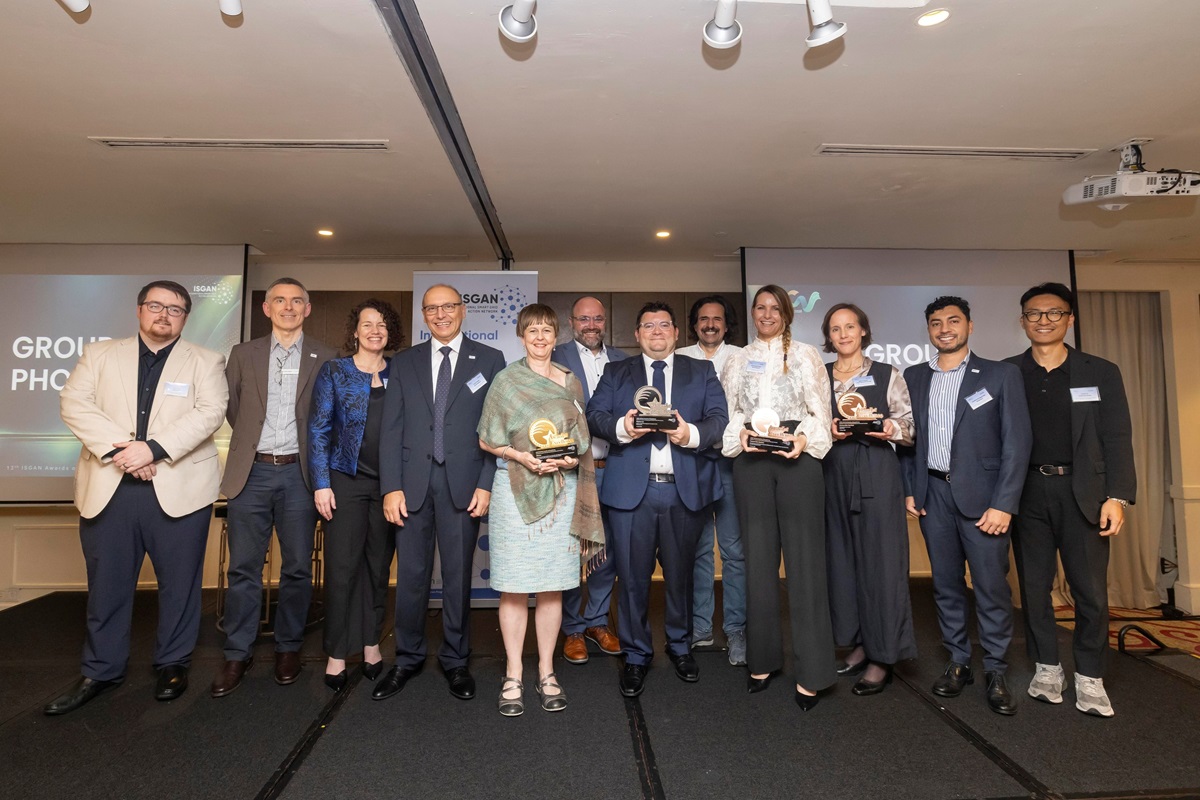
With global demand for critical minerals accelerating, the Victorian State Office of the Department of Foreign Affairs and Trade recently led a diplomatic delegation from Victoria’s Consular Corps to the Monash Technology Precinct for an immersive look into Monash’s critical minerals research ecosystem. With a global energy transition well underway, critical minerals are vital for renewable energy, electric mobility, and advanced manufacturing technologies.
The visit was the latest in an ongoing engagement series connecting international consular personnel with flagship Australian research precincts.
Representatives from over 30 countries visited the Australian Synchrotron, where researchers from Monash University’s Faculty of Science showcased their geoscientific capabilities around mineral deposit formation and characterisation. This knowledge is essential for understanding how, why and where minerals occur, and underpins the economic and responsible extraction of critical minerals.
From there the delegation moved to the Monash University Clayton campus, where the University’s diverse expertise in critical minerals across processing, economics and social licence came to the fore.
This began with a tour of Monash’s advanced engineering facilities where researchers demonstrated pilot-scale processing technologies such as membrane technologies. These advanced techniques act as a precision molecular sieve that isolates, recovers and purifies critical metals from liquids, replacing chemical-heavy extraction to deliver faster processing times, higher yields, and a lower environmental footprint.
Following the tour, delegates participated in a dedicated panel discussion and interactive Q&A centered on the complex environmental, social and economic dimensions of resource extraction. The session brought together researchers and policy experts to examine community expectations, environmental stewardship, social licence to operate, and global supply chain dynamics – drawing directly on the core principles of Monash’s Environmental, Social, and Governance (ESG) Statement.
The day ended with a guided tour through the Monash Earth Sciences Garden, showcasing Victoria’s geology in a natural setting.
Throughout the day, delegates gained firsthand insight into Monash’s integrated approach, spanning scientific research, mining technology, economic policy, social licence, and environmental sustainability.
Professor Craig Jeffrey, Monash’s Deputy Vice-Chancellor (International) and Senior Vice-President, noted the need to work with international partners to progress on global priorities like the energy transition.
“Connecting diplomatic leaders with Monash’s multi-disciplinary research isn’t just about demonstrating our innovation,” he said. “It’s about building the cross-border partnerships needed to power a sustainable global energy transition.”
Professor Peter Betts, Deputy Dean of Engagement and Graduate Research in the Faculty of Science, highlighted why a narrow focus on extraction alone is no longer sufficient in the modern resource landscape.
“Securing the critical minerals needed for a sustainable future isn’t simply a matter of digging more ore out of the ground,” he said. “It requires an interconnected strategy that weaves together technological capability, sound economics, environmental protection, and meaningful community partnership. If we want to build secure, long-term supply chains, establishing a genuine social licence and aligning business goals with community welfare is every bit as critical as the technology itself.”
Inside the engineering labs, delegates observed breakthroughs in low-energy processing, sustainable extraction techniques, and high-efficiency mineral separation.
Professor in Resources Engineering, Mohan Yellishetty, highlighted the transformative role that next-generation engineering technologies play in minimising the environmental footprint of resource development.
“Our engineering facilities are dedicated to reinventing how critical minerals are discovered, processed, and recycled,” Professor Yellishetty said. “From developing cleaner chemical processes that drastically reduce water and energy use to extracting high-value minerals from legacy mine waste, we are providing the high-tech tools necessary to ensure critical resource production is both economically viable and ecologically responsible.”
Reinforcing the importance of commercial impact in the sector, Professor Adrian Neild, Deputy Dean (Enterprise) in the Faculty of Engineering, outlined how Monash bridges academic research and industry practice. In an uncertain economic and geopolitical climate, these deep cross-sector partnerships are essential for turning lab breakthroughs into scalable, real-world solutions that accelerate the green energy transition.
The delegation’s visit underlines Monash University’s role as a primary international partner for sustainable resource innovation, helping shape the policies, technologies, and collaborative frameworks required for a decarbonised global economy.