When designing a large underwater robot that could swim silently to avoid startling sea creatures, roboticist Rob Shepherd considered the unusual swimming system of oarfish, the meters-long fish whose ribbon-like dorsal fin moves in waves to propel its body.
To learn more, he consulted his colleague Willy Bemis ’76, a retired Cornell ichthyologist.
“He called me and said, ‘I’m interested in oarfish,’ and I said, ‘me too,'” said Bemis, professor emeritus of ecology and evolutionary biology in the College of Agriculture and Life Sciences.
That was the start of a collaboration to study the oarfish’s unique dorsal fin rays. Oarfish, giant fish that are rarely spotted by humans, have hundreds of these bone-like skeletal structures, which extend from the back of the oarfish. The fin rays move in coordinated motion, creating waves along the membrane that connects the fin rays, which, in turn propels the fish.
A new study, published Sept. 30 in the journal Ichthyology and Herpetology, is the first to describe the anatomy and series of muscles that allow each of the oarfish’s fin rays to rotate independently in a full circle, like a joystick. Bemis is the paper’s senior author, while Shepherd, the John F. Carr Professor of Mechanical Engineering in the Cornell Duffield College of Engineering, is a co-author. Gabriel Afonso, a former visiting researcher in Bemis’ lab, currently a doctoral student at the Virginia Institute of Marine Science, is the paper’s first author.
The fish – and their fin rays – are not well studied in part because when they die they break into segments, making intact specimens rare.
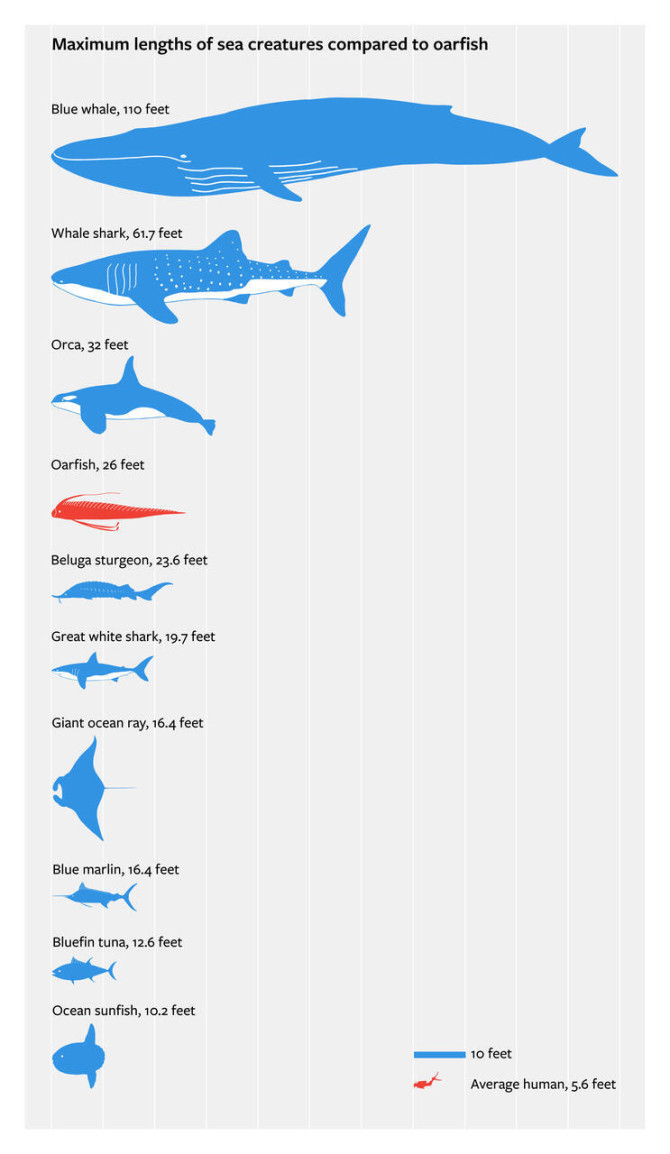
With only two recognized species found in oceans all over the world at depths up to 1,000 feet below the surface, oarfish are huge, with a ribbon-like body, with the largest specimens estimated to reach up to 8 meters (about 26 feet – making the giant oarfish the longest bony fish alive). Like many marine behemoths, they eat tiny crustaceans. They hold a vertical posture when they do so, made possible in part by the dorsal fin.
“Most fishes with long bodies swim like eels,” Bemis said. “They move in a series of undulations, pressing the water back and forth. And oarfish do that but also, remarkably, they use the dorsal fin to propel themselves without moving their bodies laterally.” The system lets them silently stalk prey without having to swim hard to propel their whole body.
The oarfish’s unusual locomotion caught Shepherd’s eye when he was researching how to make a large yet quiet swimming robot, as part of a grant he received from the Office of Naval Research. The large machine he envisioned would house a range of instrumentation for an ocean monitoring platform – which the Navy also had an interest in – that could swim silently forward and backward to monitor ocean health without scaring off fish and other aquatic creatures.
“If you swim in Cayuga Lake in the summer and a boat goes by, it’s really loud,” Shepherd said. “We think that a more biomimetic approach would make it better for playing along with fish.”
In investigating engineered systems that mimic how oarfish swim, he needed to understand the mechanics of how they do it.
In the study, the authors relied on dissections, histology, x-rays of a specimen at the Smithsonian Institution, CT scans made at Cornell, and analyses of movies of the oarfish’s dorsal fin rays. The inquiriesrevealed each fin ray is attached at the top to the thin fin membrane and then below to cartilage, a series of muscles, and a ball and socket joint enabling the rotary movement.
The unusual anatomy allows the webbed membrane to move in waves, to propel the oarfish forward and backward. A section of the membrane may wave in a posterior direction while another part simultaneously may be waving in an anterior direction, providing subtle control. “They’re continuously able to change the pattern of those dorsal fin rays and do it very quickly,” Bemis said. “The fin rays are incredibly mobile.”
The unusual locomotion, dubbed ribbon-fin swimming, has evolved about 10 separate times in bony fishes, Bemis said. It is unknown whether other ribbon-fin swimmers also evolved fin rays that spin.
“We’re describing it here,” Bemis said. “The next steps would be to go and see whether that’s the case for other fishes. My suspicion from studying fishes for a long time is that they find different solutions to the same sort of physical problems.”
Co-authors include Eric Hilton, professor of natural resources at the Virginia Institute of Marine Science, and Afonso’s Ph.D. adviser; Anastasia Koivikko, a former postdoctoral researcher, and Ofek Peretz, a postdoctoral researcher, both in Shepherd’s lab; Teresa Porri, CT manager at the Cornell Institute of Biotechnology; Taylor Lunningham ’23, a former undergraduate in Bemis’ lab and now a doctoral student at Howard University; and Katherine Bemis ’15, a research zoologist at the National Systematics Lab of NOAA Fisheries and curator of fishes at the Smithsonian Institution’s National Museum of Natural History.