A PhD project to examine how processing new mineral deposits can be refined to capture optimal metal yield has provided a geology student with the opportunity to collaborate with industry.
Chalice Mining employee and student Matthew Demmer worked with Chalice Mining’s lead metallurgist Adam Farghaly to research how palladium, platinum, nickel, copper and cobalt from the Gonneville deposit in the Wheatbelt region behave during processing.
Mr Demmer’s project is part of The University of Western Australia’s ARC Training Centre in Critical Resources for the Future and the Australian Government’s National Industry PhD Program.
Gonneville, about 70km north-east of Perth, is set to become the first primary platinum-group metal mine in Australia after the discovery of the deposit in 2020. The Project is also set to become a significant producer of the battery and electrification metals nickel, copper and cobalt.
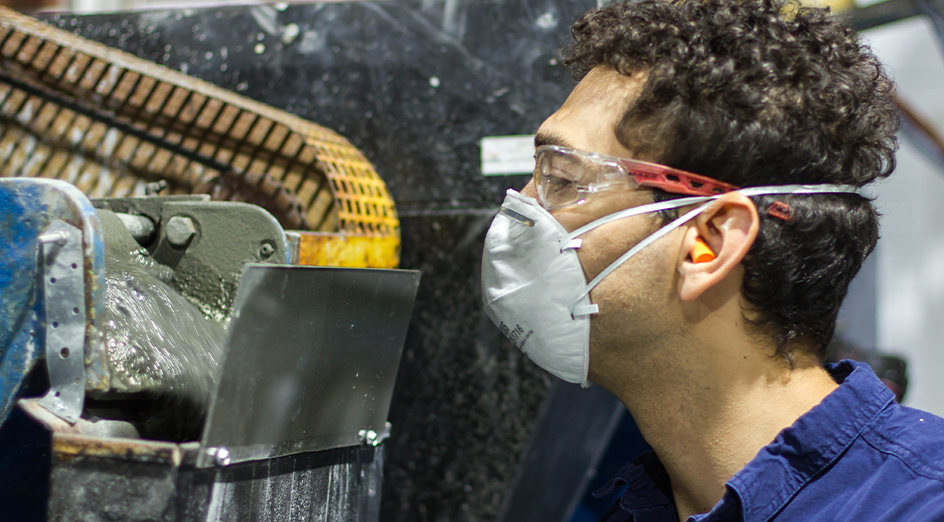 Image: Adam Farghaly looking at the copper rougher.
Initial testing showed the platinum-group elements floated, but were splitting between the copper and nickel concentrates, with a portion escaping floatation altogether.
Mr Demmer aimed to discover why and work with Mr Farghaly’s team to determine if more platinum-group elements could be captured.
Using facilities at UWA’s Centre for Microscopy, Characterisation and Analysis and CSIRO’s Australian Resources Research Centre in Perth, Mr Demmer characterised the platinum-group element minerals in detail and found the metals were mostly hosted in tellurides and bismuthides.
“Early tests told us the platinum-group elements floated, but it seemed a mystery as to why some followed the copper into the copper concentrate while others followed the nickel into the nickel concentrate,” Mr Demmer said.
“Once we knew which minerals were carrying platinum-group elements, their behaviour in the test work started to make sense.”
Tellurides and bismuthides are strongly hydrophobic and float readily, which encouraged the metallurgists to experiment with grind and flotation conditions.
By grinding the rock into smaller fragments and extending the time in the copper flotation stage the platinum-group minerals were pushed into the copper concentrate.
“When we gave the copper circuit more time, the platinum group elements followed the copper,” Mr Farghaly said
“We also discovered tellurides and bismuthides could be leached using gold industry techniques, which allowed us to introduce an extra step to capture any platinum-group elements that had been missed with flotation.”
The findings have helped Chalice lift overall palladium recovery to more than 83 per cent for the first four years of mine life.
“Being embedded meant I was working on a question that mattered commercially to the company,” Mr Demmer said. “Research only changes outcomes if people are willing to listen and act on it and Chalice did both.”
Mr Demmer’s supervisor, Professor Marco Fiorentini from UWA’s School of Earth and Oceans, said the collaboration reflected the purpose of the ARC Training Centre in Critical Resources for the Future.
“Matthew’s results show that ore body characterisation isn’t an academic sideline,” Professor Fiorentini said. “The geoscientists of the future that the centre is training need to be willing to look for solutions beyond their own discipline.”
The National Industry PhD Program supports a commitment to add 1,800 industry PhDs over 10 years.
Dr Agi Gedeon, HDR Partnerships Manager at UWA’s Graduate Research School, said the program was built for such collaborations.
“Industry PhDs give companies a researcher focused on their commercial question and give candidates the experience of seeing their research used,” Dr Gedeon said. “This is a clear example of a partnership working for everyone involved.”
Image top: Chrissy Smith, Adam Farghaly, Matthew Demmer, Paul De Ponte at the pilot plant test of the Gonneville PGE-Ni-Cu material.