Key Points
A team led by Flinders University has developed a tiny molecular cage to trap PFAS chemicals
Remediation strategies are needed to manage the environmental and health impacts of the forever chemicals
The macromolecular and microfocus beamlines at the Australian Synchrotron confirmed each cage could trap up to four short-chain PFAS molecules at once
Recent research led by a team from Flinders University has developed an approach based on a molecular cage to trap dangerous PFAS chemicals.
The investigators who used the Macromolecular beamlines at the Australian Synchrotron published their findings in the prestigious journal Angewandte Chemie International Edition.
The widespread usage of PFAS in firefighting foam, non-stick consumer products and manufacturing has contaminated soils and waterways across Australia. These ‘forever chemicals’ are extremely stable and resist natural breakdown, making them difficult to remove once they are in the environment.
Short-chain PFAS are especially challenging. Because they can dissolve in water, they pass through filters typically used to capture long-chain PFAS, leaving drinking water supplies vulnerable to contamination.
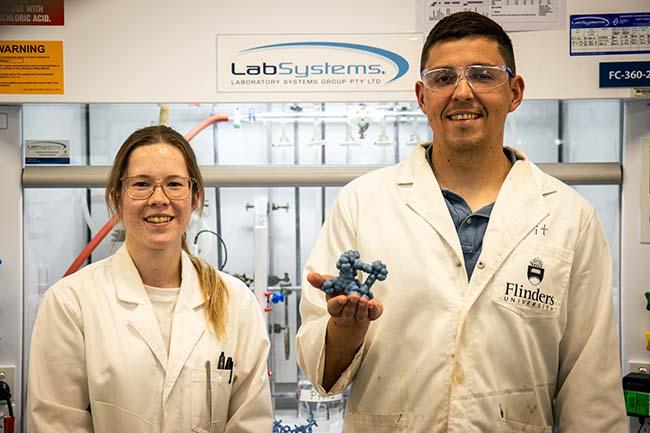
The Flinders University investigators developed a solution: a tiny molecular cage only 2.8 nm in size that can trap PFAS molecules inside. Using MX1 and MX2 at the Australian Synchrotron, they found that each cage could trap up to four short-chain PFAS molecules at once.
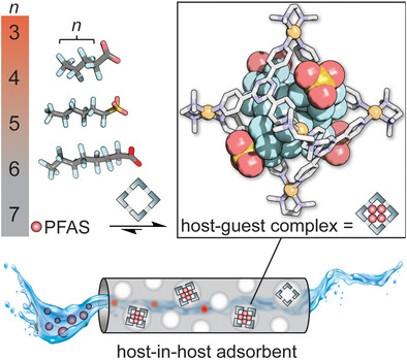
To demonstrate real-world application, the team loaded a small amount of cage (1 wt%) onto porous silica and made a flow-through column filter. In testing, they found that this filter removed 90-98% of short- and long-chain PFAS from water. When testing with PFAS concentrations and salt mixtures representative of South Australian tap water, the filter removed PFAS to below the detection limit of 1 ng/L.
Importantly, the filter can be washed and be regenerated for multiple cycles without losing effectiveness – a key step towards scalable, effective PFAS remediation.