Each time you switch on the lights, board a flight, tap your card to buy a coffee or use a maps app on your way home, there is a forecast at work behind the scenes that you’ve likely never heard of.
Space weather forecasting helps protect the technologies that keep modern life running smoothly.
Space weather occurs when the Sun’s activity affects conditions in space and on Earth. It can disrupt radio communications, navigation systems, the precise timing services that keep modern networks synchronised, and satellites orbiting our planet.
The bureau monitors and forecasts conditions in space, just like we observe and forecast weather on Earth. We track solar activity and issue warnings when space weather impacts are likely. This alerts industries and communities to possible disruptions before they occur, giving them time to take action to reduce the impacts of space weather.
There are three main types of space weather that we watch for. These are solar flares, geomagnetic storms and solar radiation storms. Each affects Earth differently.
Solar flares
Solar flares are strong and sudden bursts of X-rays and extreme ultraviolet light from the Sun. These travel at the speed of light, reaching Earth in approximately 8 minutes. Due to the speed of solar flares, bureau forecasters cannot issue warnings for individual events before they arrive. Instead, we assess and warn for the likelihood of solar flares occurring each day.
Solar flares can disrupt high frequency (HF) radio communication, satellite-based navigation like GPS, and radar technology. This can significantly disrupt maritime operations, emergency services, defence activities and aviation. On a more local scale, phone calls, navigation technology and radar observations may fail. Flights may also be delayed.
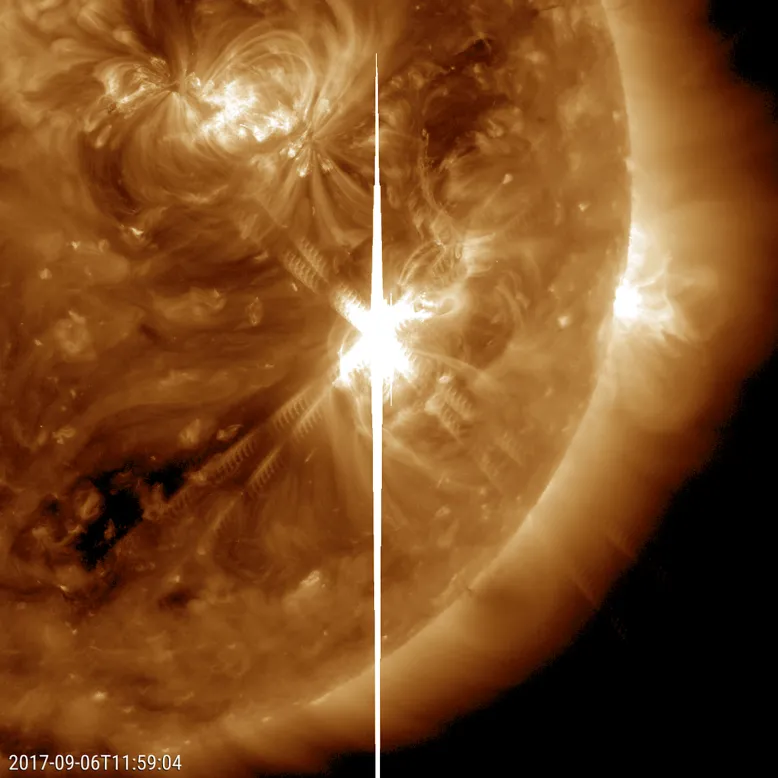
Major solar flare. Credit: NASA.
Geomagnetic storms
Geomagnetic storms are caused by coronal mass ejections (CMEs), which are large clouds of magnetised plasma ejected from the Sun. These eruptions typically take 2 to 3 days to reach Earth, but in extreme cases it can be less.
When a CME arrives, it interacts with Earth’s atmosphere and magnetic field. At times this increases the visibility and extent of auroras, creating stunning displays of green light across the sky. During particularly strong events, auroras can be visible much farther from the North and South Poles than usual.
Geomagnetic storms can also disrupt critical technologies. They can create currents in our electricity grids, leading to power outages. Satellites may also lose altitude, become more difficult to locate, and face a risk of collisions. In some cases, satellite mission lifespans can be shortened.
These impacts can disrupt satellite communication and navigation services. For the aviation industry, reduced navigation accuracy, particularly near the equator and the poles, may cause flight delays or require planes to use alternate or modified routes to avoid affected areas.
Like solar flares, geomagnetic storms can also interfere with HF radio communications. This has similar effects on the industries that rely on these systems.
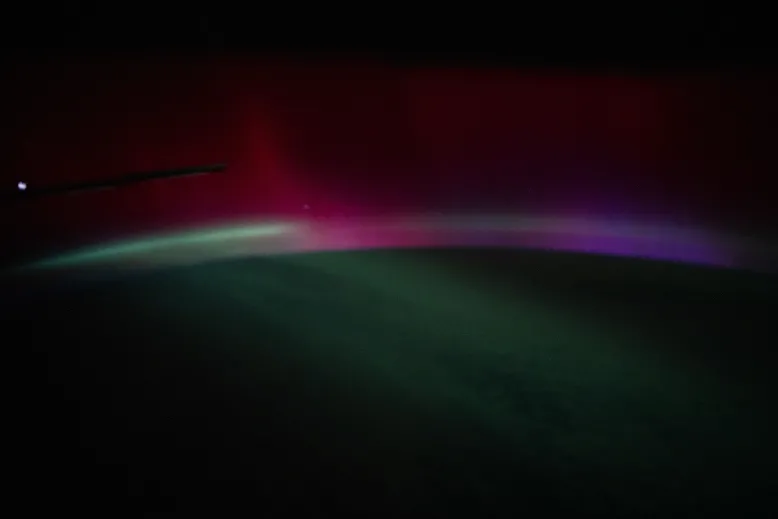
A wispy, multi-coloured aurora created by a geomagnetic storm. Credit: NASA.
Solar radiation storms
Solar radiation storms occur when the Sun ejects charged particles (protons) towards Earth. These particles travel quickly, reaching Earth in as little as 10 minutes. In some events, however, they may take several hours to arrive.
Solar radiation storms can damage satellites, leaving them inoperable in the worst cases. This can impact industries that rely on satellite-based communications, or navigation and timing systems. Impacted industries may include banking, transport, energy networks, and emergency services.
Like other space weather, solar radiation storms affect HF radio communication, however, impacts mostly occur near the poles. This may lead to some planes needing to change course to avoid these regions.
Additionally, solar radiation storms can affect electronic equipment, including radar, which may fail near the poles. Astronauts in space are also at increased risk of radiation exposure and must seek shielding during these events.