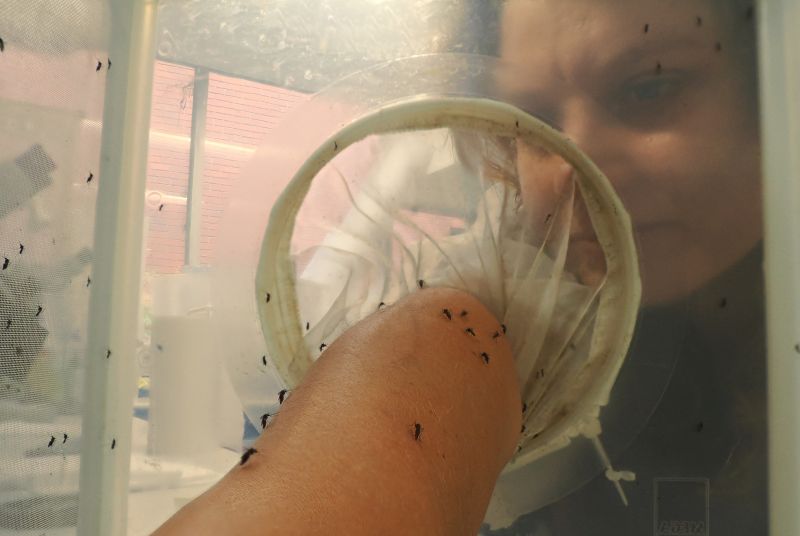
Mosquito control in an urban setting can reduce a person’s risk of contracting Buruli ulcer by over 80 per cent, finds a new Melbourne-led study.
Published in Nature Microbiology, it is the first evidence that suppressing mosquito populations directly protects people from the disease.
Buruli ulcer is a serious infection caused by Mycobacterium ulcerans, a bacterium that can destroy skin and soft tissue if not treated early. Cases have increased in Victoria in recent years, with infections now occurring across coastal parts of Victoria and in many suburbs of Melbourne.
Building on previous research that identified a common Australian backyard mosquito (Aedes notoscriptus) as a critical part of the Buruli ulcer transmission cycle in Victoria, researchers from the University of Melbourne and Peter Doherty Institute for Infection and Immunity (Doherty Institute) investigated whether targeted mosquito control could stop people getting this infection.
The team conducted a randomised controlled trial across 12 areas in Melbourne’s inner north-west, including Brunswick West, Essendon and Moonee Ponds.
Six areas received specialised mosquito control traps, known as autodissemination stations, to see if they could reduce mosquito numbers and, in turn, whether fewer mosquitoes led to fewer Buruli ulcer infections in people living in those areas, compared with the areas without traps.
University of Melbourne Dr Véronique Paris from the School of BioSciences, who is a Medical Entomologist at the Doherty Institute and co-first author of the paper, said the autodissemination stations targeted the backyard mosquito that breeds in small, hidden sources of water around homes.
“When mosquitoes visit the control station, they pick up the control agent unwittingly and spread it to other breeding sites in the neighbourhood, helping to control mosquitoes well beyond the station themselves,” Dr Paris said.
“After eight weeks, we found that mosquito egg counts had dropped by around 70 per cent across areas with the control stations.”
The researchers then examined whether this reduction in mosquito populations translated to fewer human infections.
University of Melbourne Dr Andrew Buultjens, Senior Research Fellow at the Doherty Institute and co-first author of the study, said that the team could not simply compare diagnosis dates to assess when or where infections were acquired.
“Because symptoms typically appear around five months after infection, we had to work backwards to estimate when infection happened and use forensic genomic analysis to determine which cases were acquired locally,” Dr Buultjens said.
“By intersecting timing and location of infections, we found that when we reduced mosquito numbers by 70 per cent over an eight-week period, there was an 83 per cent lower incidence of Buruli ulcer among people living nearby.”
University of Melbourne Professor Tim Stinear, Director of the WHO Collaborating Centre for Mycobacterium ulcerans at the Doherty Institute, said the findings have for the first time unlocked a feasible way to prevent Buruli ulcer across an urban area, thus controlling this critical infection.
“While we knew mosquitoes played an important role in spreading Mycobacterium ulcerans, this study shows for the first time that reducing mosquito populations can reduce the risk of disease in people,” Professor Stinear said.
“These findings provide evidence for public health control strategies to help communities affected by Buruli ulcer.”
Dr Finn Romanes, Director of the Western Public Health Unit in Victoria, welcomed the findings.
“There is now an opportunity to apply this research to find ways to respond at scale to reduce mosquito populations in areas where they contribute to Buruli ulcer infection,” Dr Romanes said.
“People can also reduce their infection risk by taking steps to avoid mosquito bites, including using repellent, maintaining fly screens and removing mosquito breeding sites around their homes.”
Winter is a key time for Buruli ulcer diagnoses, as infections acquired during summer start to become apparent. People should see their GP if they notice a slow-healing sore, unusual skin lesion, swelling or a wound that does not improve.
Mosquito expert University of Melbourne Professor Ary Hoffmann from the School of BioSciences and Bio21 Institute, highlighted the emerging problems of mosquito transmitted diseases in both local urban and rural areas.
“As climate change leads to extreme rainfall and warmer temperatures that favour mosquito breeding, we are likely to see an increase in transmission of a variety of mosquito-borne diseases like Buruli,” Professor Hoffmann said.
“We need to focus on reducing mosquito breeding sites and adopting new technologies like the autodissemination approach used here to facilitate this outcome.”