Reasonable. Necessary. Ordinary story submission.
Tuesday 23 June
Our Reasonable. Necessary. Ordinary campaign we asked for your real life stories about “What does the NDIS make possible in your everyday life?”
These are the real life stories.
I’m a dad. I live in North Queensland. And I have a permanent brain injury from a stroke in 2005, with post‑stroke epilepsy that never really goes away – it just waits.
But you wouldn’t know it to look at me.
I don’t use a wheelchair. I don’t have an obvious physical difference. I can walk. I can talk – most of the time. On a good day, I might even seem “fine.”
That’s the thing about invisible disability. It hides. And because it hides, people assume it isn’t there. Or they assume it isn’t serious.
But it is.
For years, I managed. I was seizure‑free. I worked as a pharmacist, then retrained as a social worker. I ride my bike. I raised my son. I looked fine. But underneath, my brain was still scarred. My epilepsy was still there, waiting.
Then, in April this year, it stopped waiting.
I had a seizure that nearly killed me. Status epilepticus. My body kept seizing and wouldn’t stop. I stopped breathing. I was intubated. I spent days in ICU. My son – my 15‑year‑old son – found me.
I don’t remember any of it. But he does.
I’m still here because of the NDIS. Not because I look “disabled enough.” Not because I fought harder than anyone else. Because the NDIS funds the supports that keep me safe and alive – even when my disability isn’t visible to the outside world.
With my NDIS funding, I can buy a seizure monitor. It will detect a seizure at night or when I’m out riding my bike with my son, and send an alert to my parents who are older and more elderly than me. Without it, a seizure could go unnoticed – and I could die. That’s not visible. But it’s real.
With the funding I can buy speech‑to‑text software. I can’t type for long periods because my left hand doesn’t work and my right hand is at risk of overuse. That’s not visible either. But without it, my work as a would become exhausting and painful.
I can buy low‑cost consumables like Second Skin for injuries I don’t feel because of my left‑hand sensory loss. Small cuts can become infections. Infections can become hospital visits. You can’t see my sensory loss. But it’s there.
These are not luxuries. This is not a “lifestyle choice.” This is the difference between being safe and being vulnerable. Between working and not working. Between being a dad and my son growing up without me.
I can’t imagine what it would have been like if I had died next to my son that day. The NDIS helps me stay alive next to him instead.
For decades, people with invisible disabilities were hidden away or dismissed. The NDIS changed that. It said: “You don’t have to look a certain way to deserve support.”
Now I’m scared these changes will push us back into the shadows. If the NDIS assesses me on a good day – when my thinking is clearer, my fatigue is low – I might look “too functional.” But that’s not my real life. My real life includes bad days. Seizures at night. A son who needs me alive.
Please don’t cut people like me off. The NDIS doesn’t fund a luxurious life. It funds an ordinary life. Getting out of bed. Going to work. Staying alive for my son.
That’s all I’m asking for. An ordinary life. Even when my disability is invisible.
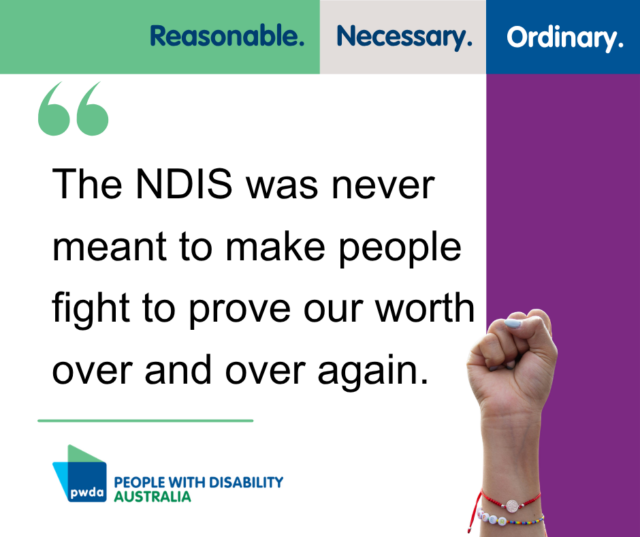
The NDIS was never meant to make people like me fight to prove our worth over and over again. It was meant to provide reasonable and necessary supports – so we could live ordinary lives. These changes are not the true intent of the scheme.