Latest
  • Police Appeal To Locate Woman Missing From Sydney CBD 18 October
  • Weekly Weather: Wet In East, Warm In South
  • Man arrested following erratic driving and multiple collisions in Keilor
  • Appeal to locate woman missing from Lightning Ridge
  • Cyber security grants doubled to help Northern Territory businesses grow with confidence
  • Police Update 1: Missing Man in Wishart, QLD
  • Rose Bowl comes to Sydney as NRMA Insurance Women’s T20 Series launched
  • Major Employers Line Up For Whyalla Workers’ Expertise
  • Shephard Storms Mackay
  • Media Alert | Deputy Chief Minister 18 October
  • Home
  • National
  • Local
    • ACT
    • QLD
    • NSW
    • NT
    • SA
    • TAS
    • VIC
    • WA
  • Politics
  • Business
  • Science
  • Technology
  • Health
  • Life
    • Sport
    • Travel
    • Education
    • Environment
  • World
SEARCH

This World Cancer Day, it is time we all act on alcohol and cancer

The National Tribune
  • Health
  • 3 Feb 2023 3:54 pm AEST Date Time
  • Share
Courtesy of Cancer Council WA

I started a new role in the Alcohol Programs Team at Cancer Council WA recently. As an injury epidemiologist, I knew about how alcohol can be a risk factor for injury. However, like many Australians, I was surprised to learn that alcohol is also an important, but often overlooked, risk factor for cancer.

World Cancer Day on February 4 offers an opportunity to raise awareness of the link between alcohol and cancer, educate, and encourage personal, community and government action. In 1988, the World Health Organization, International Agency for Research on Cancer concluded that alcohol use is a group one carcinogen, meaning that it is a direct cause of cancer in humans.

What we know about alcohol and cancer?

  • Around 5% of new cancers (741,000 cases) diagnosed worldwide in 2020 were directly attributable to alcohol use.
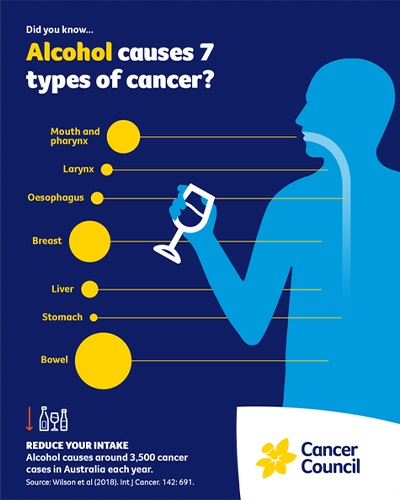
  • Alcohol use has been connected to at least seven types of cancer, including: breast (females only), colorectal, liver, pharynx, larynx, oesophagus, and oral cavity.
  • Alcohol is responsible for an increasing number of cancer cases in Australia each year, and in WA an average of three people die each week from alcohol-related cancers.
  • The risk of developing some of these cancers is higher among people who smoke and drink alcohol.
  • All types of alcoholic products increase the cancer risk. It doesn’t make a difference if you’re drinking beer, wine or brandy – alcoholic beverages all have one thing in common: they contain ethanol.
  • No level of alcohol use is completely safe. The less alcohol you drink, the lower your risk of cancer.
How does alcohol increase your cancer risk?

While large-scale genetic studies, many led by Oxford Population Health, have confirmed that alcohol directly causes cancer; researchers and clinicians across the world are still studying exactly how alcohol increases cancer risk. Current evidence indicates that many factors contribute to how alcohol impacts different tissues. Our bodies break down the ethanol in alcohol by converting it to a compound called acetaldehyde. This is a known carcinogen that damages DNA. The formation of acetaldehyde can happen with any amount of alcohol. However, the more a person drinks, the higher the risk as people who drink at high risk levels produce much more acetaldehyde. This can result in greater toxic and carcinogenic effects.

Other mechanisms include:

  • Alcohol makes it harder for the body to process and absorb important cancer protective nutrients, including antioxidants like folate and vitamins including vitamin A, B12, C, D and E.
  • Regular use of alcohol often leads to increased body weight (a risk factor for cancer) due to the ’empty calories’ alcohol contains.
  • Alcohol can damage healthy cells in the mouth and throat. As these cells repair themselves, there may be DNA changes that can lead to cancer.
  • Alcohol can make the carcinogens found in tobacco smoke easier for the body to absorb.
  • Alcohol use raises the levels of the hormone estrogen, which can modify how cells in the breast grown and divide.

We must do more to raise awareness of the link between alcohol and cancer.

Surveys in Australia and internationally find that community awareness of the link between alcohol and cancers is low, even among health care providers.

Education campaigns are an effective way to improved community awareness. One successful campaign is the Alcohol and Health ‘Glassbody’ campaign, a joint initiative between the Mental Health Commission and the former McCusker Centre for Action on Alcohol and Youth. It encouraged people to reduce their drinking to reduce their risk of alcohol associated disease. The campaign led to an increase in the awareness of health harms from alcohol in people aged 25-54 years and a significant increase in campaign participants’ belief that cancer and heart disease are associated with alcohol use.

If alcohol harm-reduction education campaigns are dependent on limited resources, and awareness of the link between alcohol and cancer in the community is low, what can we do as a community?

As someone with lived experience, a diagnosis of cancer is scary and comes with uncertainty and fear for the future. Survival rates for many cancers are improving due to new drugs and therapies, however, knowledge of the risks associated with cancer allows each of us to help ourselves and be proactive about managing our risk.

Our age, gender, genetics, reproductive history, and environmental exposures are all factors that contribute to the development of cancer. While we can’t control our age, gender, or genetics; drinking alcohol is a risk factor that we can influence and take steps to control.

Let’s take action together.

This is a call to action for the community to expect more. What can each of us as individuals do?

If information is available about the link between alcohol and cancer, but awareness is low, what can we do to get the evidence on alcohol and cancer promoted more widely?

An important step is to appeal to our political leaders. After all, the issues important to us should be the ones our politicians are focused on.

How to appeal to our political leaders

  • Write to your local state and federal politicians
  • Make an appointment to see them
  • Let them know your personal narrative of alcohol and cancer
  • Make sure they know you’re concerned about the link between alcohol and cancer and that you would like to see our governments do more

/Public Release. View in full here.
Tags:Australia, cancer council, Cancer Council WA, cancer risk, clinicians, community awareness, DNA, Health, health care, heart disease, international, mental health, Oxford, population, WA, World Health Organization

You might also like

Cyber security grants doubled to help Northern Territory businesses grow with confidence

Rose Bowl comes to Sydney as NRMA Insurance Women’s T20 Series launched

Major Employers Line Up For Whyalla Workers’ Expertise

Media Alert | Deputy Chief Minister 18 October

First look at four-lane bridge design to get Bribie Island moving again

Detectives Investigate Suspicious Buckland Park Blaze

ACU researchers recognised among world’s leading scientists

Tangara Trains Off Track

Just In

18 Oct 2026 2:39 pm AEST

Police Appeal To Locate Woman Missing From Sydney CBD 18 October

18 Oct 2026 1:33 pm AEST

Weekly Weather: Wet In East, Warm In South

18 Oct 2026 1:27 pm AEST

Man arrested following erratic driving and multiple collisions in Keilor

18 Oct 2026 1:06 pm AEST

Appeal to locate woman missing from Lightning Ridge

18 Oct 2026 12:57 pm AEST

Cyber security grants doubled to help Northern Territory businesses grow with confidence

18 Oct 2026 12:36 pm AEST

Police Update 1: Missing Man in Wishart, QLD

18 Oct 2026 12:33 pm AEST

Rose Bowl comes to Sydney as NRMA Insurance Women’s T20 Series launched

18 Oct 2026 12:09 pm AEST

Major Employers Line Up For Whyalla Workers’ Expertise

18 Oct 2026 12:06 pm AEST

Shephard Storms Mackay

18 Oct 2026 11:51 am AEST

Media Alert | Deputy Chief Minister 18 October

18 Oct 2026 11:45 am AEST

First look at four-lane bridge design to get Bribie Island moving again

18 Oct 2026 11:42 am AEST

Detectives Investigate Suspicious Buckland Park Blaze

18 Oct 2026 11:21 am AEST

Police Appeal To Locate Woman Missing From Pokolbin

18 Oct 2026 11:18 am AEST

ACU researchers recognised among world’s leading scientists

18 Oct 2026 10:57 am AEST

BRISBANE’S SHEPPARD READY TO ROLL OUT THE WELCOME FOR MUSIC ROYALTY AT THE GABBA

18 Oct 2026 10:45 am AEST

Man charged with alleged DV and stealing offences – Leeton

18 Oct 2026 10:39 am AEST

Tangara Trains Off Track

18 Oct 2026 10:39 am AEST

Urgent Surgery Referrals Left Unread

18 Oct 2026 10:36 am AEST

CommBank ParaMatildas defeat Colombia 8-0 in second group stage game

18 Oct 2026 10:36 am AEST

The CommBank ParaMatildas have defeated Ireland 19-0 to begin their IFCPF Women’s World Cup title defence

18 Oct 2026 10:09 am AEST

Detectives Investigate Dallas Shooting

18 Oct 2026 10:03 am AEST

The Price of Pain: Cost Of Living Forces Australians To Work Through Injury

18 Oct 2026 9:57 am AEST

Elderly man arrested following alleged stabbing in shopping centre – Blacktown

18 Oct 2026 9:42 am AEST

Charges laid after man allegedly stabs woman multiple times – Leeton

18 Oct 2026 9:42 am AEST

HMAS Sydney returns home after 131-day Indo-Pacific deployment

18 Oct 2026 9:27 am AEST

Arrest following Evenden Road crash, Hastings

18 Oct 2026 8:36 am AEST

Police Make Arrest – Stolen Motor Vehicle – Palmerston

18 Oct 2026 7:48 am AEST

Boat users urged to be aware of changing conditions following vessel stranding within Jordan River
More News
ABOUT US

Based in Toowoomba QLD, The National Tribune provides 24/7 free live coverage of important events and developments in Australia and the Pacific region leveraging real-time open-source intelligence. We endeavor to give the Australian community greater transparency and access to government information and other developments free from encroaching corporate, ideological or any other interests/influences. More

We acknowledge the Traditional Custodians of Country throughout Australia and their continuing connection to land, culture and community.

POPULAR TOPICS

AustraliaGovernmentAustraliancommunityPoliceNSWVictorialocal councilQueenslandUniversitycouncilAusPolministerNew South WalesEnvironmentHealthinfrastructureNew Zealandbusinessinvestigationinvestmentcrime
QUICK LINKS
  • Latest Australia News
  • Latest Toowoomba News
  • Latest Queensland News
  • Latest New Zealand News
  • Latest Police News
  • Latest University News
  • Latest AusPol News
FOLLOW
  • Facebook

© 2026 - The National Tribune Australia

  • About Us
  • Contact Us
  • Terms of Use
  • Privacy Policy
  • Disclaimer