The Tropilaelaps mite has reached Turkey, thereby crossing the border into Europe. Experts have now been discussing in North Macedonia how this dangerous bee mite can be contained.
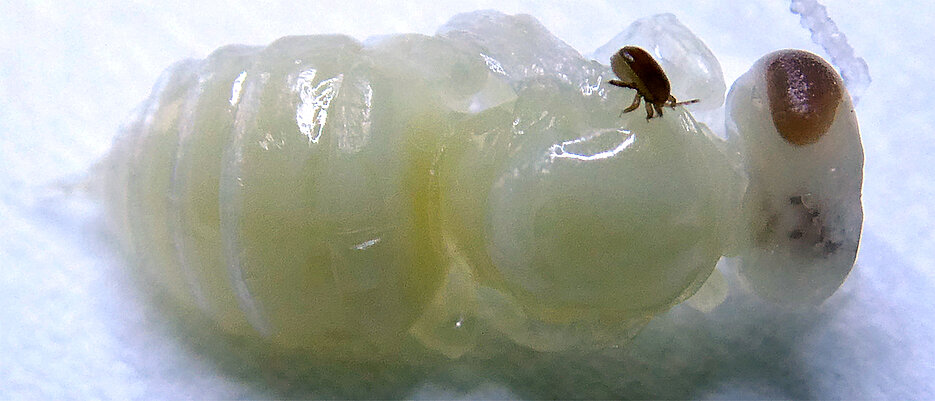
The report by the World Organisation for Animal Health (WOAH) dated 31 August 2026 marks a worrying turning point: the detection of the invasive Tropilaelaps mite in Turkey confirms that this dangerous parasite has reached the border with Europe. Originally native to Asia, the mite has spread westwards, seemingly unstoppably, via Russia and Georgia. For the western honey bee (Apis mellifera), this poses an existential threat that goes far beyond the known dangers posed by the Varroa mite.
The mite, a tiny parasite that primarily settles in the brood combs of bee colonies, feeds on the body fluids of developing bee larvae and pupae, weakening them even before they hatch. Young bees often die directly inside the brood cell.
Accelerated collapse of bee colonies
The biological mechanism is highly destructive: “The Tropilaelaps mite has a significantly shorter life cycle than the honeybee and therefore reproduces much more rapidly than Varroa, the main parasite to date. This leads to an accelerated collapse of bee colonies,” explains Ricarda Scheiner, bee expert and professor at the Chair of Zoology II – Behavioural Physiology and Sociobiology at Julius-Maximilians-Universität Würzburg (JMU).
According to her, the emergence of the Tropilaelaps mite and other invasive species such as the dwarf honeybee (Apis florea) shows that the European ecosystem is under immense pressure. Should the mite become established in Germany and Europe, there is a risk of devastating losses in honey production and pollination services, which would threaten both biodiversity and agricultural security in equal measure.
Workshop in North Macedonia
Scientists and experts from the fields of veterinary medicine and beekeeping met in Ohrid, North Macedonia, in early September to discuss the extent of the threat to European beekeeping and how further spread can be prevented. From 1 to 5 September, experts from several European countries gathered there for the workshop ‘The Tropilaelaps Mite on Its Way to Europe’.
The event was organised by Ricarda Scheiner; she was supported by Professor Aleksandar Uzunov (Sts Cyril and Methodius University of Skopje) and by Professor Ingolf Steffan-Dewenter, holder of the Chair of Zoology III – Animal Ecology and Tropical Biology at JMU. The German Academic Exchange Service (DAAD) provided financial support for the meeting, contributing just over 34,000 euros from the ‘University Dialogue with the Countries of the Western Balkans’ programme.
The workshop participants see an increasing risk, particularly for South-Eastern Europe, that the Tropilaelaps mite will reach Europe. The workshop therefore focused primarily on the question of how an introduction can be detected as early as possible and how further spread can be prevented. Possible routes for the introduction of alien species include, amongst others, international travel and trade, as well as the transport of bees and bee products. Invasive species already present in Europe, such as the small hive beetle (Aethina tumida) and the Asian hornet (Vespa velutina), were also discussed at the workshop.
Early detection aims to prevent worse outcomes
“A coordinated European approach is absolutely essential in the fight against the Tropilaelaps mite,” says Ricarda Scheiner. To this end, authorities and other relevant bodies should improve their capacity for monitoring, diagnosis and the rapid reporting of suspected cases. According to the scientists, dedicated monitoring sites at airports, ports, transport routes and border regions, as well as in areas with intensive beekeeping and bee imports, could take on these tasks.
Another recommendation involves so-called sentinel colonies. These are specially monitored bee colonies that can be used to detect Tropilaelaps mites and other non-native species at an early stage. In the event of a suspected case, contingency plans should also be drawn up, setting out clear responsibilities, diagnostic procedures, reporting channels and possible control measures.
“Prevention is better than cure”: according to Ricarda Scheiner, this phrase sums up the central message of the workshop. Accordingly, the participants concluded that prevention, early detection and a rapid, scientifically sound response are more effective and less costly than combating an invasive species once it has become established. This requires a joint effort by authorities, the scientific community, beekeepers and other relevant organisations across Europe.
Alongside Ricarda Scheiner and Ingolf Steffan-Dewenter, experts and representatives from beekeeping associations in Germany, North Macedonia, Turkey, Greece, Serbia, Croatia, Bosnia and Herzegovina, Kosovo and Hungary took part in the workshop.