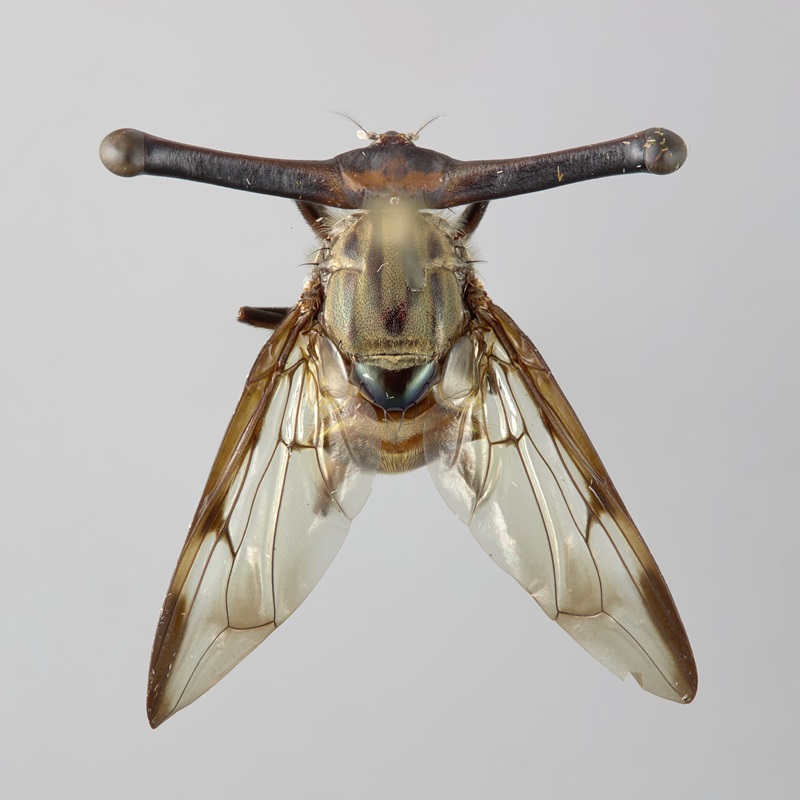
Vote for the Stalk-eyed Signal Fly, a species with a story so shiny you’ll overlook all the other insects.
Male signal flies have their eyes on wide stalks to attract females. They also jive and groove on rotting fruit. What’s not to love?!
Wide eyes limit the males’ ability to see. It’s a genuine signal that they’re worth it.
Among the 12 million specimens in the vaults of the Australian National Insect Collection at CSIRO in Canberra are some striking insects. Open a cabinet at random and you might see gigantic moths, painted butterflies, dragonflies with intricately veined wings, weevils with cute snouts, flies pretending to be bees, or beetles with shells as shiny as a mirror.
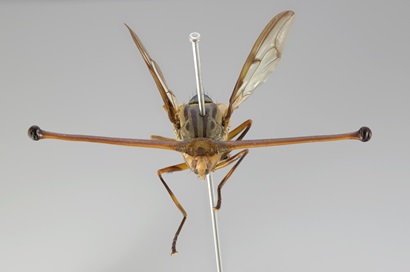
None can hold a candle to the Stalk-eyed Signal Fly (Achias australis), which lives in the rainforests or Northern Queensland and Papua New Guinea (PNG).
This fly’s eyes are on stalks so wide it’s difficult for them to do what flies do: fly.
How do animals choose mates? It’s usually females who decide, because in most species, females invest more resources in reproduction than males.
As a result, males compete to prove their worth to the females. They travel long distances, build nests, and gift delicious prey.
Flies are no different, but they do have some unique challenges. They specialise in ephemeral resources, meaning food that is rich and plentiful for a short period of time.
A signal fly who finds a bounty of rotting figs at the base of a tree in Northern Queensland or PNG has to act fast. They need to reproduce in time for their cute baby maggot larvae to feast on the mouldy figs before the bounty dries out.
But a pile of rotting figs is an abundant resource, far more than a fly family could eat. Building a house or gifting the nicest fig won’t get a male fly very far when the entire surrounds are safe and delicious. They need to do something extra to attract the females’ attention.
Hot tips for finding a mate
What would you do if you were in the shoes of a signal fly, or rather their tarsi (insect feet)?
Flicking your wings to the rhythm of a song only you can hear is a good idea. This is what gave signal flies their name. They dance and strut to display their gold stripes and show off their fabulous rides (intricately patterned wings).
But if there are a dozen other flies showing of their gold stripes and fabulous rides on the same pile of rotting figs, what’s a fly guy to do? See who’s the bigger man.
Stalk-eyed Signal Fly males measure up whose eyes are furthest apart, chosen by the female.
Why do the eyes have it?
If a female is going to choose a mate with a certain trait, it has to truly signal that he’s worth it.
When flies moult, they modify their head to emerge. A fly with wide eyes is showing the female that he’s fit and well developed.
It’s also a genuine trade-off. The vision of males with their eyes on wide stalks is not great. They can’t see as well and are more vulnerable to being eaten by a bird. If he’s managed to fly through the rainforest to that pile of rotting figs without being killed, he might be a keeper!
Who doesn’t love a brave and easy-going guy? That wide-eyed fly grooving on the pile of figs is the Aragorn of the insect world.
Stalked eyes have evolved at least nine separate times among different groups of flies. It’s an effective strategy for showing off and attracting a female.
Achias, the Australasian group of flies with stalked eyes, are the biggest. There are over 100 species and some species are as big as your thumb.
If you’re up in Cairns and take the Kuranda cable car to go for a stroll in the rainforest, you might spot some. Look for the males showing off on tree trunks near piles of rotting organic material.
Vote for the Stalk-eyed Signal Fly!
Voting for the ABC’s Insect of the Year is open until the end of October. Scutter or flutter? Who wins your vote for the 2026 ABC Australian Insect of the Year?