Key points
- A chance encounter at an agricultural conference connected CSIRO researchers with sustainable fashion brand MJ Bale, redirecting a multiyear provenance project towards an entirely new challenge.
- They discovered that carbon isotope signatures preserved in wool – and other animal products such as milk – could reveal how much methane a sheep emitted, offering a low-cost alternative to expensive on-farm measurement tools.
- The CSIRO findings point to a new method for verifying low-carbon livestock claims – and the team is now seeking industry partners to help bring it to market.
It started as a joke.
Representatives of menswear brand MJ Bale had spent three days in a design sprint with CSIRO scientists trying to nail what kind of tool the company needed to prove their sustainability credentials.
They had talked about provenance, supply chains, carbon accounting – and the inconvenient fact that half the carbon footprint of an MJ Bale woollen suit came not from spinning or shipping or stitching, but from methane. It was belched, steadily and abundantly, by the sheep.
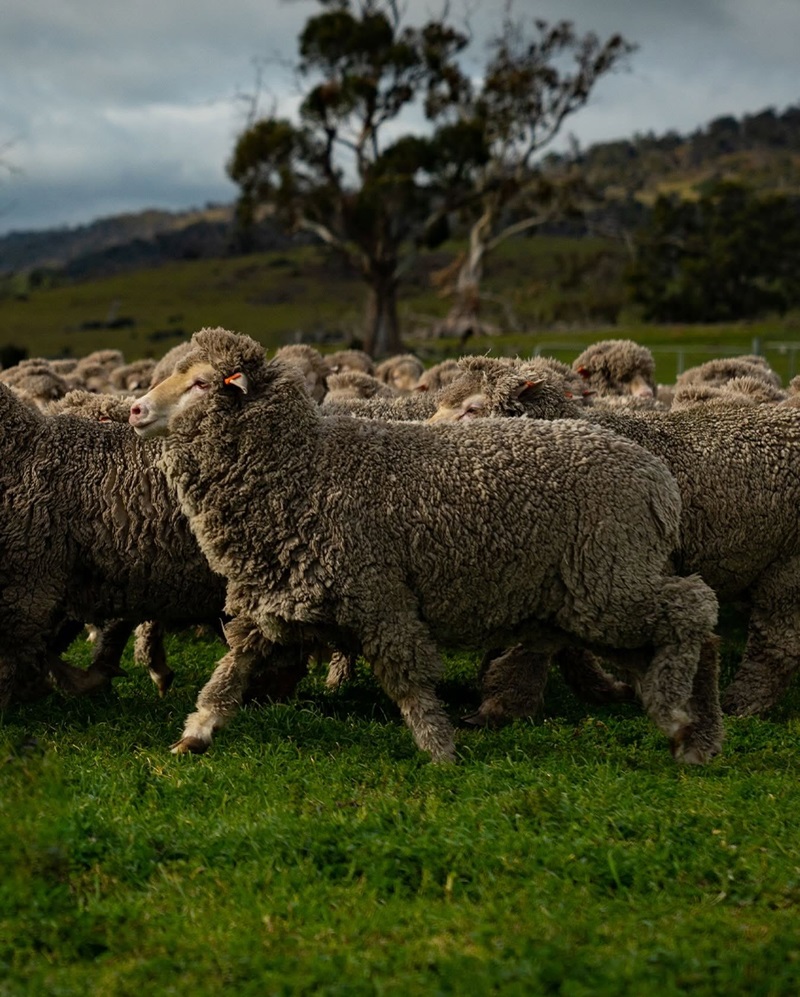
Everyone here knew measuring that methane was expensive and largely impractical on remote properties. The sustainability officer threw up her hands: “Why can’t someone just invent a breathalyser for sheep?” she asked with a laugh.
Dr Cesca McInerney laughed too – but not because it seemed so farfetched. “I think we could do that, actually,” she said.
What she had in mind wasn’t in fact a breathalyser. It was something altogether more interesting: a way to get the answer not from the animal’s breath, but from the wool on its back.
A good idea nobody needed
The story began not in that sprint room but in the months of patient, sometimes frustrating groundwork that preceded it.
Dr Nina Welti’s office sits in the leafy grounds of CSIRO’s offices at the Waite campus in Adelaide. The Senior Research Scientist and her national team had laboured for the better part of two years to build an ambitious infrastructure for food provenance.
The system they had designed relied on the inherent chemical and isotopic signatures in agricultural products to verify where they came from. The work drew on spatial modelling and AI to build predictive maps of what a product from a given region should look like chemically. What was the isotopic fingerprint of an apple from such-and-such valley, or of the wool from a particular farm?
It also pulled in regulatory technology specialists to work through a thornier problem: how do you pass verifiable location data from a farm all the way to a consumer’s shopping basket without compromising farmer privacy? They were doing sophisticated, multidisciplinary, genuinely useful science.
The problem was no one seemed to need it urgently enough to invest in it.
“It was a good idea, but it was everyone’s problem – and so it was also no one’s problem,” Dr Welti said.
Meanwhile, project funding was running out.
Then, in February that year, Dr Welti found herself on a panel at evokeAG , an agricultural innovation conference. There she was introduced to a man who was curious to know more: Jonathan Lobban from MJ Bale. Lobban explained the brand had built its identity around low-carbon merino wool suits – single-origin, sourced from Kingston Farm in Tasmania. MJ Bale had done the carbon accounting – a full cradle-to-end-of-life footprint of their flagship Kingston suit – and what they found had stopped them in their tracks.

“We’d gone in thinking Kingston wool would be looking pretty good – it’s a natural fibre; Kingston is a carbon positive farm. But our carbon footprint analysis showed that 52 per cent of all emissions from a Kingston suit came from methane. That changed everything.”
But what if they changed what the sheep were fed? Would the methane emissions drop?
They certainly hoped so, but now they had a claim they couldn’t independently verify – and no affordable way to fix that.
A design sprint, a deadline and a seaweed supplement
With the project’s end date looming, the team arranged what Dr Welti considered a Hail Mary: a structured design sprint in the last week of May 2023, bringing together MJ Bale, CSIRO researchers and an external facilitator.
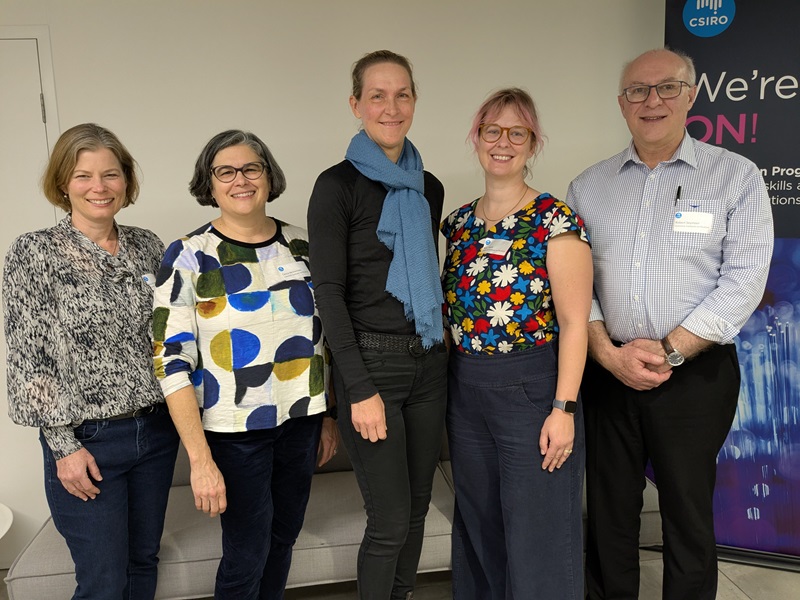
The goal was simple – to arrive, by the end of the week, at a clear vision of what a genuinely useful tool for the wool industry might look like. Dr Welti had spent months preparing for this moment … and then she came down with the flu. She didn’t make it to the room.
Dr McInerney was a key member of the team – a palaeoclimatologist and isotope geochemist who had been brought into the provenance project by Dr Welti as a visiting scientist.
In the early days of the sprint, evening updates to Dr Welti weren’t particularly exciting. Working through questions of origin and provenance, the CSIRO scientists realised MJ Bale’s relationship with Kingston Farm was already close enough that geographic traceability – knowing exactly which region the wool came from using its chemical signature – wasn’t the burning need. Two years of work, and the problem they’d come to solve wasn’t really a problem at all.
However, what they kept returning to was the brand’s low-carbon program.
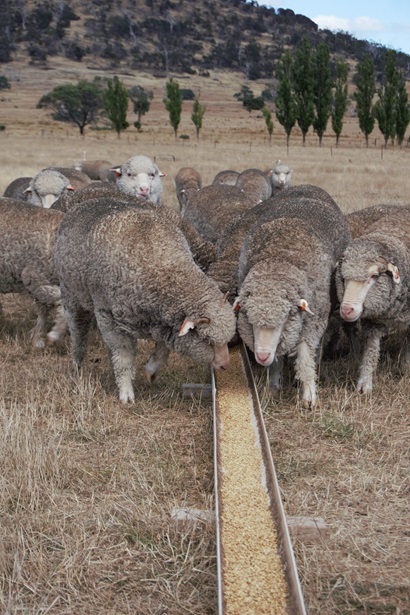
Kingston Farm fed its sheep a seaweed-based supplement asparagopsis developed by CSIRO, shown to suppress methane production. They had committed to reducing emissions. But proving they had succeeded, and to what extent, was another matter.
Measuring methane from individual animals meant installing a specialised treat-dispenser that measures belches and sends the data to the cloud – the infrastructure is expensive and requires internet connectivity that was lacking in paddocks of the Midlands, Tasmania. It was considered a research tool, not a farm practice.
Written in the fibre
After the session Dr Ryan McAllister, who led the Trusted Agri-Food Exports mission, called Dr McInerney: did she think she could actually measure methane emissions in wool?
She thought so.
“Rather than measuring the belches directly, I thought about measuring what’s left behind as a result of having belched – or not,” Dr McInerney said.
“It’s a more integrated, long-term measure, and it doesn’t require any technology at the time the belches are occurring.”
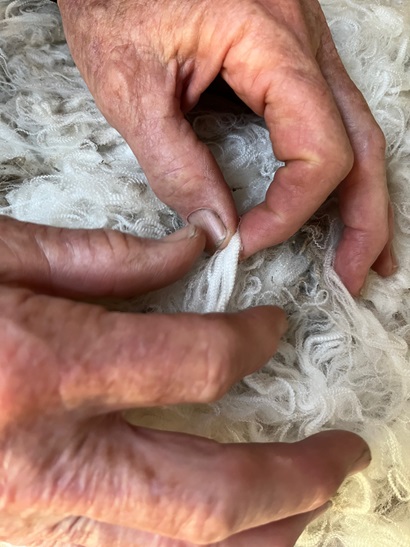
The key is carbon isotopes. As wool grows, carbon from the animal’s metabolism is laid down into the fibre. When a sheep produces less methane, it retains more of the lighter carbon isotopes – and that shift is preserved in the wool itself. No farm visit required. No connectivity, no equipment, no snapshot. Just a sample, sent to a lab, read at any point down the supply chain.
The product carried the answer. It always had.
It turns out Dr McInerney was uniquely qualified to unravel this problem: as part of her PhD research she had looked at the relationship between diet and carbon isotope ratios in animal teeth. Her palaeoclimate work had taken her to a warming event 56 million years ago – the Palaeocene-Eocene Thermal Maximum – in which a massive methane release is thought to have shifted isotopic signatures across every plant and animal alive at the time. More recently, she had modelled the isotopic balance of kangaroo body water – tracking how what an animal eats and drinks shows up in its tissues. Three separate research threads, meeting in a sprint room.
“That night after the sprint, I got up at 2am and started doing calculations in my notebook,” Dr McInerney said. “Trying to work out whether the effect would be large enough to show up. I convinced myself it probably could.”
From notebook to patent in a week
The team moved quickly, reaching out to Simon Cameron at Kingston Farm, who sent wool from the very flock that had been eating the seaweed supplement. Within days, the samples were in the lab.
The results from the initial samples were promising enough. Within a week of the sprint, a provisional patent had been filed on the concept that the team had taken to calling BELCH4.

This is where Dr Sonja Dominik, a CSIRO Principal Research Scientist with deep experience in livestock genetics and applied animal science, stepped in. Dr Dominik saw a further use: the same test could help identify and breed from animals that naturally emit less methane.
“The application of geochemistry to livestock provides the pathway to come up with something that actually meets the pain points industry is experiencing right now,” Dr Dominik said.
The proof is in the fibre
Controlled trials at CSIRO’s Chiswick Agricultural Research Station in New South Wales ran for 20 weeks in 2024, testing the isotopic response in sheep given different methane-suppressing treatments. The results were consistent with what Dr McInerney had calculated at 2am: the signal appeared to be there. The results were strong enough to support progressing the patent.

The three researchers – supported by a broader CSIRO team spanning business development and impact – subsequently completed CSIRO’s ON Prime commercialisation program, speaking with more than 80 stakeholders across industry and around the world. Listening to problems rather than pitching solutions, those conversations are now turning into genuine research partnerships, and the team is actively seeking external collaborators to firm up and validate the first set of results in larger scale trials.
For Lobban, the urgency is clear. The fashion industry is on a journey of decarbonisation – and the science to support it has never mattered more, he said.
“Companies and industries need verified evidence, and I think that’s going to become non-negotiable. Gen Z is a label turner. They care about provenance, they care about origin, and sooner rather than later, if you bring a product to market, you’ll have to prove by fact that the harm of making it has been minimised.”
Science that couldn’t have happened elsewhere
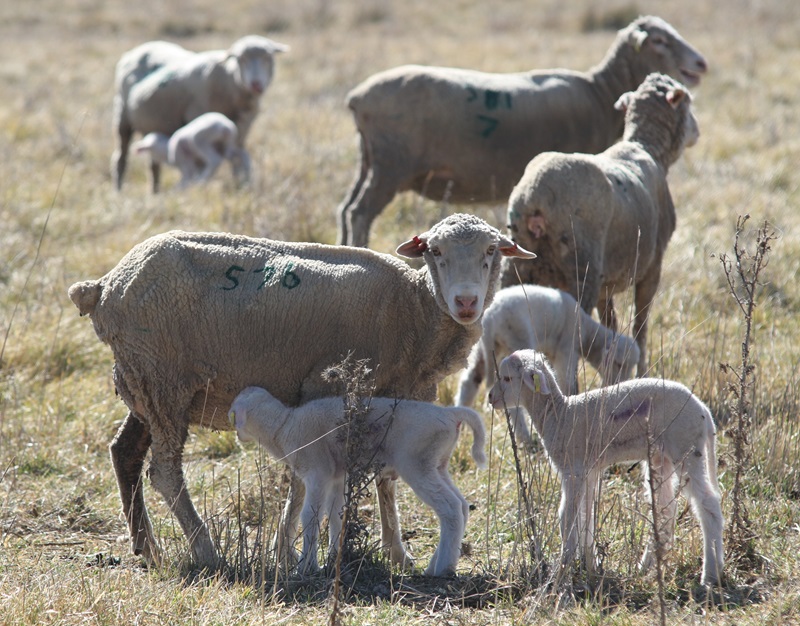
Looking back at how it all unfolded, Dr McInerney finds it hard to imagine it happening outside of CSIRO.
It required a multi-year provenance project to build the foundational thinking. It required a chance meeting at a conference. It required a design sprint that brought a fashion brand’s sustainability officer into the same room as a palaeoclimatologist. It required the IP and legal infrastructure to file a patent within days. It required the animal facilities at Chiswick to run the trials. It required the commercialisation support of ON Prime to find the right partners.
“Having a person from industry say ‘can you do this?’– and then having the size and interdisciplinarity of CSIRO made it all possible,” Dr McInerney said.
And the applications of their find extend well beyond wool.
For Dr Welti, who has spent years searching for the right use case, that prospect is particularly satisfying. Meat, milk, cheese – wherever the carbon from a low-methane animal ends up in a product, the signature may be readable. At a time when livestock agriculture is under increasing pressure to demonstrate real and verifiable emissions reductions, that is no small thing.
Not a breathalyser but something better: evidence that travels with the product, all the way to the person who buys it.