Curious Kids is a series for children of all ages. If you have a question you’d like an expert to answer, send it to [email protected] .
Author
- Mark J. P. Wolf
Professor of Communication, Concordia University Wisconsin
What was the first “first-person shooter” video game?
– James, age 12, Batesville, Arkansas
Before ” Call of Duty ,” before ” Counter-Strike ” and before ” Doom ,” there was ” Maze War .”
Generally considered the earliest first-person shooter game, or FPS, “Maze War” was developed at a NASA research center beginning in 1973. A year later, another FPS, ” Spasim ,” debuted. It was developed at the University of Illinois.
In first-person shooters, players experience the game through the eyes of a character, using a gun or other weapon to attack enemies. To pull off this first-person perspective, developers needed to create a 3D world for the players to move through – no easy feat in the early 1970s.
At the time, the computer hardware behind the most popular arcade game, ” PONG ,” and the first home video game system, the Magnavox Odyssey , wasn’t powerful enough to render the kind of 3D depth that allowed players to move forward into a virtual space, with objects appearing in the distance.
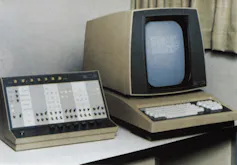
That’s why both games were developed on systems that had more processing power and speed. “Maze War” first appeared on an Imlac PDS-1 minicomputer , while “Spasim” – short for “space simulator” – launched on PLATO , an early networked computer system.
Since everyday people couldn’t easily access the Imlac PDS-1 minicomputer or PLATO, these two games have been largely forgotten. But they paved the way for one of today’s most popular video game genres .
Out of sight, but not out of mind
Both games allowed players to move through a 3D space and shoot enemy figures that appeared onscreen in the player’s view.
In “Spasim,” movement and shooting didn’t occur in real time. You moved by jumping from one position to another, with a short lag time needed to render the next view.
In “Maze War,” players could move relatively smoothly in a straight line down hallways. Turning, however, needed to be done in 90-degree increments, which created some potentially confusing graphics as entire scenes abruptly appeared. In the single-player mode, danger could lurk just around the corner: Robots would automatically shoot you if they were in line with you down a hallway.
“Maze War” and “Spasim” also had multiplayer modes that allowed networked players to shoot at each other. Before video games, popular shooting games – the kind found at fairs and carnivals – generally involved friendly competition, with players competing to see who could hit targets most accurately. The kill-or-be-killed death matches of “Maze War” and “Spasim” completely upended the way guns were used in play and competition.
‘Maze War’ introduced another new twist: the possibility of getting shot at and killed from behind, without ever seeing your attacker. Instead of the fixed and unchanging point of view found in a shooting gallery, ‘Maze War’ required you to constantly look around to try to keep track of everything in your immediate area.
And unlike most video games up to this point, players didn’t see the entirety of a game’s world from a godlike perspective. Instead, there was a sense of offscreen space surrounding the player, with events occurring out of the player’s sight.
Building a 3D world with lines
Both ‘Maze War’ and ‘Spasim’ used what are called vector graphics , which are images made by drawing lines directly between points on the screen.
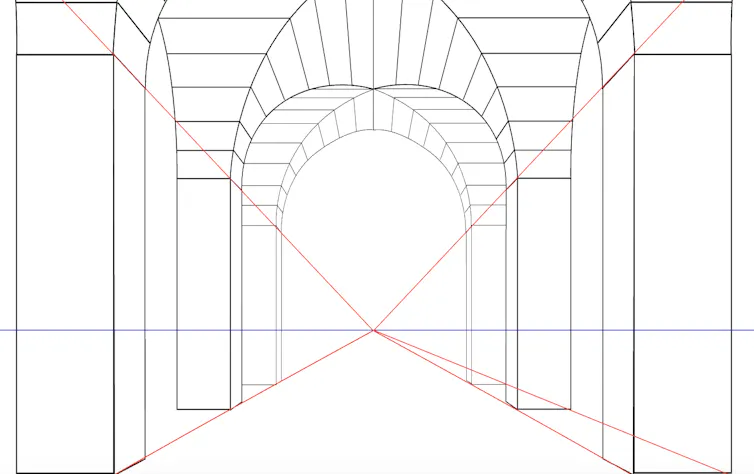
Compared with the other popular form of computer graphics, known as raster graphics , vector graphics were particularly well suited for creating a first-person perspective. They contain clean lines that converge at a vanishing point, making a flat screen appear to stretch into the distance. Raster graphics, on the other hand, create pictures by filling in a grid of tiny pixels, an approach that was less suited to drawing the crisp lines needed to create this kind of perspective.
By 1977, video game fans could play Cinematronic’s ” Space Wars ,” which used vector graphics, at arcades. In 1978, Vectorbeam’s ” Speed Freak ” deployed vector graphics to render the first real-time, 3D computer animation in an arcade video game – an explosion of car parts when the player crashed . Atari’s 1980 arcade game ” Battlezone ” was a huge hit that gave many players their first chance to try a first-person shooting game.
“Maze War” and “Spasim” didn’t have the aiming capabilities that players are used to today. Shooting was done with a keystroke, with aiming limited to facing in the right direction. Nor did they have the speed, spectacle and realism of their modern descendants. But they introduced something more fundamental: a new way of seeing and experiencing a video game.
Hello, curious kids! Do you have a question you’d like an expert to answer? Ask an adult to send your question to [email protected] . Please tell us your name, age and the city where you live.
And since curiosity has no age limit – adults, let us know what you’re wondering, too. We won’t be able to answer every question, but we will do our best.