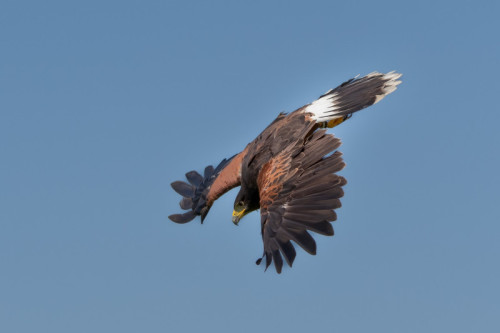
New research into the physics of bird flight has shed light on why birds swoop as they come in to land, and how the demands of landing may have shaped their evolution.
Birds may not always take the flight path that physics suggests is the perfect landing, at the safest and lowest possible speed, using the least energy, according to new research.
Most birds flap their wings as they come in to land, despite powered flight requiring more energy than gliding. Now, researchers at The University of Manchester have used mathematical modelling to help explain why.
The study, published in Proceedings of the Royal Society A, found that a bird flying without flapping its wings could, in theory, reach zero speed just as it touches down. However, the manoeuvre would require much higher approach speeds and considerably more space than birds typically use when landing.
For a pigeon-sized bird, the model showed that reaching zero speed would require it to begin at more than twice its typical cruising speed, travel around 60 metres horizontally and climb around 20 metres.
The findings suggest that achieving the lowest possible touchdown speed may not always be practical. Birds may use flapping not simply to slow down, but to do so within the limited space available in a real landing environment.
The research also provides new insight into why some birds swoop when landing on a perch, and how the physical demands of landing may have helped shape bird evolution.
Lead author Dr Ben Parslew, Lecturer in Aerospace Engineering at The University of Manchester, said: “Birds might make landing look effortless but coming to a safe stop presents a fundamental physical challenge. Landing isn’t as simple as just slowing down. The slower a bird flies, the less aerodynamic control it has, so it has to find a way of reducing its speed while still being able to manoeuvre safely. How birds do this and manage these competing demands is still not well understood.
“We used mathematical modelling to calculate how a bird flying without flapping could minimise its speed at touchdown while maintaining the control needed to complete the manoeuvre.
“In doing so, we’ve been able to gain insights into the swooping approaches seen in some perching birds, such as birds of prey, and more broadly, understand how physical demands of landing may have helped shape their evolution.”
Why some birds swoop
The modelling also provides new insight into the swooping behaviours observed in some birds when landing on perches.
Previous research on Harris hawks found that the birds learned to swoop down below their target landing spot before gliding upwards towards a perch. It was proposed that the manoeuvre helped them minimise the distance they travelled after their wings stalled, when aerodynamic control is reduced.
The new modelling suggests that there is more to this behaviour. The landing trajectories appear to reflect a balance between reaching the perch at a low speed and limiting the time spent stalled. The researchers say touchdown speed appears to have a greater influence on the swooping behaviour than previously documented.
Could landing have shaped bird evolution?
Landing on the ground creates a different challenge. Unlike swooping and perching, the bird coming to the ground cannot continue its trajectory below the landing surface or climb upwards through its destination.
The modelling showed that a bird landing on the ground without flapping cannot eliminate all of its speed before its feet touch down. It must therefore use its wings, legs, or a combination of both to deal with the remaining energy.
This places physical demands on the bird’s body, requiring more substantial muscles and bones to cope, particularly in the legs. But additional mass can reduce flight performance.
The researchers suggest this trade-off between being light enough for efficient flight and robust enough to land safely could have helped shape the evolution of birds.
The researchers say the same physical principles could also help explain how other flying animals manage unpowered landings.
This research was published in: Proceedings of the Royal Society A
Full title of the paper: Flight dynamics and optimal control of unpowered avian landings
DOI: 10.1098/rspa.2026.0103