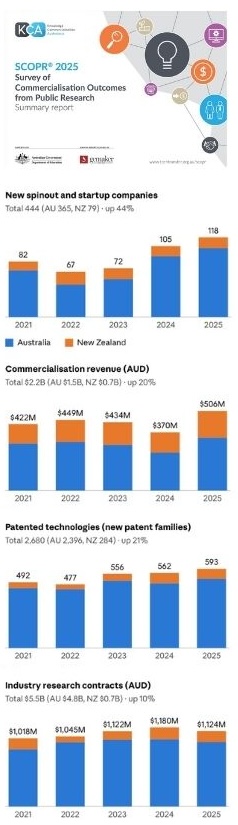
 Australian universities, medical research institutes, and public research agencies have created hundreds of spinout businesses and over $1.5 billion in commercialisation deals over the past five years according to Knowledge Commercialisation Australasia’s (KCA) annual SCOPR® survey.
And the survey shows we’re getting better at knowledge commercialisation, with a 39 per cent growth in commercialisation revenue reported in 2025.
“The survey demonstrates that public funding for research is translating into economic impact at scale,” says KCA’s John Grace AO, founder of the survey, now in its 9th year.
“Companies are trusting universities and research institutes with their big ideas. Industry signed 766 new licence and partnership deals with Australian researchers in 2025, up 25 per cent on the year before, and invested almost $1 billion in research contracts,” he says.
The 2025 survey reports:
- 118 new companies were created – 102 in Australia and 16 in New Zealand
- Universities and other agencies have active equity in 580 companies (466 in Australia and 114 in New Zealand).
- Australian commercialisation revenue was up 39% to AU$336M and New Zealand’s up 35% to NZ$189M.
- 834 new deals – putting research into the hands of industry (766 in Australia and 68 in New Zealand).
“We are getting better at turning research into economic growth, creating hundreds of companies and growing commercialisation activity, including revenue” says Kate Taylor, chair of KCA.
“However, our members are warning us that the pressure of reduced funding is being felt at every stage, from research to market. The loss of Australia’s Economic Accelerator, pausing of the Industry Growth Program and uncertainty regarding the R&D tax incentive and CGT has done great damage. Universities are also losing income with the reductions to international students.”
“Fixing one source of funding won’t be enough. The sector needs continuity across the whole commercialisation pipeline, to maximise the benefits of public funded research,” Kate says.
Highlights in 2025
- Potential new vaccines through UQ’s molecular clamp – UQ secured the biggest IP deal in Australian university history when spinout company Vicebio was acquired by Sanofi in a deal worth up to US$1.6 billion.
- Cleaner fuel for diesel engines – UNSW research licenced to a startup, DeCarice, that will enable retrofitting of giant mining trucks and other heavy industry diesel engines.
- Ultra-pure silicon for quantum chips – a collaboration between UNSW, Silex Systems and Silicon Quantum Computing which led to a pilot production plant to make up to 20 kg annually of ‘quantum silicon’ from 2027.
CSIRO has the most active deals (licences, options and assignments) in 2025 (over 500), followed by Macquarie University, the University of Sydney, UNSW, then the University of Melbourne
UQ led in commercialisation revenue, boosted by Vicebio to $165 million. They were followed by Plant and Food NZ, CSIRO, Auckland University and UWA.
UNSW led in new start-up and spinout companies with 25, double that of the University of Melbourne in second place, followed by Sydney, Adelaide, and UQ.
The University of Melbourne had the most active start-ups and spinouts (45) followed by the University of Sydney, Auckland University, CSIRO, and UQ.
CSIRO held over $220 million in equity in start-ups and spinouts, followed by GRDC, UQ, UNSW, and Melbourne.
Monash University generated $160 million in annual gross income from for-profit companies, followed by UNSW, CSIRO, UQ, and Deakin.
The 2025 survey received responses from 72 publicly funded research organisations including 34 Australian universities and 8 NZ universities.
“The survey demonstrates the role of trained professionals in technology transfer offices,” says John Grace.
“We thank the Australian Government’s Department of Education for their support of SCOPR® and gemaker for managing the survey and report,” says Kate Taylor.
Read the full report at https://www.techtransfer.org.au/scopr.
Kate Taylor and John Grace are