As electric vehicles become more widespread, researchers are looking for ways to make rechargeable batteries store more energy while reducing their cost and environmental impact. Aluminum is a promising candidate. It can store large amounts of lithium, and a single sheet of aluminum foil can serve as both the battery’s active material and the component that carries electricity.
However, aluminum has a weakness: it does not last long enough during repeated charging and discharging. Now, researchers at Tohoku University and UACJ Corporation have found a way to mitigate this degradation by adding a small amount of manganese to the aluminum. Their approach improves the electrode’s durability without sacrificing its ability to store lithium, addressing a major obstacle to the practical use of aluminum-foil anodes.
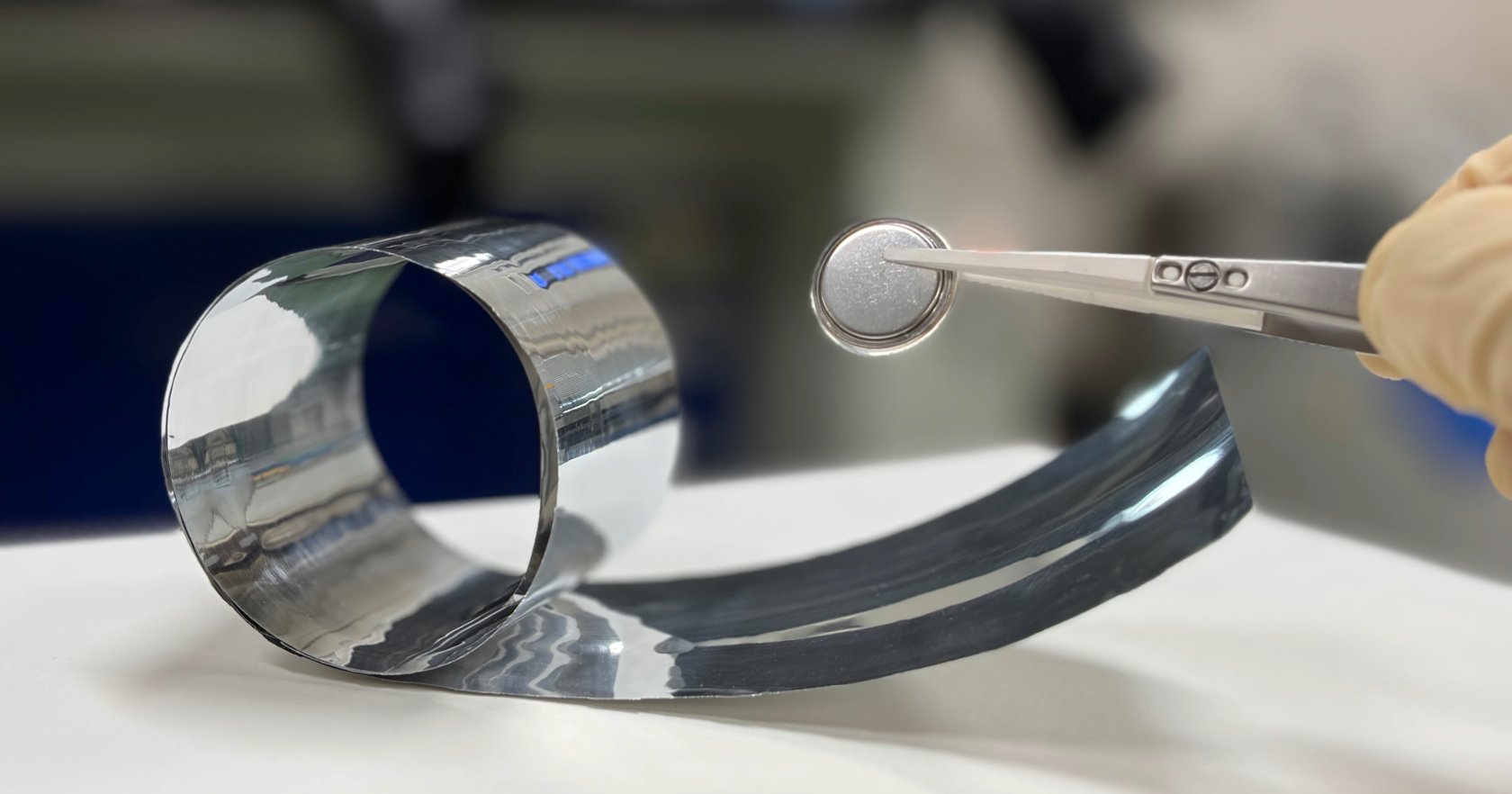
In conventional lithium-ion batteries, anodes are typically made by coating a material onto copper foil. Aluminum-foil anodes offer a much simpler alternative. Because the foil itself stores lithium and carries electricity, it could eliminate the need for copper current collectors, binding materials and energy-intensive coating processes. This could make batteries lighter, cheaper and more environmentally friendly to produce.
The challenge is that pure aluminum changes significantly as lithium moves in and out during charging and discharging. As lithium is removed, the material develops tiny gaps and becomes porous, weakening its structure. Repeated reactions with the battery electrolyte also create surface layers that interfere with performance. One way to prevent this damage is to add silicon, but this creates another problem: lithium becomes trapped deep inside the material and cannot be fully used. Researchers have therefore struggled to improve the electrode’s lifespan without reducing its usable capacity.
The team found a solution by uniformly dissolving a small amount of manganese into the aluminum, an element that does not readily interact with lithium. The manganese atoms slow the movement of lithium through the aluminum, encouraging the material to develop a fine network of internal boundaries. These boundaries provide pathways that help lithium move through the electrode more easily. As a result, lithium can be removed more thoroughly while the aluminum maintains a dense, stable structure. This helps prevent the damage that would otherwise shorten the electrode’s lifespan.
“Our study demonstrates that the internal microstructure of an electrode can be spontaneously optimized during battery operation simply by adding a trace amount of an element with low lithium affinity,” says Yuki Nakata, an assistant professor at Tohoku University’s Institute for Materials Research and co-author of the study. “By harnessing the material’s intrinsic properties without relying on complex, pre-engineered nanostructures, this approach offers a practical, low-cost strategy for designing next-generation electrodes.”
The team will now work to extend the electrode’s lifespan further to meet the demanding requirements of commercial batteries. To achieve this, they plan to investigate improved alloy designs and protective surface coatings.”
Details of the study were published in the journal Communications Materials on October 23, 2026.
- Publication Details:
Title: Breaking the delithiation bottleneck in aluminum-foil anodes for rechargeable lithium batteries by Mn alloying
Authors: Yuki Nakata, Hongyi Li, Weiqi Liu, Shingo Matsumoto, Tomohiro Hayashi, Takafumi Yoshinaga, Yoshiaki Honda, Toshiaki Kumagai, Hiroaki Hoshikawa,Takitaro Yamaguchi, Tetsu Ichitsubo
Journal: Communications Materials