The expansion of the Osborne Naval Shipyard in South Australia is progressing as Australia builds the infrastructure, workforce and industrial capability needed to construct and sustain its future conventionally armed, nuclear-powered submarines under AUKUS.
Construction on our first SSN-AUKUS will begin by the end of this decade at Osborne, with plans to deliver the first Australian-built SSN-AUKUS in the early 2040s.
The Nuclear-Powered Submarine Construction Yard (Construction Yard) at Osborne, will house construction of Australia’s SSN-AUKUS submarines, one of the most complex engineering tasks Australia has ever undertaken.
The Australian Government recently announced a further $4.6 billion investment for Australian Naval Infrastructure (ANI) to support delivery of the Construction Yard, bringing the Government’s total investment in the project to $8.5 billion.
Recent progress includes the opening of the Eurimbla Way overpass, critical infrastructure that enables access for the future Construction Yard.
Work is also advancing on the Skills and Training Academy Campus, which will support the development of the skilled workforce required to deliver Australia’s future submarine capability and broader naval shipbuilding enterprise.
Meanwhile, construction is well underway on the Production Demonstration Facilities, which will allow the first steps of assuring submarine construction capabilities at Osborne.
These facilities will allow for Australian workers to build experience within the Construction Yard and achieve certification of the facilities and workforce before construction on Australia’s first SSN-AUKUS begins.
ASA Head of Infrastructure, Planning and Coordination, Josh Watkin, said that the work underway at Osborne demonstrates that AUKUS is progressing and happening now.
“Through projects such as the Skills and Training Academy Campus, and the Production Demonstration Facilities, we are building the facilities, workforce and industrial capability needed for Australia’s future submarine program while creating opportunities for Australian industry and workers for decades to come.”
Around 1,100 workers are currently supporting delivery of the Construction Yard and associated projects, including designers, project managers, construction workers, trainers and apprentices.
Once complete, the Construction Yard will contain approximately 600,000 square metres of floor area, making it around 10 times larger than the existing Osborne South Development project. The transformed yard will comprise three major areas: Area 1 is fabrication, Area 2 is outfitting, and Area 3 is consolidation, test, launching and commissioning.
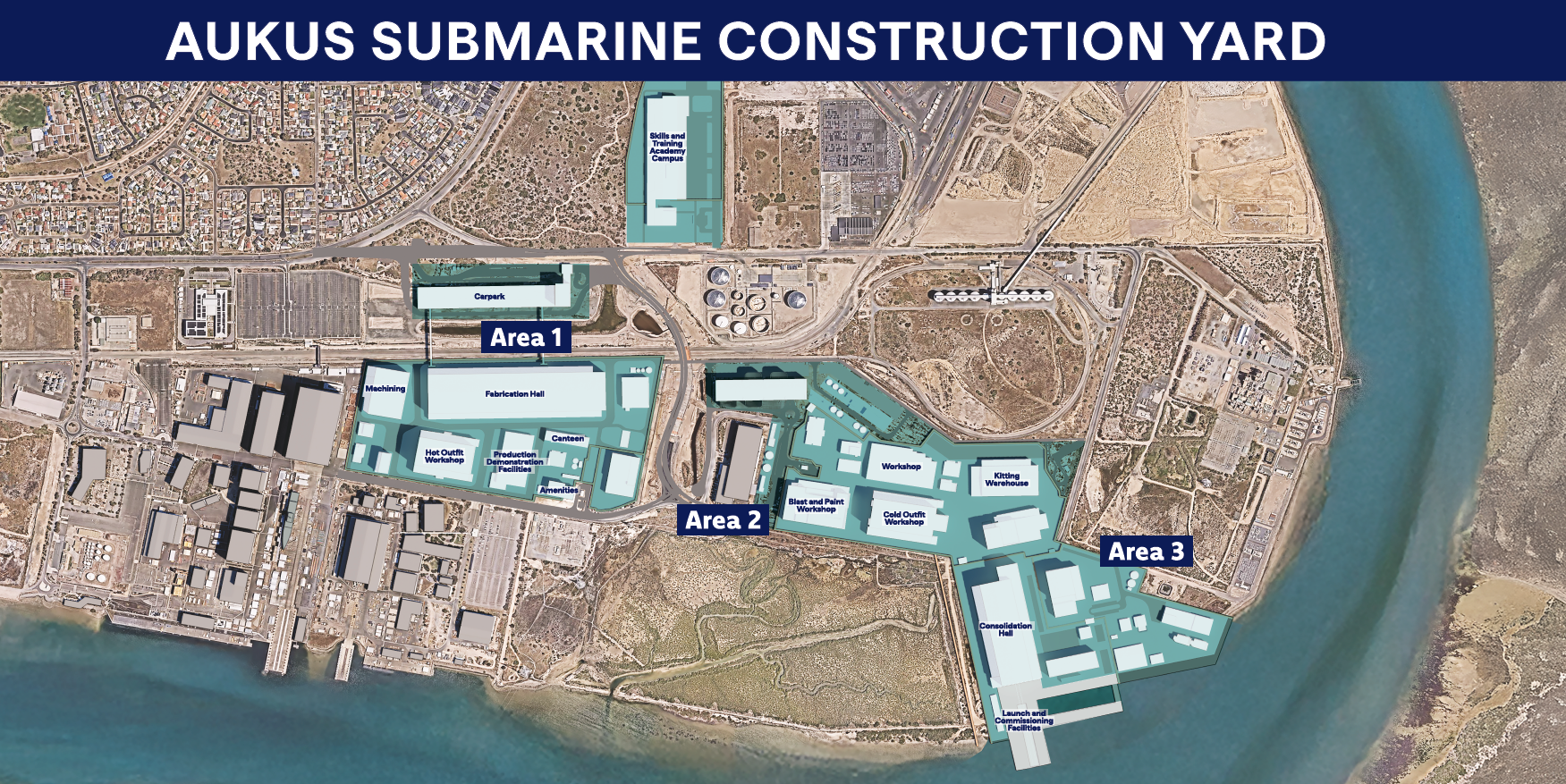
More than 50 new structures will be built across the precinct, including fabrication halls, outfitting facilities, warehouses, offices and worker amenities. The Construction Yard will also include a dedicated submarine launch facility, wet basin and wharf along the Port River.
The project is expected to use around 126,000 tonnes of structural steel, equivalent to 17 Eiffel Towers. Construction is expected to require approximately 66 million work hours, around 44 times more than the Osborne South Development Project. Around 25,400 foundation piles will be installed, approximately six times the number used in the existing development.
One of the site’s largest facilities will be the Fabrication Hall, which will extend approximately 420 metres in length, around two-and-a-half times the length of Adelaide Oval. The Fabrication Hall will house initial construction of Australia’s sovereign SSN-AUKUS submarines before progressing through outfitting, consolidation, testing, launching and commissioning.
To support development and delivery of the Construction Yard, ANI has partnered with a joint venture between Laing O’Rourke Construction Australia Pty Ltd and Amentum Australia Pty Ltd.
ANI selected the capability partner through an international competitive process for its Australian infrastructure know-how, local knowledge and international nuclear expertise. The upcoming major construction activity in South Australia will be backed by experience in developing large, complex projects, including nuclear-licenced facilities in the United Kingdom.
Australian industry continues to play a central role in delivery of the program. ANI has already awarded approximately $1.9 billion in contracts, primarily to Australian businesses, helping grow local supply chains and strengthen sovereign industrial capability.
Together, the Skills and Training Academy Campus, Production Demonstration Facilities, Fabrication Hall and supporting infrastructure projects are laying the foundations for Australia’s future submarine construction program.