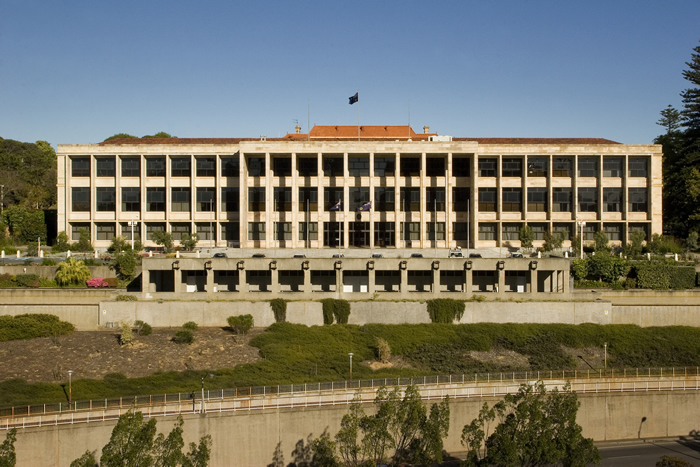
Good afternoon. I’m very pleased to be joined by the Deputy Prime Minister and the Defence Minister Richard Marles here at this historic site of Victoria Barracks. And today, I can announce that Victoria Barracks will be free for all Sydneysiders to enjoy, and it will remain in public hands. This will give an assurance to the public that the heritage at this site is vital, that it be not just maintained, but indeed enhanced. And that is why we’ll engage as well with the Australian War Memorial to make sure that there’s proper recognition for the important history of this site. I’ve lived in Sydney my whole life, and this is the first time I’ve been to Victoria Barracks. And most Sydneysiders have not been to this beautiful site, and have not availed themselves of the opportunity to see the history that has been made here over such a long period of time. This is an asset for Sydney that should be opened up for Sydneysiders. And at the same time, we should make sure, of course, this is all heritage listed, so it was always going to be preserved for parts of it, including some of the roads here that are heritage listed as well. This is one of four defence sites out of the 67 that were identified by the review into the Defence Estate that will be kept in public ownership. The other three being Fort Queenscliff, Point Cook, that’s part of RAAF Williams, and the Victoria Barracks in Melbourne. We think this is absolutely critical. Importantly, the estate that was examined was about in what way are assets helping to do the primary purpose of Defence, to defend our nation, and that is why we want to maximise every single dollar that Defence has into giving support to the men and women of the Australian Defence Force, and to make sure that our force posture, as well, is appropriate. And that’s why you’ve seen the significant increase in defence expenditure under my government to make sure we’re in the best positions possible to defend our nation. I’ll call upon the Deputy Prime Minister, then we’re happy to take some questions.
RICHARD MARLES, DEPUTY PRIME MINISTER: Well, thank you, Prime Minister, and it’s great to be here with the PM at Victoria Barracks Sydney to give the first significant update to the government’s progress in respect of implementing the Defence Estate Audit that we announced in February of this year. As the Prime Minister has just said, when we made that announcement, we announced that Defence would divest itself in whole or in part of 67 sites around Australia. The Defence Estate Audit was damning in its criticism and assessment of the way in which Defence has managed its estate over decades, and it particularly cited the inability to make difficult decisions in the past has left Defence today with a burden of spending hundreds of millions of dollars on sites which it does not use. Now, in respect of those 67 sites, I can say that 11 of those have now been fully transferred to the Department of Finance. What that has seen over the course of this year is Defence vacate a number of sites, and there are a number of other sites which it will shortly be vacated from, and that includes here at Victoria Barracks Sydney. But for a handful of personnel, all the personnel here at Victoria Barracks Sydney, will have left the site by the end of the year, and will be relocated at Randwick Barracks at Defence Plaza Sydney. And I might say in respect to Defence Plaza Sydney, which was established under the former Coalition Government, a good policy. It is a state-of-the-art facility, one kilometre here, which right now is 60 per cent empty, and is much better suited to enabling the work which is currently being undertaken here.
Now, as the Prime Minister has said, we face the most complex, in some ways the most threatening strategic landscape that we have faced since the end of the Second World War, and as a result of that, our government has significantly increased defence expenditure. We’ve done 12 times as much in the last four and a half years as what the Coalition Government did in its entire nine years in office. But what that means is that we need to have a defence force that is focused. Every person who wears our nation’s uniform matters. Every hour they spend, and it counts, and every dollar which resources them is precious. Which is why we are making these decisions. And it is simply impossible to disconnect what we are doing here in respect of defence as a state with that overall challenge that Australia faces in terms of our strategic landscape.
Now that said, we have always acknowledged that in respect of these sites there is enormous history, and these sites are protected in terms of their heritage value by law. But the announcement that we’re making today in respect of these four sites: Victoria Barracks Sydney, Victoria Barracks Melbourne, Fort Queenscliff and Point Cook will further ensure that the heritage value of these sites will be maintained. We will be commissioning the Australian War Memorial to interpret these sites and tell the defence stories here. And what that means is that many more Australians will be able to access them. This site will be returned to Sydneysiders, to Australians, and in respect of the stories which relate to defence which are captured in these buildings, those stories will be told in a bigger and better way to a much larger audience, which is a much better heritage outcome.
Now, I know this has been very challenging for a number of service personnel who feel very attached to these sites, and we do understand that. And I really want to thank all of them for doing the real work of engaging in their movement over the course of the last 12 months, and I particularly want to acknowledge the members of the Australian Army who have been serving here at Victoria Barracks Sydney. Can I also, though, acknowledge those in the Security and Estate Group at the Department of Defence and officials in the Department of Finance who have also been working very closely on this,
There are two other announcements that form part of the details of announcements that we’re making today, which I’d like to refer to. In respect of HMAS Penguin, which is being partially divested, that part of it which is being divested, the Angophora Forest, will be handed over to the Sydney Harbour Federation Trust, who will maintain it from here on in. And in respect of the Stokes Hill Fuel Installation, which is in the Northern Territory, that will be handed to the Larrakia people. There is a sacred site, a registered sacred site on that facility, so that’s a great outcome for the Larrakia people. All of this means that these buildings will have a much better future than what they have had in the past. It is a great outcome for these buildings. But much more significantly, this is a really important outcome for the Australian Defence Force and the defence of our country,
JOURNALIST: Prime Minister, apart from the heritage preservation, what development will be allowed on these sites?
PRIME MINISTER: Well, only any development or any proposal or any activity will, of course, be consistent with heritage and the preservation. But you can see the space that is right next to where you are standing now. The potential for activity there that brings Sydneysiders onto this site is extraordinary. The potential for that to receive some commercial benefit as well, which would help to pay for the maintenance of the site.
JOURNALIST: Prime Minister, why has the government backflipped on the sale of Victoria Barracks when the Minister and his Assistant Minister were so steadfast that it should be sold?
PRIME MINISTER: What we’ve done is to make sure that consistent with the heritage listing of this site, there was never ever going to be able to be any interference which would degrade the heritage significance of this site. So, in terms of the income, we had the Defence Estate Audit of 67 sites that were identified, in terms of income and sale, there is a limited amount to what you could do at this site because of the heritage listing.
JOURNALIST: Prime Minister, is there any reduction in the $3 billion of revenue that the government had hoped to raise from this sale? And secondly, what would you say to Jess Collins and David Shoebridge, who say that the fight continues because this is no longer a defence base, and there are other sites they want to protect?
PRIME MINISTER: Well, David Shoebridge, of course, it’s up to him to present whatever position he sees fit. But this is an appropriate outcome, and David Shoebridge has been critical of the defence expenditure and investment that we have made to defend our nation. The development of new products like Ghost Bat and Ghost Shark, the investment that we have through AUKUS is a significant investment, and we want to make sure that defence is funded properly, and that every dollar is properly and appropriately used. This is a good outcome, working with the community and working constructively to promote as well, I think very much the national interest. And when it comes to Sydneysiders, as I said, I don’t know if you’ve been here before, Paul, just a question?
JOURNALIST: Was just at the demo a fortnight ago.
PRIME MINISTER: Yeah, well that’s the point, Paul. You live in Sydney, and you had never been to this site in Paddington, as had not, most journalists, all of whom seem to live in the eastern suburbs or the inner areas of Sydney, and they had never had access to this site. What we want is for people to actually have access to this site, to learn about the history of the Australian Defence Force presence here, and give appropriate tribute to it.
JOURNALIST: Prime Minister, this is quite the walkback. What did you make of the pushback from a broad coalition of politicians, veterans, and members of the public? And will this change the timeline for when defence personnel will move out?
PRIME MINISTER: No, this is a good outcome, and the timeline is the same.
JOURNALIST: And the first part of that question? What do you make of that big pushback from broad coalition of politicians, veterans, members?
PRIME MINISTER: One of the things that that was said was that somehow heritage could be interfered with on this site. I know at one stage there was a front page about heritage listing. It’s listed. It’s protected under Australian law.
JOURNALIST: So, Sydney’s in a housing crisis. To clarify, are you, is the government openly to developers developing housing on the site?
PRIME MINISTER: Look, what we’re open to is making sure that there’s proper use of the site, is respected, and in terms of commercial opportunities that are there, they’ll be explored. Of course, it’ll go to like all of these sites will go to the Department of Finance, will look after the commercial interests that are required, but this is a site as well that’s so close to a lot of the activity that happens here in Sydney, close to the football stadium, the SCG, a lot of the facilities that are around here in what is a pristine location, and at the moment, this pristine location has been locked out for Sydneysiders. So, I don’t know if you’ve been to the site before here? No? And you’re a Sydneysider?
JOURNALIST: I am now, yeah.
PRIME MINISTER: Yes, and what we want – that’s the point. That’s the point. This is an extraordinary site, which we should cherish. This announcement today does just that.
JOURNALIST: So, will any part of the site be sold to private interests of developers?
PRIME MINISTER: No, this will be held by the Australian Government, and we will keep it in full public ownership. That doesn’t mean that there can’t be activities.
JOURNALIST: Prime Minister, just on another matter –
PRIME MINISTER: Anything more on this?
JOURNALIST: Yes. Minister, with HMAS Penguin, you say that the part you are selling off is going to the Sydney Harbour Trust, is that –
DEPUTY PRIME MINISTER: Yes.
JOURNALIST: What do you expect to happen to that land?
DEPUTY PRIME MINISTER: Well, the Angophora Forest will be maintained by the Sydney Harbour Federation Trust, so that forest will remain, and it will be transferred to them. And in respect of obviously the remainder of HMAS Penguin, Defence will keep that, and that was part of the announcement we made.
JOURNALIST: Why were the concerns of the former Chief of Army, a former Land Forces Commander, and an internationally renowned intelligence expert, been ignored when they were suggesting that this place still has enormous strategic value to Australia’s Defence Force?
DEPUTY PRIME MINISTER: Well, firstly, I have the highest respect for those who have worn our nation’s uniform, and for those who have worn our nation’s uniform in the highest level. I don’t think there is anyone who has served our country and in the Defence Force who would suggest that if you look at the Defence Estate, there wasn’t a whole lot of it, which we were no longer using. That’s why we commissioned the Defence Estate Audit. Now, what we’re doing is following through on that. Now, this was not thought up out of the blue. The Defence Estate Audit looked at every defence facility and looked at whether or not it formed a key, relevant part of defending our nation, and it made its decision in relation to this, or provided advice in relation to Victoria Barracks Sydney, we took that advice seriously. It was an exhaustive process, and we are following through on that. And I don’t think there is anyone, actually, who is really seriously suggesting that Victoria Barracks Sydney is central to the defence of Australia.
JOURNALIST: I mean, just to that point, there are a lot of people who are worried, in the event of say, a terrorist attack, that we wouldn’t have this site as an active military base. I mean, what do you think about that?
DEPUTY PRIME MINISTER: Well, you know, been listening to that argument as well. In terms of Defence’s contribution to counterterrorism on the East Coast, but here in Sydney, that occurs at Holsworthy Barracks. That’s where the commandos are based. That’s where the urban warfare centre is. That’s where all the scenario planning is in respect of an event that would occur here in Sydney, or in fact anywhere on the East Coast. That is the centre of our counterterrorism effort in respect of the Australian Defence Force. Now, what you do have here is an open space where you can land a helicopter. The space will still be here. I mean, that, that function can still occur, but counterterrorism is not done from Victoria Barracks Sydney and hasn’t been done from Victoria Barracks Sydney, which is, and people making the argument know that. I don’t think there’s anyone who’s really seriously suggesting this facility is fundamental to the defence of Australia. What goes on here is largely office work, and what we have a kilometre from here is a state-of-the-art office facility, which has had tens of millions of dollars spent on it, which began under the former Coalition Government, which is 60 per cent empty. Now, those who are working here now are being transferred to Randwick Barracks and to Defence Plaza Sydney, which are much better, much more suitable sites for what they’re doing.
JOURNALIST: Deputy Prime Minister, if you’re still expecting to raise $3 billion, there’s still going to be activities, there’s still going to be development on the non-heritage listed parts at this site. Is it the only thing you’re announcing today free, free access and 99-year leases instead of the sale?
DEPUTY PRIME MINISTER: Well, firstly, in respect of the financial part of this, which we announced back in February, that remains unchanged. In answer to an earlier question, and we’re working that through with the Department of Finance, and ultimately, there’s been an allocation to Defence as part of this, that there’ll be a reconciliation of it all when the sites are fully divested in due course, and that may take many years in respect of some of the more complex sites. Of course, from a Defence point of view, our intention is to be off all of the sites in a two-year time frame, we’re on track to being able to achieve that. But in the fullness of time, when these sites are fully divested, there’ll be a reconciliation. But as the Prime Minister has just said, in respect of this site specifically, there is a very significant heritage overlay. It is protected by law, not just this building, but the layout of the facility, and so there was always going to be you know a limit to the commercial side of this in terms of its development, which is why maintaining this in public hands, allowing it in a way which will maximise community and commercial use of the site, is a, is a good outcome which works for Defence. We’re not spending hundreds of millions of dollars on this site to maintain it as a Defence site with all the security that goes with that, and the heritage of it will be maintained.
JOURNALIST: Sir Peter Cosgrove was scathing of your comment, you said a lot of old generals like to hang out here. Do you regret making that comment now?
DEPUTY PRIME MINISTER: Let me be clear that I have the highest regard for Peter Cosgrove, and I have the highest regard, as I said earlier, for those who have worn our nation’s uniform and those who have worn it in in positions of high command. But let me be clear as well in relation to what we need to do in respect of our Defence Estate, there are difficult decisions that have to be made. That was cited in the Defence Estate Audit itself, and more than that, the failure to make those decisions in the past have left the Defence with an enormous burden right now, which is utterly untenable. It is utterly untenable to be spending hundreds of millions of dollars maintaining Defence sites as Defence sites when we don’t use them and when they are not central to the Defence of Australia, and so I make that argument.
JOURNALIST: And Deputy Prime Minister, do you have any concerns about the ability to hold secure conversations in the Defence Plaza given the foreign ownership?
RICHARD MARLES: Well, firstly, the Defence Plaza Sydney was established under the Coalition Government, so all the issues in respect of the ownership of it were assessed by the former Coalition Government and to be seen as being acceptable from their point of view. I’m completely comfortable with Defence Plaza Sydney in the way in which it operates and the level of security which occurs there. We get into the weeds here a little bit, but there are, you know, level four sites at Defence Plaza Sydney which enable a certain degree of conversations. I’m very comfortable about those. There will be level five sites, which is the highest level of a site that you can have, essentially, a SCIF for those of you who’ve been watching The Diplomat. There are, there’s a SCIF at Fleet Base East. There are other SCIFs around. We will be developing SCIFs as part of the relocation of personnel here. But I’m very comfortable with what exists of defence plans to sit there.
JOURNALIST: Prime Minister, would you consider means testing for EV and battery subsidies? And ahead of COP, is there a disconnect between climate ambitions of the government and the need to rein in spending and increase productivity?
PRIME MINISTER: No, to the latter part of the question. Look, this is one of, the Defence Estate Audit is an example of the government being fiscally responsible and how careful we are with public money. Would be easy to just do what previous governments have done, which is just you know, let it ride and to do nothing. About 67 sites, some of those sites I’ve been to. I’ve been to the Derwent, I was in Adelaide recently with Premier Rockliff and Malinauskas respectively. They’re going to have significant housing development in pristine locations and produce revenue for the government. We’ll continue to look for savings. We’ll have budget announcements when we make them. We work them through in an orderly way. But the program, for example, on Cheaper Home Batteries, has benefited 600,000 Australian households and small businesses. That represents over a million Australians, and importantly, it’s benefited every Australian because it’s taking pressure off the national power grid. It has made an enormous difference.
JOURNALIST: Prime Minister, given the u-turn on the sale of Victoria Barracks today, are you confident the Defence have handled this issue well?
PRIME MINISTER: Yes.
JOURNALIST: Just on another matter as well. What can Labor learn from the Republicans’ brutal loss in the midterms, and do you expect voters to punish Federal, State Governments at the ballot box for the cost-of-living pressures they’re enduring?
PRIME MINISTER: There’s an interesting link there that you’ve made. Look, we, we run our own campaigns here in our own democracy and with our own issues. I leave other democracies to take their course. We respect outcomes. It’s good that the outcome in the United States has been respected. That’s really a matter for the people of the United States. My government will continue to focus on cost of living, continue to focus on getting inflation down. We know this is a global issue everywhere, not just in the United States or Australia or New Zealand for that matter, but in the UK, I note that the Bank of England increased their cash rate on Friday as well.
JOURNALIST: But your message to Donald Trump at the Quad will be to end the Iran war, won’t it?
PRIME MINISTER: My message has been consistently, publicly and privately, has been that we want to see a de-escalation. That is in the world’s interests. There is a significant economic impact from the ongoing conflict in the Middle East. Australia are not protagonists in that conflict, but Australians are impacted by it. Thanks very much.