An earthquake or a sudden impact puts building materials to the test, subjecting them to forces that can bend beams and crack walls. Engineers in the Cornell Duffield College of Engineering are exploring a different approach, designing structures that can bend and buckle in ways that work with those forces rather than simply resist them.
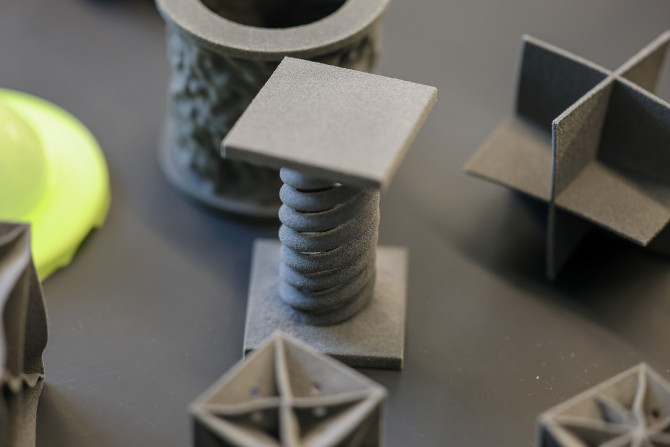
Palm-sized metastructures in the Scalable MetaStructures Laboratory are engineered to buckle, bend or change shape in controlled ways.
At Cornell’s new Scalable MetaStructures Laboratory (SCALE Lab), Fani Derveni, assistant professor of civil and environmental engineering, and her research team design intricate structures whose geometry gives them unusual mechanical properties. These metastructures can be engineered to buckle, bend or change shape in controlled ways, enhancing mechanical performance and enabling new functionalities for everything from more resilient infrastructure to transformable structures to sustainable buildings that use less material.
To understand how these designs behave in practice, the lab is using a high-resolution X-ray scanner that reveals what is happening inside the structures, down to the microscopic details invisible from the outside.
The SCANCO MicroCT 100HE produces three-dimensional images of a structure’s interior at a resolution as fine as 3.3 microns. Researchers can use it to identify tiny pores and variations in thickness, compare manufactured structures with their computer-designed counterparts, and observe how they deform under stress – all without cutting them apart.
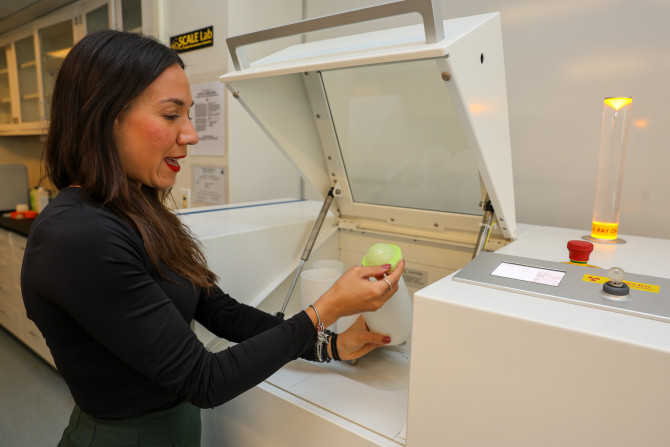
Fani Derveni, an assistant professor who directs the Scalable MetaStructures Laboratory, places a metastructure inside a microCT scanner capable of producing 3D images of a structure’s interior at a resolution as fine as 3.3 microns.
“What we’re excited about is that we can use this machine to connect the two core areas of our research – experimental mechanics and computational mechanics,” said Derveni.
The team combines computer simulations with physical experiments to understand how complex structures respond to compression, tension and torsion. Researchers fabricate their designs using 3D printing and polymer molding, then test them to see how they perform.
The MicroCT adds a crucial view of what happens inside during those tests. Researchers can scan a structure before and after testing to track changes in its geometry. For relatively small samples, they can even image the structure in situ, as it is being mechanically tested.
“In our lab we care a lot about mechanics, specifically the buckling of structures,” Derveni said. “The MicroCT allows us to see defects that might otherwise go unnoticed and eventually relate those defects to how a structure fails.”
That insight is important because a manufactured structure rarely matches its digital design perfectly. A 3D-printed component may contain tiny pores, variations in thickness or other imperfections that change how it bends or buckles under a load. By identifying and leveraging those differences, researchers can better understand the relationship between a structure’s geometry and its actual performance, then use that information to refine both their designs and computer models.
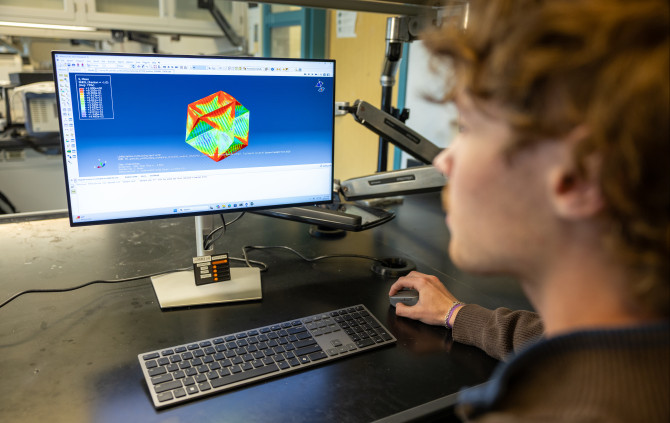
Graduate student Gavin Linton examines the results of a metastructure microCT scan in the Scalable MetaStructures Laboratory.
“We’re looking at imperfections because they’re vital in industry, especially in structures like the cylinders used in rockets and spacecraft,” said Gavin Linton, a graduate student in the SCALE Lab. “We use the MicroCT to understand how the structures we actually manufacture differ from what we designed.”
Graduate student Konstantinos Dimitriadis is exploring how metastructures could be incorporated into civil engineering applications, including buildings designed to better withstand earthquakes.
“We’re thinking about lightweight structures in which we could replace specific components,” Dimitriadis said. “For example, a kind of building material that could absorb the energy of an earthquake and remain safe as it is, but then we could replace portions of the material that might have some residual deformations.”
Other lab projects focus on structures that can change shape or be deployed when needed. Postdoctoral researcher Tiantian Li sees potential applications in healthcare and in structures designed for communities with different mobility and accessibility needs.
“We’re interested in structures that are rigid enough to perform their function but can also be easily deployed and reused,” Li said. “For example, a single self-supporting structure could open into a temporary shelter or enclosure, with its size adjusted to provide different levels of shading, protection or heat management.”
The MicroCT will also benefit researchers beyond the SCALE Lab. Derveni said other groups on campus have expressed interest in using the scanner to examine a variety of materials, including biological samples.
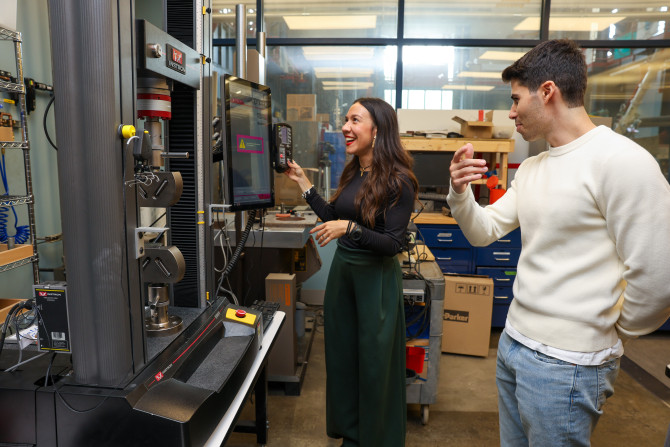
Assistant professor Fani Derveni (left) and graduate student Konstantinos Dimitriadis use a tensile testing machine in the Bovay Laboratory Complex.
The scanner is part of a larger suite of equipment supporting the lab’s work. A powder-bed 3D printer enables rapid prototyping, while a laser cutter produces precise components and experimental setups. Polymer molding allows researchers to fabricate thin shells with controlled material properties. Additional equipment in the nearby Bovay Laboratory Complex supports vibration-isolation and other mechanical tests.
Together, these tools allow the team to move through a complete research cycle: designing a structure, simulating its behavior, manufacturing and testing it, then imaging its interior. The resulting data can inform the next round of designs, helping researchers bring the behavior of physical structures closer to what their models predict.
“At the end of the day, we’re not studying these structures just because they are interesting,” Derveni said. “We want to understand the fundamental mechanics well enough to design structures that perform better and can adapt to the needs of the people who use them. That is where the real potential of this work lies.”