Key points
- Butterfly collections and citizen science records are helping researchers track how butterfly ranges (where they live) have changed over time.
- Some non-migratory Australian butterfly species are moving south, with one species now found almost 1,000 km beyond its previously known range.
- Climate change is likely the major driver of changes to where butterflies live in Australia.
Wings of history
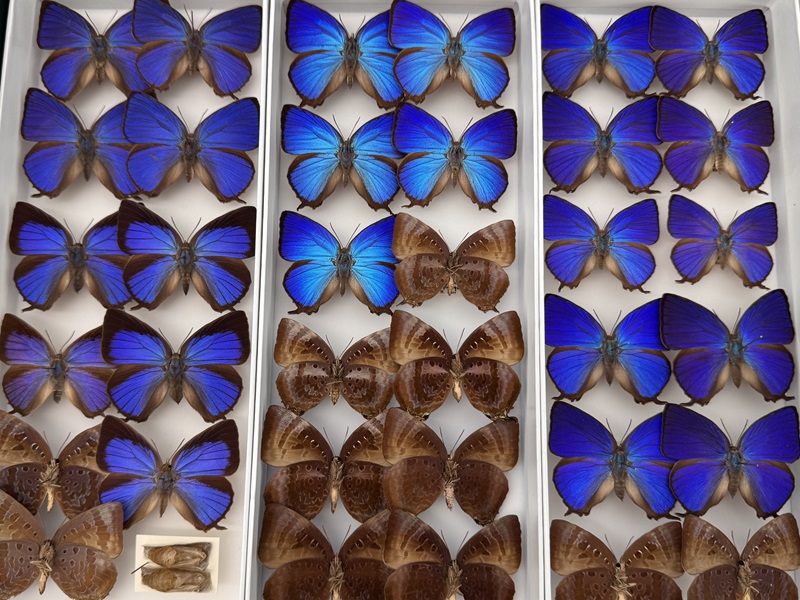
The Australian National Insect Collection at CSIRO holds 2,000 thousand drawers of butterfly specimens, including some that were collected more than a century ago.
In the past, insect collecting was a hobby as well as a science, and butterflies were hugely popular. Over time, many historical butterfly collections have been donated to CSIRO. These carefully pinned specimens, together with the data recorded about where and when they were found, are highly valuable for researchers today.
They tell us where different butterfly species used to be found across Australia.
Combined with scientifically collected specimens held at CSIRO and in museums, and published scientific literature about butterflies, we can build a picture of how the ranges (where they live) of different species have changed over time.
We can also use photographs of butterfly sightings that people add to databases like iNaturalist and Butterflies Australia.
Where are they now?
Working with butterfly collections, taxonomists have described and scientifically named the majority of Australia’s estimated 465 species of butterflies.
Dr Michael Braby knows them well. He wrote the definitive textbook on the identification, biology and distribution of Australia’s butterflies back in 2000 and is currently working on the third edition of the Field Guide .
Dr Braby has been reviewing the geographical ranges of Australia butterfly species and is finding nearly all the maps need to be updated.
“At least 100 species have undergone range changes during the past 20 to 30 years,” Dr Braby said.
There can be different reasons for range changes:
- climate change or habitat changes
- accidental transport by people, sometimes thousands of kilometres from the butterfly’s original home
- movement by migratory species in which a small number of individuals have moved temporarily well beyond their normal breeding range
- invasions – at least three species (Lime Swallowtail, Tawny Costa, Cycad Blue) have invaded Australia from SE Asia and are spreading rapidly
- changes in our knowledge of where butterfly species live due to increased survey efforts in areas where butterflies had not been well studied.
Dr Braby is especially interested in range shifts of sedentary butterfly species.
“We’ve found at least 23 species that have definitely changed their range, some quite dramatically,” Dr Braby said.
“These species have moved into new areas southwards along the eastern coast of Australia.
“Some of these species may have gone locally extinct in the northern part of their range, but there is not enough monitoring data to say.
“Most range shifters are species in the nymphalid and lycaenid families. These are colourful butterflies that people tend to notice and like to collect, which means we have good records for where they lived in the past and where they live today.”
A long way from home
Dr Braby found that the distances range shifters have moved varied from 55 to 960 km. That’s an average of 218 km over the past 20-30 years, or around 10 km per year.

The record holder is the Pale Ciliate-blue (Anthene lycaenoides).
“The previous southern limit of this species was Cannonvale near Airlie Beach in northern Queensland, but it is now well established in the Brisbane region, 960 km further south,” Dr Braby said.
“We suspect climate change is the major driver of change in the range shifting species. Other causes include butterflies exploiting introduced or ornamental host plants or possibly moving into disturbed areas, such as regrowth vegetation after fires.”
What’s happening to butterflies overseas?
Dr Braby contributed to a recent paper released last week in Nature Ecology and Evolution, which looked at changes to butterfly ranges around the world.
Led by Dr Shawan Chowdhury, head of the Global Change Ecology Lab at Monash University, the researchers found that the ranges of 10 per cent of butterfly species had changed (1758 of approximately 18,000 species), distributed across 105 countries and territories.
Most of the changes in butterfly ranges were linked to climate change and severe weather events.
If you’d like to help map Australia’s butterflies, download the iNaturalist app and start taking photos of the butterflies near you.