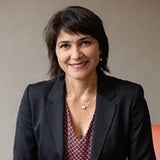
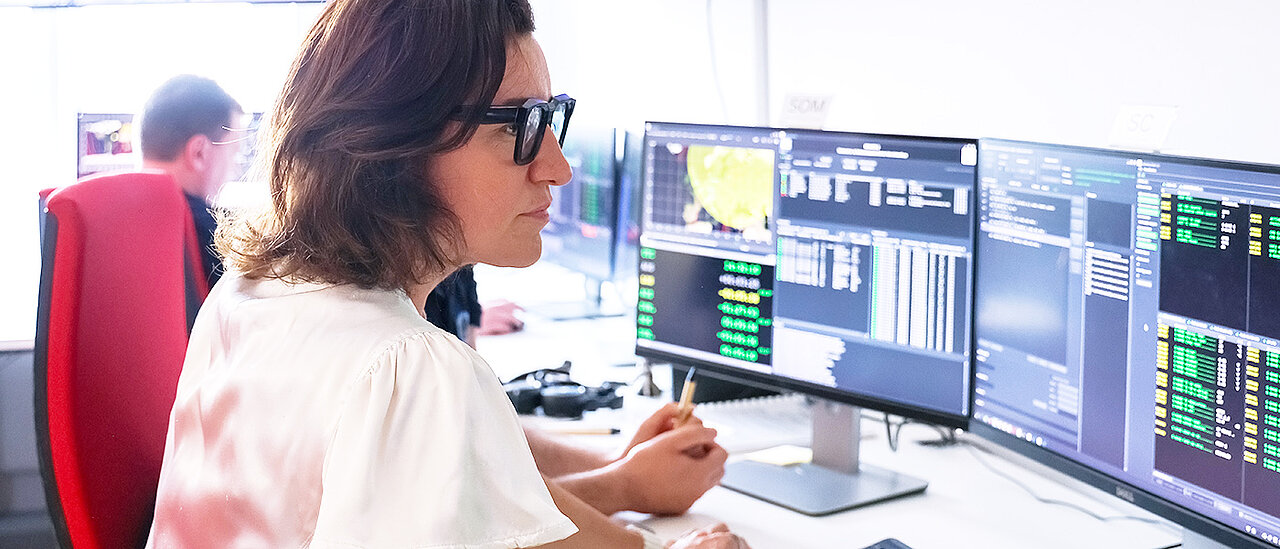
At the invitation of the Würzburg-Schweinfurt Chamber of Industry and Commerce, Federal Minister Dorothee Bär visited the university. In the Mission Control Centre, she spoke about the opportunities that research, technology and space travel offer the Mainfranken region.
Dorothee Bär has been Federal Minister for Research, Technology and Space of the Federal Republic of Germany since 6 May 2025. In this capacity, she attended the plenary session of the Würzburg-Schweinfurt Chamber of Industry and Commerce for the first time on 16 July 2026 and delivered a guest lecture.
In her talk, she discussed the opportunities that research, technology and space offer the Main-Franconia region. In keeping with the theme, the meeting took place at the Mission Control Centre at the University of Würzburg, which is headed by Hakan Kayal, Professor of Space Technology at the Institute of Computer Science.
Just under 22 billion euros for research, technology and space
In her guest lecture, Bär outlined the opportunities she believes the Mainfranken innovation region offers: “Innovation arises wherever competent people put good ideas into practice and find support for them. Particularly in these times, when it is more important than ever to strengthen Germany’s competitiveness, research policy cannot be business-friendly enough,” said the CSU politician.
The Federal Minister reported on the draft 2027 federal budget, which includes a stable allocation of 21.9 billion euros for research, technology and space. The outstanding institutions in Mainfranken, which are making significant contributions to promising scientific fields such as robotics, quantum physics and the life sciences, should also benefit from this.
JMU 1: Research for extraterrestrial missions
One such institution is the Julius-Maximilians-Universität Würzburg (JMU). Hakan Kayal and his team, for example, are working on nanosatellites for future extraterrestrial missions. This research focus examines a wide range of aspects, including the conception and design, manufacture and integration, as well as the utilisation and operation of space systems.
In 2024, the scientists launched the SONATE-2 nanosatellite into orbit aboard a SpaceX rocket. They communicated with SONATE-2 and received data via the mission control centre at the Hubland Nord campus. During her visit to Würzburg, the Federal Minister for Space was even given the opportunity to send several control commands to this very satellite herself. “With SONATE-2, Germany has, for the first time, trained an AI on a satellite in space,” said Bär enthusiastically. This is of particular significance for future applications in the exploration of the solar system, according to Bär.
In addition to the design, construction and operation of space systems, Hakan Kayal focuses on two further areas: enhancing the autonomy of such systems and the search for extraterrestrial intelligence, as well as research into ‘Unidentified Anomalous Phenomena’, or UAP for short. It was partly for this purpose that he founded the Interdisciplinary Research Centre for Extraterrestrial Studies (IFEX) ten years ago, with the aim of investigating objects in our solar system, distant stars and galaxies, and the universe as a whole – always with the question in mind: “Is there extraterrestrial life?”
JMU 2: Embedded Systems and Sensors for Earth Observation
Among those attending the meeting with the Minister was Marco Schmidt, Professor of Computer Science at JMU, whose work focuses on embedded systems and sensors for Earth observation. Together with his team, Schmidt develops technologies at the interface of space science, robotics and computer science for Earth and environmental observation.
His work ranges from the development of small satellites and networked sensor systems to new methods for the efficient processing of large remote sensing datasets. All projects are set within the context of space informatics and combine theoretical foundations with practical applications.
The most recent example of this is the development of an innovative camera payload for small satellites, which enables AI methods to be used directly in orbit and the hardware to be reconfigured as required. This makes it possible to respond to changing mission requirements whilst in orbit and to adapt both software and hardware accordingly.
JMU 3: Global Urbanisation and Remote Sensing
‘Earth observation’ is the apt keyword for the third participant from JMU at the meeting: Hannes Taubenböck holds the Chair of Global Urbanisation and Remote Sensing, which the university established in cooperation with the German Aerospace Centre (DLR).
In this context, remote sensing means that the researchers involved work primarily with digital imagery obtained via active and passive sensors on Earth observation satellites, as well as from aircraft and drones. Their research focuses on the topics of ‘urban remote sensing’, ‘geohazards and civil security’, ‘ecosystem functions and biodiversity’, and ‘sustainable land management’.
During the meeting with Dorothée Bär, Taubenböck outlined the potential of remote sensing in relation to natural hazards, geohazards, climate change and even geopolitical crises. He highlighted that remote sensing, as an information technology, has great potential for the future and is undergoing dynamic technical and methodological development at an international level.
Hakan Kayal, Marco Schmidt and Hannes Taubenböck are therefore likely to be fully in line with Dorothée Bär’s views. After all, in her guest lecture she had said: “It is a matter of strengthening value creation in our country and securing our technological expertise for the economy of tomorrow.”