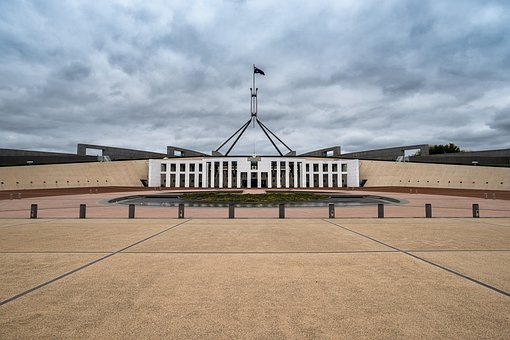
Hundreds of ACT government workers have marched on the Legislative Assembly to demand a larger pay rise in the largest co-ordinated strike in the history of self government, putting fresh pressure on the Labor administration.
The strike included corrections officers walking off the job from the ACT’s prison, the Alexander Maconcochie Centre, and from the court transport unit for the first time.
Workers held signs that declared a below-inflation pay rise offer was a pay cut, while others targeted government ministers.
Community and Public Sector Union national secretary Rebecca Fawcett said it was time for the government to listen.
“Workers have voted down the government’s pay offer in a historic no vote. You’ve taken strike action and you’re standing together, all of the unions here together today,” Ms Fawcett said.
“It’s time for the Barr government to come back to the table and give workers an offer that they deserve. It’s time for the Barr government to respect workers and finally recognise you for the work that you do. And it’s time for the Barr government to stop dragging this bargaining campaign out.”
Public Service Minister Rachel Stephen-Smith said the government’s pay offer was fair rather than generous.
“But I do recognise that for some public servants, they are facing really significant cost of living challenges and people are squeezed as are people in other parts of our community,” Ms Stephen-Smith told ABC radio on Thursday.
Ms Stephen-Smith said conversations with the CFMEU had been “really constructive” and the government was close to putting their enterprise agreement to a ballot.
The minister had previously indicated the government was not in a position to offer higher pay rises.
“The bottom line is that the budget is in deficit. Our … fiscal situation is challenging, and so we don’t have the opportunity to just come back and offer more,” Ms Stephen-Smith said in September.
“We do need to undertake further negotiation with the unions to be really clear about what the priorities are, recognising we’ve heard clearly that current cost-of-living pressures are the priority and the risk-sharing approach that we had put forward was not something that people necessarily had confidence in.”
The price of goods in Canberra rose 4.7 per cent in the past year, higher than the national rise of 4.3 per cent, new figures released by the Australian Bureau of Statistics on Wednesday showed.
Inflation ran higher than the Reserve Bank’s forecasts, making a Melbourne Cup Day interest rate rise likely.
Earlier in September, 63 per cent ACT public servants who voted in a pay ballot rejected an offer that included 3 per cent increases each year for three years.
Public sector staff were offered top-up payments in the second and third years of the deal, linked to inflation spikes, as part of an offer designed to de-escalate the threat of industrial action after almost a year of bargaining talks.
But the government’s own inflation estimates showed the government was betting on not having to hand over the extra cash to its staff.
The wage offer was an improvement on the government’s first position, put to staff in February, that included a first-year pay rise of 3 per cent, followed by rises of 2.5 per cent and 2 per cent in the following two years.
First published in Canberra Times on October 29, 2026 as ‘Workers on history-making strike call on ACT to deliver higher wages’ by Jasper Lindell.
Licensed by C©PYRIGHTAGENCY. You must not copy this work without permission.
+612 9394 7600 copyright.com.au