An industry conference in Hanoi recently explored how research, industry and policy can support a more resilient and higher-value acacia sector for Vietnam.
Australian native acacia trees have helped transform Vietnam’s forestry sector over the last 3 decades. Today, the country has more than 2 million hectares of acacia, supporting 1.5 million smallholder growers and underpinning timber product exports valued at US$17.2 billion in 2025. But with the sector facing growing environmental, biosecurity and market pressures, a new question is emerging: how can the industry create more value and remain resilient in a changing world?
Emerging threats and changing market demands
One of the industry’s biggest challenges is reducing its heavy reliance on woodchip exports and creating more value through higher-quality wood products. However, it must do this while responding to emerging pest, disease and climate threats as well as changing market demands.
‘Around 80% of Vietnam’s acacia timber is exported as woodchips, representing the lowest value-adding end of the chain. Producing larger diameter, higher-value timber is a strategic priority for the government, but many of the 1.5 million Vietnamese smallholder growers still face constraints, including cash flow pressures, storm risk, pests and diseases, and challenging site conditions,’ said Dr Tran Lam Dong, Vice President of the Vietnam Academy of Forestry Sciences (VAFS).
‘Addressing these barriers requires more strategic, systematic investment in research and development across the entire value chain, from breeding, silviculture, plant protection to wood processing and the economics of higher-value products,’ said Dr Dong.
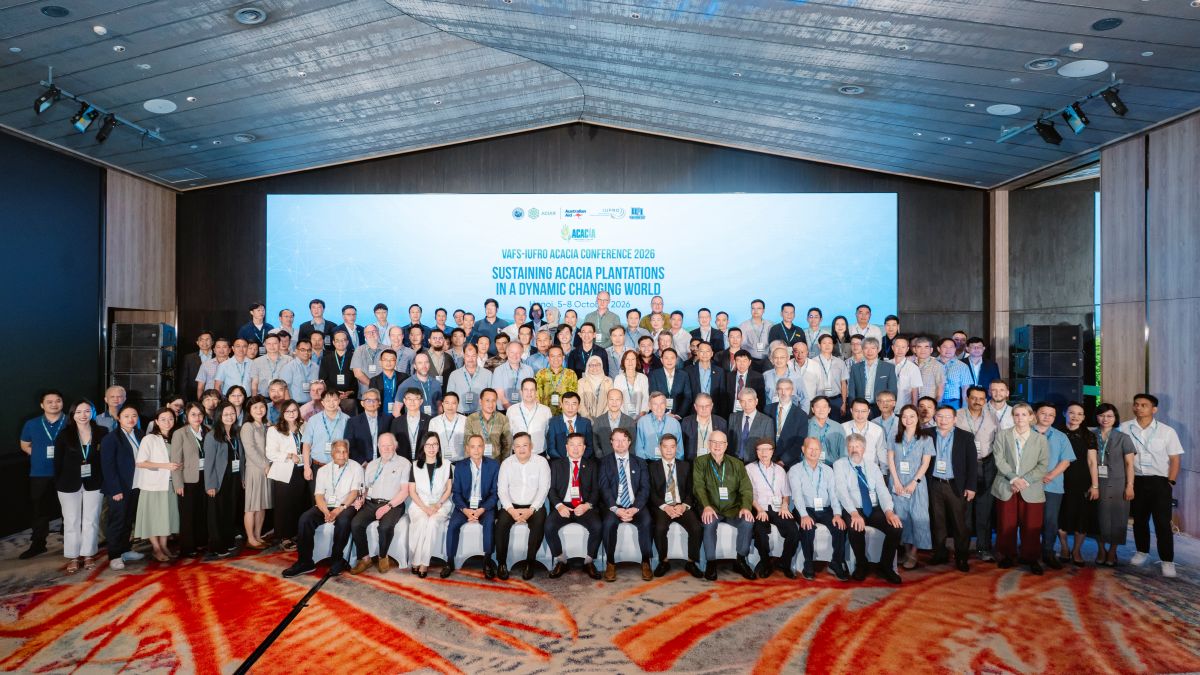
These challenges came into focus at the international conference ‘Sustaining acacia industry in a dynamic changing world’, held recently in Hanoi. Hosted by the Vietnam Academy of Forestry Sciences in partnership with ACIAR, the International Union of Forest Research Organizations (IUFRO) and Vietnam Timber and Forest Product Association (VIFOREST), the event explored how research, industry and policy can support a more resilient and higher-value acacia sector.
The conference brought together leading scientists and industry representatives from Vietnam and other acacia-producing countries to discuss the breeding technologies, plantation productivity, pest and disease risks, value chain analysis and the role of partnerships in strengthening the sector.
Research capacity and smallholder support
For ACIAR, the conference has helped shape thinking about future collaboration.
‘The ACIAR-Vietnam acacia research partnership has evolved alongside more than three decades of acacia plantation development in Vietnam,’ said Dr Nicholas Hogarth, ACIAR Research Program Manager, Forestry.
From early work on seed systems in the 1990s, ACIAR-supported research evolved into management of productive plantations, and then to value-adding wood products.
The partnership also invested in building research capacity from the beginning. Along with capacity building embedded in projects, ACIAR-supported postgraduate fellowships allowed Dr Tran Lam Dong as well as 10 other leading researchers from VAFS, to develop their skills and expertise. As a result, they have been able to lead plantation transformation and respond to emerging industry challenges.
More recently, ACIAR-supported research has focused on pest and disease management and regional biosecurity, helping the industry better understand and respond to emerging threats. A current research project on regional forest biosecurity is helping Vietnam and neighbouring countries detect, map and respond to forest pest and disease risks through capacity building, surveillance and contribution to policy development.
‘The Vietnamese acacia industry is unique among the world’s largest plantation sectors. While most multi-billion-dollar plantation industries are dominated by large corporations, Vietnam’s acacia model is primarily driven by smallholder producers. The fast-growing trees provide relatively quick, predictable cash income for rural households, while the broader acacia industry generates significant employment in harvesting and processing, as well as driving infrastructure development and business growth,’ said Dr Hogarth.
‘Further development of the acacia industry will require continued investment not only in better trees, but in the systems that support them, including the very important role of the smallholder producers and their ability to access improved varieties and practices’ he emphasised.
Learn more about ACIAR in Vietnam.